
NBA ticket prices for the 2025–26 season reveal a sharper divide between top tier teams and developing markets. Using verified secondary market data, this breakdown ranks all 30 teams by their average get-in cost, measures year-over-year movement, and compares pricing trends across conferences. The data highlights how franchises such as the Knicks and Lakers continue to command record premiums, while several Western Conference teams have seen demand soften.
The average get-in price for an NBA game this season is $52.88. That number conceals major disparities: New York leads the league at $213.43, nearly four times the average, while Memphis sits last at $22.00. Four teams now exceed the $100 threshold, while 12 others remain under $40, illustrating the growing concentration of fan spending around a handful of flagship franchises.
This report examines the pricing tiers, year-over-year changes, and what drives those extremes.
Key Insights
- The New York Knicks have the most expensive NBA tickets on average at $213.43, which is 46% higher than the next-closest team, the Los Angeles Lakers ($146.20).
- The average get-in price to attend an NBA game in 2025–26 is $52.86.
- The Oklahoma City Thunder recorded the biggest year-over-year increase in ticket prices at +92.67%.
- The Los Angeles Clippers cut ticket prices by 49%, the largest drop in the league.
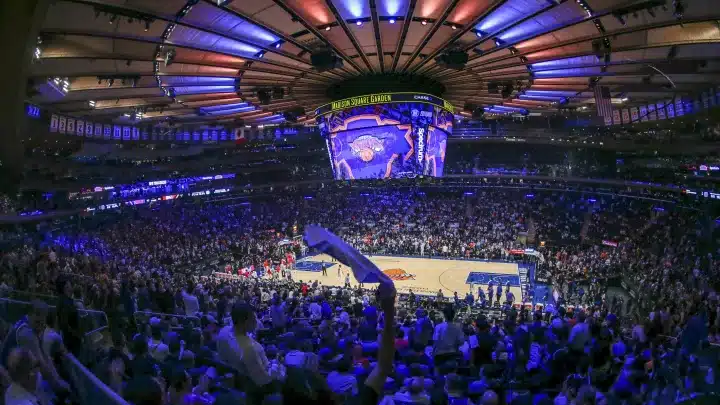
- The New York Knicks will host five of the 10 most expensive NBA games this season at Madison Square Garden.
- Eastern Conference tickets are 14.1% more expensive on average than those in the Western Conference.
Average NBA Ticket Prices in 2025–26
| Team | Average Get-In Price ($) |
|---|---|
| New York Knicks | $213.43 |
| Los Angeles Lakers | $146.20 |
| Golden State Warriors | $127.73 |
| Boston Celtics | $114.18 |
| Chicago Bulls | $78.88 |
| Minnesota Timberwolves | $73.13 |
| Toronto Raptors | $65.15 |
| Dallas Mavericks | $64.01 |
| Miami Heat | $63.18 |
| Orlando Magic | $57.73 |
| Brooklyn Nets | $56.08 |
| Oklahoma City Thunder | $52.08 |
| Los Angeles Clippers | $49.58 |
| Sacramento Kings | $48.83 |
| Denver Nuggets | $44.80 |
| San Antonio Spurs | $41.19 |
| Cleveland Cavaliers | $41.14 |
| Detroit Pistons | $41.03 |
| Atlanta Hawks | $39.25 |
| Milwaukee Bucks | $37.95 |
| Houston Rockets | $37.10 |
| Indiana Pacers | $37.05 |
| Washington Wizards | $35.60 |
| Phoenix Suns | $33.30 |
| Philadelphia 76ers | $31.70 |
| Portland Trail Blazers | $30.63 |
| Charlotte Hornets | $25.33 |
| New Orleans Pelicans | $22.58 |
| Utah Jazz | $22.28 |
| Memphis Grizzlies | $22.00 |
The average cost to attend an NBA game this season is $52.86, but the spread from top to bottom shows how uneven the market has become. The Knicks dominate the upper end at $213.43, 46% higher than the Lakers and roughly four times the league average. That figure reflects Madison Square Garden’s limited supply and constant tourist-driven demand, amplified by New York’s resurgence as a playoff contender. Even midweek opponents now draw prices that rival primetime games elsewhere.
The Lakers’ $146.20 average reinforces how player star power still drives ticket economics. LeBron James remains one of the sport’s biggest draws, and the team’s brand sustains global interest regardless of on-court volatility. Golden State’s $127.73 average underscores the same principle: Stephen Curry continues to anchor one of the NBA’s most bankable fan experiences, and a single player can keep a team in the top pricing bracket for a decade.
Boston’s $114.18 reflects the stabilizing power of consistent relevance. The Celtics’ national exposure, deep-rooted fan loyalty, and playoff expectations maintain steady demand in a market with a high baseline for entertainment spending. After those four, pricing drops sharply to the Bulls at $78.88, marking a clear separation between legacy franchises and the rest of the league.
The middle band, which features, teams like Minnesota, Toronto, Dallas, and Miami, benefits from solid markets and competitive teams but lacks the cultural or global pull of the top four. Their averages in the $60–75 range suggest strong local loyalty without the inflated tourist or resale effect.
At the other end, Memphis ($22.00), Utah ($22.28), and New Orleans ($22.58) define the affordability floor. These are smaller markets with limited corporate buyers and fewer national TV games to push demand. Prices remain steady but low, with no structural mechanism, like star power or tourism, to drive sustained premiums.
Year-Over-Year Ticket Price Changes
| Team | 2024 Price ($) | 2025 Price ($) | % Difference YoY |
|---|---|---|---|
| Oklahoma City Thunder | $27.03 | $52.08 | +92.67% |
| Portland Trail Blazers | $16.41 | $30.63 | +88.68% |
| Detroit Pistons | $23.33 | $41.85 | +79.39% |
| Washington Wizards | $20.28 | $35.60 | +72.09% |
| Houston Rockets | $21.80 | $37.10 | +70.18% |
| Cleveland Cavaliers | $24.48 | $41.14 | +70.16% |
| Orlando Magic | $37.01 | $57.73 | +56.01% |
| Chicago Bulls | $25.73 | $78.88 | +53.59% |
| Minnesota Timberwolves | $55.85 | $73.13 | +30.95% |
| Dallas Mavericks | $44.73 | $64.01 | +43.12% |
| Brooklyn Nets | $43.70 | $56.08 | +28.33% |
| Charlotte Hornets | $20.25 | $25.33 | +25.19% |
| Indiana Pacers | $30.50 | $37.05 | +21.48% |
| Boston Celtics | $99.26 | $114.18 | +15.04% |
| San Antonio Spurs | $36.23 | $41.19 | +13.71% |
| New York Knicks | $186.80 | $213.43 | +14.29% |
| Utah Jazz | $20.13 | $22.28 | +10.72% |
| Miami Heat | $57.73 | $63.18 | +9.46% |
| Atlanta Hawks | $36.62 | $39.25 | +7.18% |
| Milwaukee Bucks | $37.38 | $37.95 | +1.51% |
| Phoenix Suns | $32.83 | $33.30 | +1.43% |
| Los Angeles Lakers | $144.73 | $146.20 | +1.02% |
| Golden State Warriors | $131.01 | $127.73 | -2.50% |
| Toronto Raptors | $66.20 | $65.15 | -1.59% |
| Philadelphia 76ers | $35.93 | $31.70 | -11.77% |
| New Orleans Pelicans | $45.55 | $22.58 | -50.39% |
| Memphis Grizzlies | $34.62 | $22.00 | -36.29% |
| Denver Nuggets | $62.80 | $44.80 | -28.76% |
| Sacramento Kings | $77.30 | $48.83 | -36.84% |
| Los Angeles Clippers | $96.93 | $49.58 | -48.85% |
Thunder See Biggest YoY Rise in Ticket Prices, Clippers Prices Fall by Half
The biggest year-over-year changes in NBA ticket prices trace directly to what happened on the court. Oklahoma City’s 92% surge is the clearest example. The Thunder won the 2025 NBA title, Shai Gilgeous-Alexander claimed MVP, and the team’s home schedule became a spectacle. That kind of rise, young core, national spotlight, sold-out arena, turns once-cheap tickets into premium listings overnight.
Several rebuilding teams followed the same logic, though on smaller scales. In Portland, Detroit, Washington, and Cleveland, fans are finally paying to see progress rather than potential. Each club added meaningful talent, saw preseason expectations rise, and regained relevance in its market. The Cavaliers, in particular, benefited from a playoff push, while Detroit and Portland drew curiosity for their revamped rosters after years of bottom-table finishes.
Orlando, Minnesota, and Dallas climbed for steadier reasons. The Magic have built a sustainable core around Paolo Banchero and Franz Wagner, creating real playoff expectations. Minnesota’s growth around Anthony Edwards has made the Timberwolves a reliable postseason draw. Dallas remains a consistent Western contender with a proven star pairing, which keeps home demand elevated even when the team doesn’t headline nationally every week.
On the other side of the table, the biggest drops stem from fatigue and frustration. The Los Angeles Clippers’ prices collapsed nearly 49% after an early playoff exit and another off-season of roster uncertainty. The buzz of their new Intuit Dome debut faded quickly once Paul George departed and Kawhi Leonard’s health questions resurfaced. New Orleans’ 50% fall mirrors the same dynamic: Zion Williamson’s limited availability and another uneven campaign have drained local confidence. Memphis slid for related reasons, Ja Morant’s absence and a season derailed by injuries took them from hot property to low-risk buy.
Sacramento’s correction was predictable. The Kings missed the playoffs after a short post-season burst in 2024, and demand reverted to its regional baseline. Denver also cooled from championship highs after an earlier playoff exit, its one-year title premium evaporating as attention shifted to newer contenders. Philadelphia’s ticket values dipped after a season marred by injuries to Joel Embiid and roster instability, even with high-profile additions arriving over the summer.
At the very top, the Lakers and Warriors barely moved. Their ticket prices are already near maximum sustainable levels; the only real shifts now come from scheduling quirks or minor swings in opponent quality. Both still dominate resale because of LeBron James, Stephen Curry, and brand gravity that no other franchises match.
Across the league, the pattern is consistent: winning, health, and visibility inflate ticket markets fast, while uncertainty, injury, or disappointment deflate them just as quickly. The 2025–26 data simply quantifies what fans already know, momentum sells, and nostalgia alone no longer does the heavy lifting.
Most Expensive NBA Games to Attend in 2025–26
| Date | Fixture (Home Team First) | Get-In Price ($) |
|---|---|---|
| Feb 1 | New York Knicks vs. Los Angeles Lakers | $522 |
| Jan 24 | Chicago Bulls vs. Boston Celtics | $442 |
| Dec 25 | New York Knicks vs. Cleveland Cavaliers | $437 |
| Dec 5 | Boston Celtics vs. Los Angeles Lakers | $375 |
| Feb 28 | Golden State Warriors vs. Los Angeles Lakers | $358 |
| Apr 9 | Golden State Warriors vs. Los Angeles Lakers | $343 |
| Mar 15 | New York Knicks vs. Golden State Warriors | $338 |
| Apr 12 | Los Angeles Lakers vs. Utah Jazz | $329 |
| Jan 2 | New York Knicks vs. Atlanta Hawks | $288 |
| Dec 21 | New York Knicks vs. Miami Heat | $273 |
MSG Hosts 5 of the Top-10 Most Expensive NBA Games in 2025-26
The Knicks dominate the premium schedule again, with their home games accounting for five of the ten most expensive NBA games of the 2025–26 season. Madison Square Garden continues to set the league’s pricing ceiling, with Knicks–Lakers on February 1 leading all matchups at an eye-watering $522 to get in the door. That number’s roughly ten times the league average, and still sells out well before tipoff.
Star power drives the rest of the list. LeBron James and Stephen Curry headline multiple fixtures, including Lakers–Warriors games that consistently push past the $340 mark. Their long-running rivalry remains the NBA’s biggest traveling draw, with both teams appearing repeatedly on national broadcasts and resale leaderboards. The Lakers also appear in five of the top ten games overall, proof that LeBron’s final years are still a live-event magnet wherever the schedule takes him.
The Celtics and Bulls add historic weight to the mix, hosting one another in a $442 clash at the United Center. Holiday and milestone dates, like Christmas Day at MSG and late-season meetings between contenders, round out the premium slate. In short, the pattern is simple: New York is still the league’s financial epicenter, and any matchup involving LeBron, Curry, or the Knicks commands a different level of demand entirely.
Which Teams Drive the Highest Ticket Prices When Visiting?
Top 5 Most Expensive Visiting Teams (Average Price)
| Opponent | Avg Price ($) |
|---|---|
| Los Angeles Lakers | $165.79 |
| Golden State Warriors | $107.64 |
| Boston Celtics | $76.20 |
| New York Knicks | $75.18 |
| Houston Rockets | $67.03 |
Top 5 Cheapest Visiting Teams (Average Price)
| Opponent | Avg Price ($) |
|---|---|
| Portland Trail Blazers | $37.50 |
| Washington Wizards | $39.80 |
| New Orleans Pelicans | $40.95 |
| Charlotte Hornets | $43.68 |
| Sacramento Kings | $43.75 |
Lakers Are the NBA’s Biggest Road Draw, Blazers the Least Expensive
The Los Angeles Lakers once again headline the road ticket market, with an average get-in price of $165.79, the highest in the NBA by a wide margin. Their combination of global brand recognition and the continued star power of LeBron James keeps prices inflated in every city they visit. Even markets that rarely sell out see immediate surges when the Lakers are in town, making them the undisputed gatekeepers of the NBA’s traveling economy.
Right behind them, the Golden State Warriors remain a marquee attraction. Stephen Curry’s ongoing brilliance guarantees strong turnout, especially in cities that see Golden State only once per season. The Boston Celtics and New York Knicks sustain national interest through tradition, large fan bases, and title contention. The Houston Rockets round out the top five as a young, exciting team with rising stars who are turning road appearances into must-see events.
At the other end, the Portland Trail Blazers have the league’s cheapest average visiting ticket at $37.50. With a young roster deep in a rebuild and limited national exposure, demand stays modest outside Oregon. The Washington Wizards and New Orleans Pelicans also rank among the least expensive draws, two teams with shrinking fan confidence and inconsistent star availability. The Charlotte Hornets and Sacramento Kings complete the group; both have respectable cores but little pull beyond local markets.
This split highlights the NBA’s economic hierarchy. The league’s biggest names, LeBron, Curry, and the major coastal franchises, elevate every arena they visit. Teams without those elements see stable but subdued demand, where affordability replaces spectacle as the main selling point. The 2025–26 season reinforces the same truth that’s held for a decade: stars and storylines, not standings, drive ticket prices more than anything else.
Conference Comparison: East vs. West Ticket Prices
- Eastern Conference: $62.42 average ticket price
- Western Conference: $54.70 average ticket price
- Difference: East tickets are $7.72 (14.1%) higher on average
The East’s higher pricing comes down to market density and brand pull. Big-city franchises like the Knicks, Celtics, Bulls, Heat, drive demand and elevate resale value, while the West balances elite teams with far smaller markets. It’s an economic gap that mirrors population and tourism as much as basketball success.
Market Concentration: How Ticket Revenue Is Distributed
The NBA’s ticket market remains top-heavy. A handful of franchises account for the majority of all ticket-driven revenue, showing how brand value and location dominate demand.
| Metric | Value |
|---|---|
| Top 5 Teams’ Share | 38.9% |
| Top 10 Teams’ Share | 57.2% |
| Bottom 10 Teams’ Share | 16.9% |
Just five teams, the Knicks, Lakers, Warriors, Celtics, and Bulls, account for nearly 40% of all estimated ticket revenue. Expanding to the top 10 raises that share above 57%. The Knicks alone contribute over 12% of the entire league total, while the bottom 10 clubs collectively don’t reach 17%. This shows how market size and legacy brands continue to drive the NBA’s economic imbalance.
Superstar Tax: The Premium for Elite Opponents
Fans pay a major markup when marquee franchises come to town. Games against the Lakers, Warriors, Celtics, Knicks, Bulls, or Heat average $87.69, about 71% higher than the $51.34 average for other opponents.
Here’s which teams hike their ticket prices the most when the big guns roll into town:
| Team | Premium ($) | Premium (%) |
|---|---|---|
| Chicago Bulls | $103.87 | 171.1% |
| Phoenix Suns | $41.81 | 167.7% |
| Philadelphia 76ers | $36.95 | 158.0% |
| Los Angeles Clippers | $55.06 | 142.8% |
| Brooklyn Nets | $59.00 | 141.2% |
Even rebuilding teams experience spikes when big brands arrive. Chicago’s 171% increase is the steepest, proof of how strongly name recognition drives local resale. Across the league, a visit from LeBron, Curry, or a major-market rival transforms pricing overnight, regardless of record.
Cross-Town Rivalries: Local Games Still Command a Premium
| Matchup | Date | Get-In Price ($) |
|---|---|---|
| Lakers vs. Clippers | Feb 20 | $186 |
| Clippers vs. Lakers | Dec 20 | $170 |
| Knicks vs. Nets | Jan 21 | $159 |
| Knicks vs. Nets | Nov 9 | $157 |
| Clippers vs. Lakers | Jan 22 | $154 |
Cross-town games remain reliable sellouts. The Lakers–Clippers rivalry drives some of the highest in-season averages in Los Angeles, and Knicks–Nets games continue to draw triple-digit entry prices despite team records. Local bragging rights, national coverage, and easy travel for away fans keep these fixtures among the most in-demand nights on the schedule.
Closing Overview
The 2025–26 NBA ticket data shows a clear divide between markets that command global attention and those still chasing relevance. The New York Knicks and Los Angeles Lakers sit alone at the top, not only setting record-high averages but also driving up road prices wherever they play.
Rising franchises like the Thunder and Magic highlight how quickly enthusiasm for young stars can reshape market value, while the Clippers, Pelicans, and Grizzlies demonstrate how easily that demand can fade when rosters or results stall.
Overall, NBA ticket pricing continues to mirror competitive balance, star power, and city size, three forces that together define who pays the most, and why.