
In most cases, NBA stars drive winning and impart most of their value on the offensive end. Defensive impact matters, but most of the sport’s all-time greats are also the best offensive players in basketball history. Evaluating offensive potential and translation is a critical component of draft scouting and that extends well beyond traditional box scores and even advanced metrics.
I’m creating a film-based grading system to project prospect impact to the next level, which I’m calling “Net Impact Plays”, assigning credit and evaluating every play a prospect makes in a game to minimize bias and crystallize my scouting process. Click here for offensive and defensive grades on 52 2026 NBA Draft prospects alongside a detailed explanation of my process for watching film and scoring players.
Counting stats and advanced stats capture and project offensive impact far more effectively than they do defense; four of my top-five prospects in offensive net impact plays rank in the top-6 nationwide in Offensive Box Plus-Minus. But those metrics fail to incorporate crucial aspects of offensive impact like advantage creation, potential assists, gravity, off-ball movement and more.
Let’s break down the top-five offensive players in the 2026 class so far based on my offensive grades from their film this season, normalized on a per 40-minute scale. The samples are all still fairly small, as it’s early in the season and samples are still incomplete, and these aren’t necessarily my top five offensive prospects going forward. To qualify for the list, players must have at least 100 minutes charted playing 25 minutes or more per game.
5. AJ Dybantsa, Wing, BYU: 14.68 Offensive NP/40 (30.9 minutes per game)
Games Evaluated and Graded (9): Clemson, Wisconsin, Villanova, UConn, Dayton, Miami, Delaware, Holy Cross, UC Riverside
A scoring wing megastar constructed in a basketball lab, Dybantsa is the best wing shot creator prospect to enter the NBA in years. Advantage creation, rim pressure and tough shotmaking fuel his star-level offensive impact, consistently bending defenses to his will through a variety of methods. And he’s eviscerating defenses out of self-created actions (pick-and-roll handler, isolation, post), generating an elite 1.18 points per possession on 8.6 chances per game.
His speed and explosiveness snap defenses in half on their own; the court is a red carpet for Dybantsa en route to the rim, where he’s self-creating the most valuable shot in the sport:

When defenders deny his angles and force him to dig through his bag of tricks, Dybantsa will weave through traffic with deft footwork or bash his way to the basket with brute force. That’s produced elite interior scoring results so far; he’s finishing a staggering 76.4 percent of his 5.5 close 2-pointers per game, nearly 80 percent of those makes unassisted, and drawing tons of fouls.
But Dybantsa entered college with a penchant for often-too-tough turnaround jumpers and that mid-range mastery hasn’t gone anywhere. Standing near 6-foot-9 with long arms, he effortlessly rises over contests like few shotmakers on the planet can:

He’s an underrated passer, plenty qualified to create shots for teammates off his enormous scoring gravity. A player of Dybantsa’s magnitude won’t need the same tight-window passing chops or inventive vision that smaller guards do. Help defenders will naturally flow towards him, opening easier passing angles than other players receive.
And Dybantsa is already figuring out second-level defensive tricks — Clemson doesn’t expect him to fire the interior pass, but he read and punished the weak defender:

His 3-point volume is a surface concern, but his prior shooting volume and excellent 2-point shotmaking are strong indicators for growth. At his apex, Dybantsa could become one of the sport’s most dominant scorers.
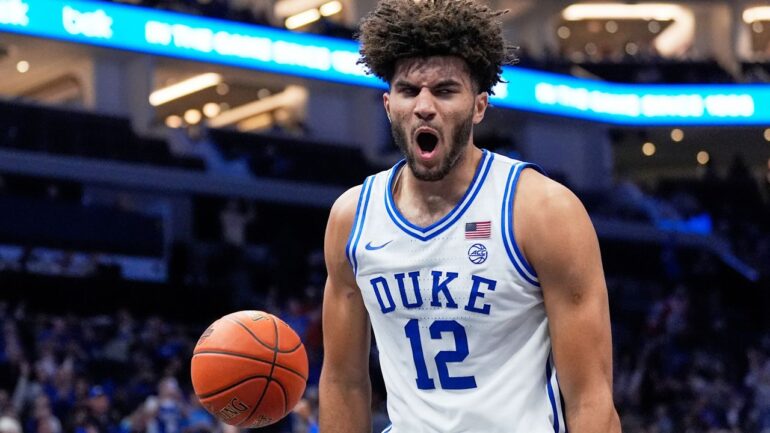
4. Cameron Boozer, Forward, Duke: 14.94 Offensive NP/40 (32.1 minutes per game)
Games Evaluated and Graded (9): Arkansas, Kansas, Texas, Michigan St., Florida, Indiana St., Western Carolina, Lipscomb, Texas Tech
Boozer’s star-caliber offensive impact, at least from a translation standpoint, is driven by his playmaking. He’s a stellar scorer, especially on the interior, but there’s reason to wonder if his limited vertical athleticism and limited advantage creation could cap his scoring ceiling. No such anxiety exists for his passing, though.
But we’ll unearth the truly special stuff in his blend of scoring efficiency and positive, speedy decision-making. He’s currently harboring a usage rate above 30 percent and an assist-to-turnover ratio above 1.5 and only three other drafted freshmen (Cooper Flagg, Markelle Fultz, Trae Young) accomplished that.
Boozer rarely places the ball in harm’s way and he’ll find high-value shots on the move, punishing help defenders who inevitably commit to his post and face touches:

His instantaneous processing speed and decision making acumen are his most valuable and dangerous traits, greatly narrowing defensive margin for error. This isn’t a terribly timed trap from the Longhorns, but Boozer fires the pass into a tight window at the perfect moment to beat the rotation:

In the NBA, Boozer will faces defenses who prioritize removing his passing threat and force him to win one-on-one on the outside. He’s strong and skilled enough to find deep catches against nearly anyone in his college, but his ultimate offensive peak will depend on his ability to dribble into those bread-and-butter spots.
While I have some doubts about Boozer’s self-creation translating to the NBA, I have little question about his touch and close-quarters projection. Finishes like these, pivoting and twisting before bumping into and shooting over Rueben Chinyelu’s 7-foot-8 wingspan, are standard throughout Boozer’s tape and will be for as long as he plays:

He’ll also space the floor (especially once he quickens his release), showcasing the 3-point volume, shot versatility and touch of a future dangerous shooter. And Boozer won’t dribble the ball up the floor and command offense like AJ Dybantsa or Darryn Peterson will, but he’s capable of own the most valuable area of the court and fitting next to other star teammates seamlessly.
3. Darryn Peterson, Point Guard, Kansas: 16.15 Offensive NP/40 (26 minutes per game)
Games Evaluated and Graded (4): UWGB, North Carolina, Missouri, NC State
Peterson is the only player to appear in the offensive and defensive top-five net impact plays and, despite clearly playing below full health, is producing and impacting the game offensively like a bona fide superstar. That sub-full capacity athleticism has primarily limited his rim pressure and foul-drawing, but he’s talented enough elsewhere to compensate in the games he’s played in.
He’s answered minor questions regarding his 3-point volume quickly in college, firing near 15 triples per 100 possessions. Peterson’s unbelievable touch most obviously fuels his ambidextrous intermediate scoring game, but it also allows him to convert absurd shots off the dribble and off screens, which significantly boosts his scalability projection.
Several of Peterson’s 10 catch-and-shoot 3-point makes (on 17 attempts) display high-level, NBA-caliber shooting stuff:

Elite off-dribble mid-range shooting touch and strong off-dribble volume project outside shooting improvement; young prospects, especially high usage ones, often shoot poorly on off-dribble threes. But I’ll bet on a player with Peterson’s pull-up and runner touch, in combination with his volume, figuring that out.
And Peterson creates so many of these shots with his elite burst, change of direction and ball-handling, hallmarks of future star NBA lead guards:

My play-by-play grading also accounts for gravity and Peterson bends defenses to his will, forcing constant traps and double teams to force the ball out of his hands. Nowhere was this more apparent than in his matchup with NC State, which relentlessly blitzed him in favor of leaving his teammates wide open beyond the arc:
Peterson trapped pic.twitter.com/f88JIg3mg2
— bjpfclips (@bjpfclips) December 31, 2025
Peterson may fall when the 2026 NBA Draft rolls around, teams fearing the worst from his hamstring issues. But if that happens, it won’t stem from anything he does (or doesn’t do) on the offensive end of the floor.
2. Mikel Brown Jr., Point Guard, Louisville: 16.33 Offensive NP/40 (28.2 minutes per game)
Games Evaluated and Graded (6): Kentucky, Cincinnati, Indiana, Louisville, South Carolina St., Jackson St.
Brown is the one prospect among this top-five that doesn’t feature atop the advanced impact or efficiency leaderboards and net impact plays begin to explain that disconnect. Much of the mainstream discourse about his limitations has circled around his low 3-point percentage, currently a tick below 27 percent. And, to be frank, I couldn’t care less.
My grading does not punish players for missing shots. Prospects earn or lose credit based on shot creation and selection in some instances, but even all-time shooters endure 30-35 game slumps, roughly the length of a college basketball season. And even if we ignore Brown’s strong pre-NCAA shooting priors, his statistical indicators and film-based metrics agree that this is nothing to worry about.
Volume, shot versatility and touch all offer far more predictive power than 3-point percentage which is extremely variable. Brown attempts an elite 14.2 triples per 100 possessions while shooting 83.8 percent at the line. His penchant for launching long, off-dribble threes certainly deflates his percentages, but young shotmakers commonly struggle with their discernment with the ball.
His ability to catch, quickly organize and fire from well beyond the NBA line opens the floor for himself and his teammates, currently attempting a quarter of his threes from beyond 27 feet:

Brown will rip these NBA-range threes on and off the dribble, lulling defenders to sleep with his handle before a sharp side or step back bomb:

Even some of the most prolific nascent shotmakers struggle to make forward-momentum off-dribble threes, relying on a hard deceleration for balance, but Brown isn’t one of those players:

He complements his outside shooting with a much-improved first step and functional strength and arguably the savviest passing in the entire class. Despite Brown’s shot sitting in a valley, he’s playing like an elite offensive prospect and one of the draft’s most prolific shot creators. Imagine what that looks like when the jumpers start falling?
1. Labaron Philon, Point Guard, Alabama: 17.42 Offensive NP/40 (31 minutes per game)
Games Evaluated and Graded (6): St. John’s, Purdue, Gonzaga, Illinois, Arizona, Clemson
As a freshman, Philon proved a vital cog on a great Alabama team as a connective third guard. I viewed him as a lottery-level prospect despite that fact, but he returned to Tuscaloosa for a second season and massively improved his offense, exceeding my expectations. Like Brown, he’s a high-volume shot creator with blinding speed, constantly creating paint touches.
Philon’s slight frame and rushed decisions with the ball limited his efficacy in the paint, but strength and skill gains turned him into a monster slasher this season. He lost the ball and gave up his dribble at slight contact last season, but he’s probing deeper into the paint as a sophomore, converting this trip to the rim into a post-up:

His efficiency at the basket skyrocketed as a result of those improvements to functional strength and handling, converting 13.8 percent more of his close twos than as a freshman. Philon also improved his 3-point volume and efficiency, adding more off-dribble shotmaking to his toolkit:
as a freshman, labaron philon went 1-12 on shots beyond 24 feet. through 12 sophomore contest, he’s already 10-20 on 25 foot+ threes
he’s notably more comfortable and willing to pull from deeper, which stretches out defenses even farther pic.twitter.com/SXIZ2HU3g7
— Ben Pfeifer (@bjpf_) December 26, 2025
Despite his high usage rate, Philon scores with elite efficiency (64.6 percent true shooting) on a diet of largely self-created shots, especially inside the arc. But he still possesses the innate feel and sense for moving off the ball, fooling helpers and breaking defensive shells with subtle movement and relocation around the perimeter:

Countless potential draft prospects return to school with the hopes of improving their stock and correcting weaknesses like Philon has and don’t accomplish that, but the 20-year-old guard looks the part of a future NBA star on the offensive end of the floor.