
Basketball teams at all levels, especially NBA teams, pour copious resources into finding breakout prospects. Knowing these players before the masses is a challenging endeavor. It’s not impossible, though, as bright scouting minds have forecasted draft stars.
In January 2019, Bomani Jones aired a High Noon segment on Ja Morant, who would end up as the second overall pick later that year. He referenced an article written by then-draft Twitter wunderkind Jackson Hoy, who lauded Morant before he was on any real draft radars.
let’s just enjoy ja morant highlights without worrying about the draft or anything else. this stuff is incredible. #highnoon pic.twitter.com/qV1KSbUi8B
— bomani (@bomani_jones) January 18, 2019
Hoy, who now works for the Memphis Grizzlies as a Senior Manager of Player Personnel, dug through proverbial weeds to uncover a hidden gem, despite Morant not receiving serious mainstream recognition before the 2018-19 college season. In 2025, Auburn transfer Elyjah Freeman could replicate Morant’s breakout.
An unlikely NBA story
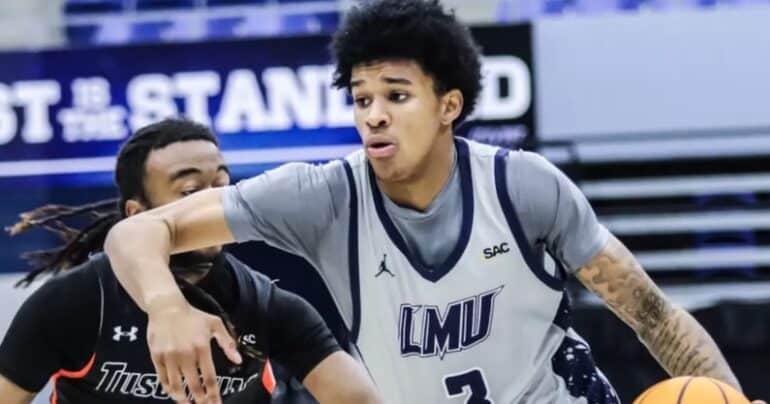
Somebody deserves their flowers for bringing Freeman to the draft space and that person is long-time internet scout Mike Gribanov. He’s made plenty of prescient predictions over the years and told me about Freeman in December 2024. Freeman played for Lincoln Memorial at the Division II level at that time, and Gribanov wrote about him in January.
In his piece, Gribanov concluded Freeman is a long-term NBA prospect worth monitoring with more upside than usual DII transfers to high major college hoops. I’ll push that a bit: at this stage, I view him as a top-10 player for the 2026 NBA Draft with more offensive upside than almost anyone else in the draft.
Freeman’s statistical profile last season looks the part of a future NBA player — the 6’8, 18-year-old wing averaged 18.6 points, 8.5 rebounds, 2.3 assists and 2.5 stocks (steals + blocks) per game on 68.5% true shooting. His more granular statistical indicators are just as impressive (and we’ll get into that later).
another note on elyjah freeman — he averaged 18.6 pts per game on 68.5% TS in 31 games as a freshman in d2
the only d1 freshman to match or eclipse 18 pts/game on 65% TS (since 2008) was zion williamson. really impressive even considering the lower competition level https://t.co/Uyr4SkLQKZ
— ben pfeifer (@bjpf_) September 2, 2025
What makes Freeman special?
Sometimes, elite prospects are easy to spot. Here’s the second touch of Freeman’s final game of the season, where he went on to drop 33 points on 17 shots. He waves away the screener and sizes up his defender, buckles his defender and explodes off of two feet for a dunk:

Later in that game, Freeman pulled off a similar, even more impressive play, self-creating another half-court dunk. I can’t remember many wings his size and age who toggle between speeds as fluidly as he does, backing out before exploding past his defender for a brutal poster slam, this time off one foot:

He dunked the ball 50 times in those 31 games, more than every drafted player in 2025 aside from four bigs (Khaman Maluach, Asa Newell, Yanic Konan-Niederhauser, Ryan Kalkbrenner). Freeman posted a strong 57 free-throw rate, making 80% of those foul shots. Film and athletic indicators suggest Freeman is an elite, functional athlete with more room to grow and add strength. The Division II level features fewer athletes and frames capable of slowing Freeman, but his dominance is impressive nonetheless.
Projecting translation to the Division I level
Lincoln Memorial relied on him as a primary offensive option more frequently as the season progressed. He logged seven isolation possessions (per Synergy) in his final game, a DII playoff game, after isolating just 37 times throughout the previous 30 games. Their trust in Freeman in key games is promising, though he functioned as an off-ball big man for most of the season.
Without consistent ball control in traffic or decision-making as a scorer, his team stationed Freeman off the ball to maximize his play finishing gifts. He thrived as a transition gunner, offensive rebounder and cutter, impacting the game on offense without commanding possessions. That role versatility is a promising sign for future development and adaptation.
Cranked-up levels of speed and physicality could lead Freeman to struggle at the Division I level, especially early on. Defenses sagged off him frequently and likely will do the same in the SEC despite his efficient, low-volume shooting. They’ll test him on defense, stretching his burgeoning awareness and instincts to their limits.
Maybe this piece looks silly rather quickly. But pre-college takes are for bold takes and shooting for the stars. If everything comes together for Freeman, he’ll mirror players like Jonathan Mogbo, Jaylen Wells and Bennett Stirtz jumping from lower-level college hoops to the biggest stage and eventually the NBA.