
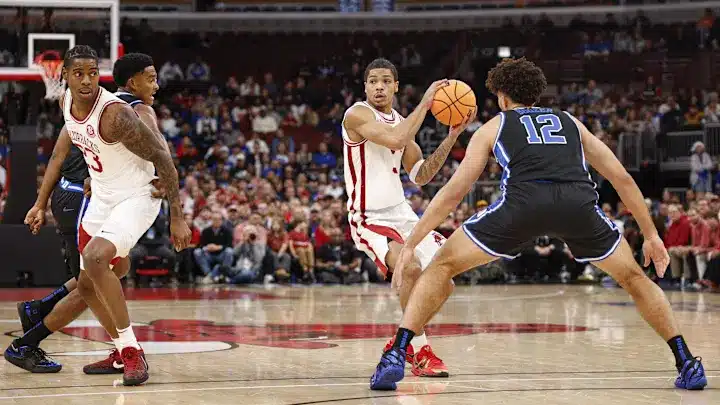
Early-season college basketball matchups, especially during the week of Thansgiving, often feature elite teams full of future NBA prospects. The Duke Blue Devils’ win over Arkansas in Chicago was one of those games, featuring five prospects in my top 30 and eight in my top 100.
I created a hand-tracked, film-based “metric” for projecting impact at the next level, based on grading each play a player makes in a game. You can read here for a more detailed explainer on my process, but I’m effectively totalling those plays for a single game/season-long average and grading those plays through the lens of projection, not necessarily current impact.
Here are the single game results from the Duke versus Arkansas game, with “Net Impact Plays” for both offense and defense for those nine prospects in my current top 100. I included each player’s season average Net Plays per 40 minutes, but the sample for those players range from 80-150 minutes, serving those numbers as benchmarks rather than reliable indicators.
Freshmen led the way for Duke and Arkansas
Unsurprisingly, Cameron Boozer and Darius Acuff topped the impact charting from the game as the two top scorers on each team. Most of their impact was driven by offense, both posting below average defensive impact scores. This was Cameron Boozer’s highest Net Plays/40 game against a high major team so far, matching up with his gaudy 35 point, nine rebound and three assist line on 75% true shooting.
Boozer mashed Arkansas’s slimmer bigs on the interior all night, too quick for them to handle on the perimeter and too strong to prevent deep paint touches. He shot 7-8 at the rim and 7-11 from the line, many of those resulting from his excellent footwork, power creation and touch that bode well for his NBA future.
Despite his two steals, Boozer wasn’t particularly impactful defensively. Defensive Net Plays scores are lower because of challenges evaluating defense and the limitaitons of individual defensive impact, but Boozer hasn’t been able to impose himself on defense. His stiffness and lack of vertical explosiveness make it tough for him to change directions and move in space and to impact shots at the hoop.
Acuff was an offensive machine for Arkansas all night, creating shots for his teammates off of the dribble beyond his 21 points and five assists. His excellent vision and passing feel on the move let him fire passes into tight windows and spray out to shooters, many of whom didn’t pay him off — the Razorbacks made 10 of their 30 threes against Duke.
The rest of the prospects were inconsistent
He only logged one block and one steal, but Ngongba’s defensive performance was impressive, evidenced by his 6.9 defensive Net Plays/40, a well above-average mark. Those points stemmed from some of his usual defensive disruption but also from some nimble possessions switched out onto the perimeter.
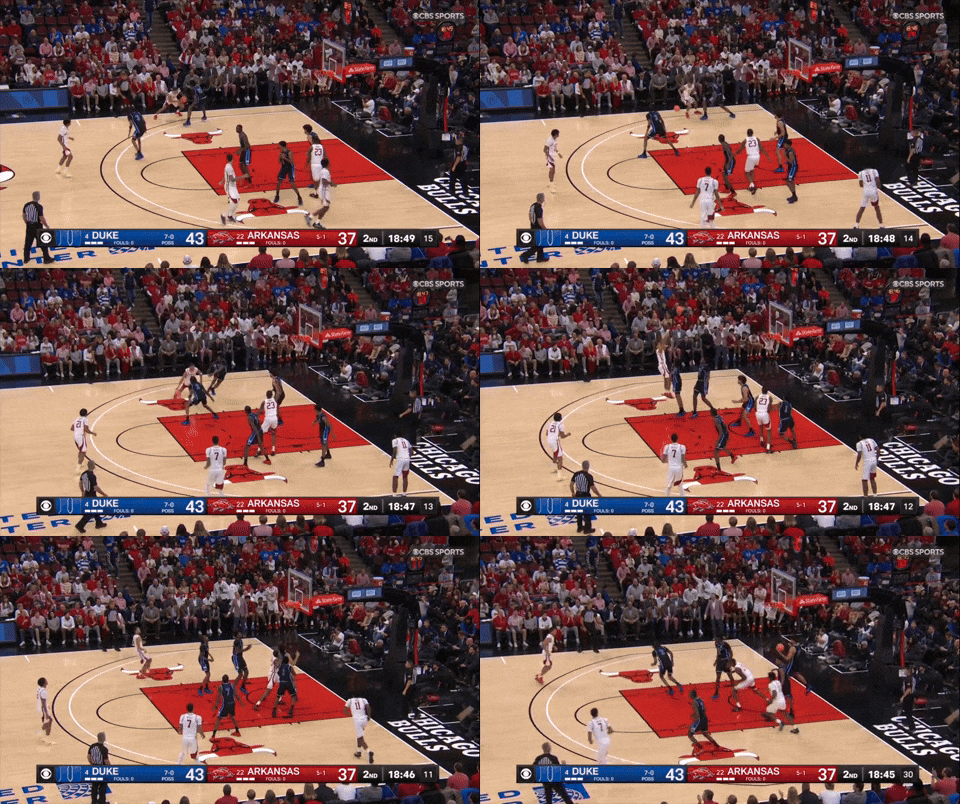
None of the prospects in this game aside from Boozer, Acuff, Ngongba and Meleek Thomas posted Net Plays/40 marks above the class average (10.68, 222 games charted). That matches with their generally unimpressive box score production, not consistently impacting the game in a positive manner as much as the top players.
These Net Plays scores from single games shouldn’t be viewed as predictive or scientific evidence, rather another lens to view how a player performed in a match. I’ll continue to update these scores throughout the season and learn more about how these prospects change and grow throughout the cycle.