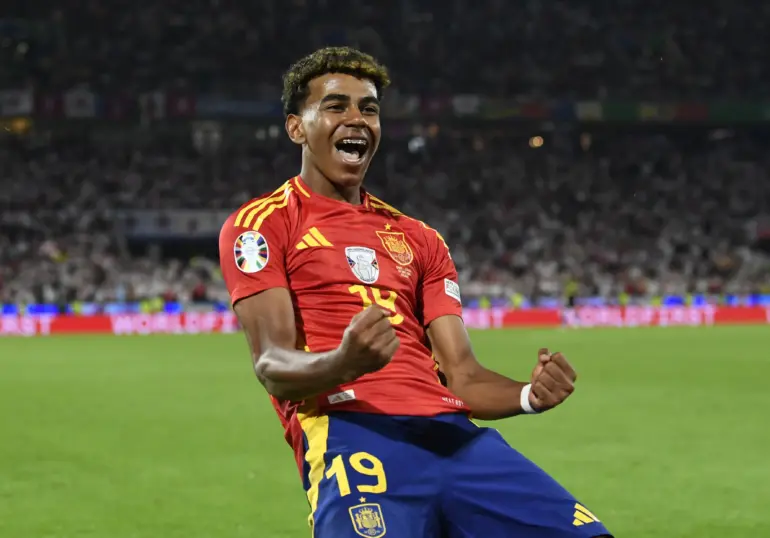

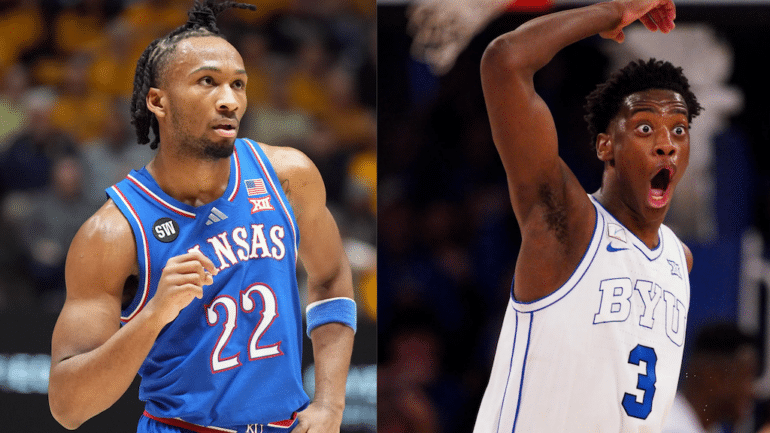
On Saturday, two of the 2026 NBA Draft’s proverbial big three will meet for the first time in college as AJ Dybantsa and BYU travel to Lawrence to play Darryn Peterson’s Kansas Jayhawks. Those star freshmen, alongside Duke forward Cameron Boozer, comprise one of, if not the strongest, top threes of any class in recent history.
Peterson and Dybantsa have battled each other before and the Kansas star won both of their matchups last season, his Prolific Prep squad topping Utah Prep once in December and again in February. On December 7th, 2024, Peterson dropped 32 points in a win over AJ, who scored 27. Both nascent superstars went nuclear during their second matchup two months later; Dybantsa scored 48 points, but that wasn’t enough to lift his team over Darryn and his 61 points, including a game-winning three.
A showdown between Peterson and Dybantsa, both vying for the top spot in the 2026 NBA Draft, will always land in the spotlight, especially considering both Kansas and BYU enter the matchup ranked inside the top-15 nationally. Peterson has missed time this season battling a hamstring injury, but he’s expected to play against the Cougars on Saturday.
Before we dive into the headlining prospect matchup, let’s discuss how the two young stars have performed this season.
Darryn Peterson
Any discussion surrounding Peterson’s play thus far begins with his absence on the court, missing significant time already, including multiple in-game exits due to lower-body health. He’s managing superstar impact at the college level, even without his full athletic powers for much of the season. That primarily manifests in his low half-court rim frequency, down from 25.6 percent during his final season at Prolific Prep to 17.6 percent at Kansas.
Shot selection mostly explains that sharp decrease, as Peterson seems less willing to slash deep into the teeth of defenses, instead (understandably) relying on his silky intermediate touch. Despite his efficiency on runners (41.7 percent), some of these drives could morph into deeper paint touches at his peak to further bend defenses.
Peterson clearly creates advantages at an elite clip and has finished more explosively above the rim in the past (even though his vertical pop was never elite), and I wouldn’t raise long-term alarm bells about his paint pressure yet. It’s a nitpick compared to the rest of his body of work, already one of the best scorers in college basketball.
Some questioned Peterson’s 3-point shooting heading into college after shooting under 34 percent across his final AAU and high school seasons. But his elite shooting indicators predicted his current white-hot shooting form, now converting 42 percent of his 15 threes per 100 possessions while shooting 82 percent at the line and making 46.8 percent of his non-rim twos. The sample is still small, but these sparkling indicators are nothing new for Peterson.
If Peterson sustains his volume and free-throw efficiency, he’ll join Steph Curry, Trae Young and Carsen Edwards as the drafted players since 2008 with seasons of 15 threes per 100 and 82 percent from the line with a 30 percent usage rate or higher. He’s a flamethrower both on and off the dribble, warping defenses with his off-dribble creation and scoring gravity.
He adds impactful defensive playmaking to dominant volume scoring and creation, rounding out an elite prospect profile. Questions about the level of defensive energy Peterson expends relative to his offensive load and health will always follow him, but his defensive work at the college level (as well as pre-college dominance) make Peterson a no-brainer blue-chip prospect.
AJ Dybantsa
Unlike Peterson, who most corners of the scouting world regard as a top-tier prospect independent of his off-court worries, polarization has characterized Dybantsa’s draft stock. Many in more mainstream circles view Dybantsa as an all-time prospect worthy of the top pick in a loaded class, while others on the internet believe his non-scoring skills don’t hold up to top-player status.
I lean closer to the first group, though I understand some of the concerns surrounding Dybantsa’s translation. He’s inarguably a worse basketball player today than Peterson (or Cameron Boozer) by almost any metric and the wider draft community undervalues the importance of age-weighted dominance. While Dybantsa has already put brilliant offensive work on tape, he’s performed less consistently than his elite peers, especially against top competition.
In seven games against top-50 opponents, Dybantsa’s numbers decrease across the board — true shooting (61.5 -> 51.1 percent), assist rate (21.9 -> 18.2 percent) and stock rate (3.8 -> 3.8 percent) — compared to his full-season splits. Small sample noise renders these numbers mostly inconsequential to me at this point, but he’s struggling more against athletic, well-coached teams equipped to exploit his decision-making woes.
Opposing teams center their game plans around Dybantsa, challenging his brain-power with constant double-teams, coverage mixing and physicality. It’s understandable for young players without standout feel for the game, like Dybantsa, to struggle at this age and fall back on their less-optimal habits, especially considering BYU’s relative lack of offensive talent around him.
He’s still bashing defenses en route to the rim, shooting an absurd 76.8 percent on 5.2 rim attempts per game with 77.2 percent of those makes coming unassisted. His blend of first-step burst, all-time flexibility and body control and creativity with the basketball lets Dybantsa live in the paint when he chooses to. That basket pressure, paired with elite mid-range scoring and solid, if-limited, passing chops, keeps him among the top tier of prospects despite his flaws.
What to watch for when BYU-Kansas tips off
BYU’s varied defense should force Peterson on the ball more than normal, assuming they continue to mix coverages, press occasionally and toggle to zones as they’ve done all season in tough matchups. Opposing offenses spend 2.2 percent of their offensive possessions in off-screen playtypes against BYU, directly opposing Peterson’s bread-and-butter offense.
A significant 17.7 percent of Peterson’s possessions finish with off-screen possessions, ranking in the 92nd percentile nationwide. Pick-and-roll scoring is Peterson’s highest-frequency play-type (24.7 percent frequency) but that only places him in the 65th percentile among all Division I players. He used a season-high nine possessions in the pick-and-roll in his second college game against North Carolina and there’s a good chance he tops that number against BYU.
Dybantsa has posted a mediocre 3-point shooting season so far, making 31.8 percent of his 5.7 3-point attempts per game. He’s not always comfortable firing threes confidently off the catch and suffers from mechanical inconsistencies, though these aren’t harrowing long-term concerns. The Jayhawks’ defense will allow him to shoot from deep, ranking 305th in the country in opponent 3-point rate (43.6 percent) and won’t foul much (23rd opponent free-throw rate in the NCAA), presenting another potentially challenging matchup for the freshman.
In their high-school matchups, Peterson and Dybantsa often didn’t guard each other, saving energy for the offensive end as their team’s only sources of consistent offense. We saw more of Peterson checking Dybantsa than the other way around, but neither star was the other’s primary defender. Will round three feature more one-on-one moments with better offensive support systems around them?
All stats updated prior to games played on January 28, 2026, per Synergy Sports and Bart Torvik