
This is becoming an odd Most Improved Player race. At least from my point of view, there aren’t any slam-dunk candidates and the list of potential inclusions stems beyond the customary top five. But at this point in the season, we’ve learned which players have taken leaps and which were just blips, so let’s dive into this convoluted MIP ladder.
1) Austin Reaves
Missed games will serve as the largest obstacle to Reaves’ MIP candidacy — he’s already missed 12 games on the season. But he’s eligible for the moment and deserves the list’s top slot, still playing like one of the NBA’s better offensive players when healthy. Reaves sits just inside the top 15 in per-game scoring, averaging a career-best 26.6 points and 6.3 assists on scorching plus-9.1 relative true shooting.
During his 360 minutes with Luka Doncic off the floor, Reaves revs his scoring volume to the tune of a primary initiator, averaging 35.9 points and 8.2 assists per 75 possessions on 68.5 percent true shooting with star-level usage rate (35 percent). He scores from all levels, leveraging his constant off-dribble shooting threat to open driving lanes, draw fouls and play-make for others.
Improvements to other areas of his skill-set fully unlocked his ridiculous free-throw game; his 8.6 attempts at the stripe per 75 possessions ranks him top-10 league-wide. If Reaves finds a good stretch of health and makes his first All-Star team this season, he’d make a deserving Most Improved winner as one of the NBA’s new offensive engines.
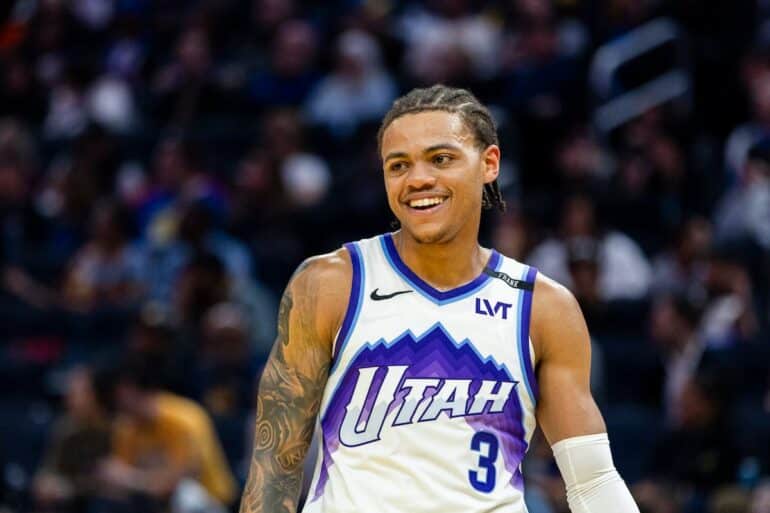
2) Keyonte George
Young players ascending toward star-level usage and on-ball timeshare often dip in efficiency with more responsibility but George continues to produce efficient offense as the Utah Jazz’s engine. He leads the Jazz in usage rate (29.7 percent) and is second in on-ball rate (35.8 percent), averaging 24.3 points and 6.8 assists per game on plus-three relative true shooting, up from 16.8 and 5.6 on minus-3.6 relative efficiency last year.
Like Reaves, George’s blend of outside shooting and foul-drawing bends defenses when he has the basketball. Improved burst, strength and functional athleticism makes him tougher to guard in the paint, helping him place in the top-25 league-wide in free throws per 75 possessions (7.4). He’s a strong shot creator, especially on pick-and-roll skip passes, though Utah’s scheme does influence that to an extent.
George grades as one of the league’s worst defenders but many of the other Most Improved Player candidates have regressed defensively with more offensive responsibility. The Jazz have benefitted greatly on the offensive end from his athletic progression and skill development, turning George into one of the league’s most potent young initiators.
3) Jaylen Brown
It might initially feel odd to include Brown, a Finals MVP and four-time All-Star, as a Most Improved Player candidate, but he’s taken a major step forward in year 10. That came out of necessity, as Jayson Tatum’s Achilles injury and other roster changes forced a bump in usage. He’s responding resoundingly to this point, posting career-high marks in Offensive Estimated Plus-Minus (plus-3.1) and true shooting (59.1 percent), despite ranking second among all NBA players in usage rate.
Brown’s 28 percent on-ball rate is the highest of his career by a five percent margin, forced to initiate more offense without Tatum in the fold. He’s self-creating offense at a ludicrous clip, ranking fifth in creation (isolation, post, pick-and-roll) attempts per 100 possession (16.2) on plus-7.2 relative true shooting. Shai Gilgeous-Alexander, Luka Doncic and Donovan Mitchell are the only other players to match or exceed that volume and efficiency.
He’s not at his highest level of defensive impact but that’s understandable, considering the monster offensive load he’s carrying. Brown is playing the best basketball of his career and is a primary driver of the Boston Celtics’ excellent 23-13 record, despite a new-look roster. Though Brown was already an excellent player, creeping closer to true All-NBA scorer status deserves recognition.
4) Jalen Johnson
With Trae Young officially off the Atlanta Hawks’ roster, Johnson will have all the opportunity he can handle to claim the Most Improved trophy. He’d already seen a significant increase in offensive usage from last season, averaging career-high marks across the board — 23.7 points, 8.4 assists and 10.4 rebounds per game on plus-3.5 relative true shooting.
He’s been able to manage a career-high on-ball rate (27.4 percent) with improved outside shooting, forcing defenses to pay more attention to him from beyond the arc. Johnson making 36.7 percent of his triples opened up his already explosive driving game and he’s an always dangerous playmaker, especially at the basket.
Impact metrics view Johnson’s year-to-year increase as modest (plus-0.7 to plus-1.5 Estimated Plus-Minus) and that mostly stems from defensive regression. More offensive responsibility has zapped most of his defensive force, regressing in nearly every defensive metric. His All-Star-caliber production on offense still earns him a spot on the ladder.
5) Collin Gillespie
First-year Phoenix Suns head coach Jordan Ott has squeezed excess value out of many of his players, none more noteworthy than Gillespie. Finally receiving a full-time role in his second season with the Suns, Gillespie broke out as one of the NBA’s fledgling impact role players, posting a career-high 13.6 points, five assists and 4.1 rebounds on plus-1.6 relative true shooting. He ranks in the 90th percentile in Estimated Plus-Minus (plus-2.4) after finishing last year in the 78th percentile.
Gillespie’s outside shooting has crystallized and he’s firing from deep like an elite outside shooter, making 41.9 percent of her nine threes per 75 possessions on a 13th percentile assisted rate. Pull-up shooting acumen and pick-and-roll playmaking fuel his offensive impact while he’s also finding more creative angles to pass to the basket, jumping from 1.6 rim assists per 100 possessions last season to 3.1 this year.