
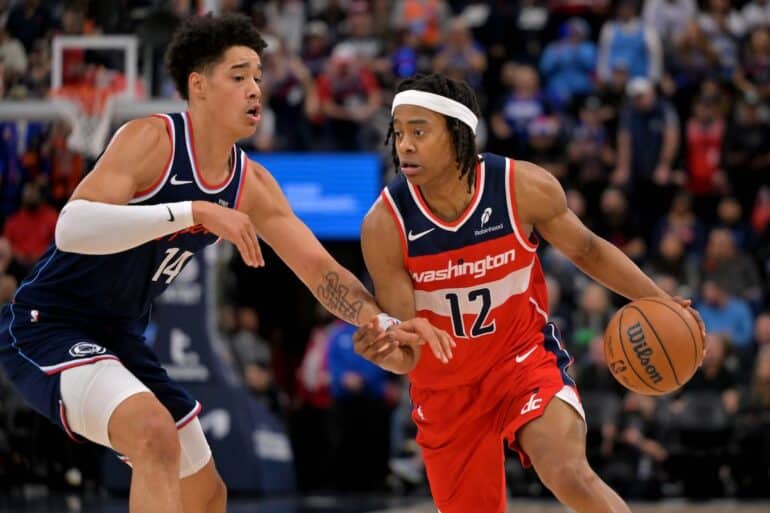
With the 2025-26 NBA regular season approaching its halfway point, first-year players are fully entrenched into their new professional settings. After a brief holiday hiatus, I’m back for another installment of the NBA Rookie Ladder to sort out what still looks like an excellent 2025 class.
As always, for this rookie ladder, we’ll rank all rookies (playing at least 15 minutes per game) by their play this season, not their long-term outlook. As a reminder, the tier placement for each player matters more than the exact rankings in those tiers.
Ascending Stars
Kon Knueppel
Cooper Flagg
Impact NBA Players
Collin Murray-Boyles
Cedric Coward
VJ Edgecombe
Dylan Harper
Tre Johnson
Ryan Kalkbrenner
Positive Play By Rookie Standards
Derik Queen
Will Richard
Sion James
Jeremiah Fears
Egor Demin
Ace Bailey
Dylan Cardwell
Hugo Gonzalez
Maxime Raynaud
Flashes/Inconsistent Play
Caleb Love
Walter Clayton Jr.
Ryan Nembhard
Drake Powell
Kobe Sanders
Nique Clifford
Danny Wolf
Ethan Thompson
Micah Peavy
Ben Saraf
Nolan Traore
Collin Murray-Boyles
Murray-Boyles is the best rookie defender from his formidable draft class and it’s not particularly close. Among eligible rookies, Murray-Boyles ranks first in Defensive Estimated Plus-Minus (plus-1.5, 91st percentile), first in deflections (6.4) and fourth in steal and block rate. His presence improves Toronto’s defense by 5.6 points per 100 possessions (non-garbage time), the best mark on the team among regular rotation players.
That defense reaches its highest levels of potency when paired with Scottie Barnes. Lineups with Murray-Boyles and Toronto’s All-Defensive-caliber ace (309 minutes) post a defensive rating a staggering 11.9 points below league average. Those two rangy, versatile forwards make life hell for opposing offenses, even when paired with offensively slanted personnel.
Murray-Boyles typically guards centers in these lineups (and all others), spending 93 percent of his possessions at the position, according to Cleaning the Glass. But Toronto’s switch-heavy scheme means he’s nominally a center more than anything. He’ll start a possession guarding the center while Barnes marks the opposing team’s primary (Pascal Siakam in this case), eventually switching onto a guard and forcing a miss:
Barnes and Murray-Boyles do not look fun to design a pick-and-roll-centric attack around. Without star-level creators, that tandem forces tough shots and turnovers without allowing clean advantages:
Centers with the size and ball-handling chops to overwhelm Murray-Boyles or the offensive firepower to force him into true drop coverage situations trouble the rookie but he’s held up remarkably well against NBA big men from the jump. Toronto’s unorthodox top-10 pick has played like an ascending defensive star with the foundation to become an All-NBA defender in the coming seasons.
Tre Johnson
Johnson has quickly cemented himself as one of the NBA’s premier young shooters after years of stellar college and high school marksmanship. Absurdly deep shooting range is Johnson’s clear standout shooting trait, currently converting 37.9 percent of his 58 threes from 27 feet or beyond, according to Synergy.
Confidence is everything for projecting young shotmakers and Johnson oozes that, firing some of the most audacious triples of any player in the league. His blinding green light sits among the coolest NBA things happening right now:

He’s sinking 39.4 percent of his 9.9 3-point attempts per 100 possessions, shooting the ball like an upper-tier sniper. His penchant for outside shooting outbursts and his impressive scoring numbers for a rookie over his previous 10 games —14.4 points on 63.4 percent true shooting — could suggest he develops into a primary on-ball option one day.
But he doesn’t command the ball, ranking in the 38th percentile league-wide in on-ball rate (11.3 percent). That’s a feature, not a bug, however, as Johnson is at his best off quick-hitting actions. He feasts with off-ball screening actions, spending over 20 percent of his offensive possessions on handoffs and off-ball screens.
Even Johnson’s best on-ball moments feature decisive, intentional movements, not an inexperienced rookie pounding the air out of the ball. He won’t ever boast the dynamic creation that other guards display but he rarely lets advantages flounder, a rare trait for a scorer his age.
His off-ball prowess should pair him smoothly with new Washington Wizard point guard Trae Young — whenever he suits up for his new team. At his peak, Johnson will likely be most dangerous as an attacker off movement rather than a heliocentric creator but that’s a viable path to offensive stardom. As for that defensive backcourt pairing? That’s what Alex Sarr and Bilal Coulibaly are for, I suppose.
Dylan Cardwell
I appreciate rookies, especially undrafted free agents like Dylan Cardwell, who bother and battle with the NBA’s best players. Karl-Anthony Towns scored 13 points on 14 shots in a New York Knicks loss to the Sacramento Kings on Wednesday and Cardwell’s on-ball defense and playmaking chops contributed to those struggles.
The 6-foot-10, 24-year-old rookie entered the league as an aerial specialist, imparting most of his value as an above-the-rim threat on both ends. But Cardwell boasts the mobility and athleticism to contain even strength-based star creators like Towns, helping him rank third among rookies in D-EPM (plus-0.7):
Cardwell averages a hair over four points per game on minus-8.6 relative true shooting while shooting 50 percent at the free-throw line. Despite the pogo sticks attached to his torso, he’s finishing just 53.1 percent of his shots at the rim (ninth percentile). But as a rookie, he ranks inside the top 10 in offensive rebounding rate (16.5 percent), creating valuable extra possessions for the Kings.
Explosive vertical athleticism fuels Cardwell’s 98th percentile block rate (8.1 percent), though he recovers fewer than half of his blocks, which saps some of that rim-protecting value. Even if he’s closer to his ceiling as an older rookie, Cardwell’s explosiveness, energy and rebounding have already found him a home in Sacramento’s rotation.
All stats accurate prior to games played on Jan. 15.