
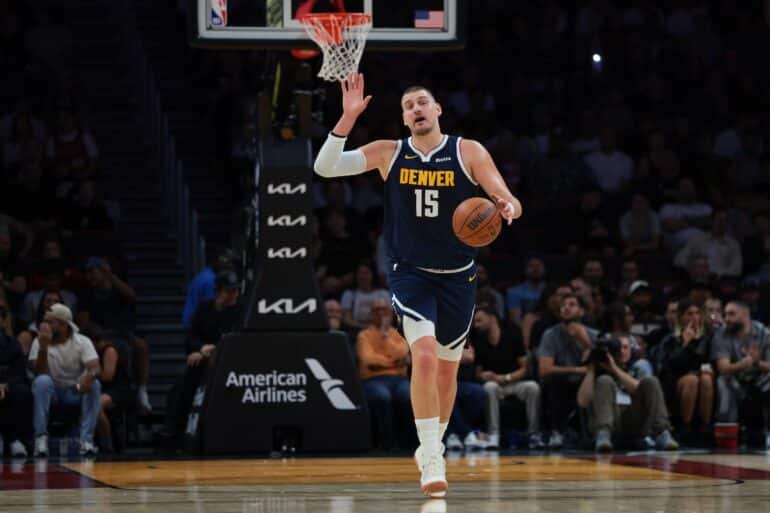
Nikola Jokic is set to miss at least four weeks with a left knee injury. The Denver Nuggets, despite beating the Raptors in Toronto on New Year’s Eve, have lost consecutive games to the Cleveland Cavaliers and Brooklyn Nets. This stretch should most likely only further amplify, beyond Jokic’s gaudy numbers, his case as the most valuable player in the league.
Except for one thing, if Jokic does indeed miss all of January, that will be 18 missed games and automatic ineligibility for end-of-season awards. Jokic’s streak of finishing first or second in MVP voting would end at five consecutive seasons.
We’re talking about eligibility, though, not performance. Not the historic night of Jokic becoming the first player to drop at least 55 points, 15 rebounds and 15 assists in a game, nor following that up with a 34-point, 21-rebound, 12-assist triple-double. Not him averaging a 29-point triple-double with a slash line of .670/.435/.853 (twos/threes/free throws).
And it’s not just Jokic. Giannis Antetokounmpo has played 22 of 36 games this season, so he is four missed games away from being ineligible for the major end-of-season awards. Victor Wembanyama has missed 14 of the San Antonio Spurs’ 35 games thus far, so even a one-week absence from here on out could disqualify him.
We’ve had a few years with the 65-game minimum rule for award eligibility, offering a decent amount of time to crystallize some thoughts on its merit. At this stage, it feels safe to say it doesn’t strike the right balance between evaluating performance and evaluating availability and the intended purpose of curbing rest/injury management is not being met. Here’s why.
Has the 65-Game Minimum’s Purpose Been Served?
To understand if the rule is even fair in the first place, we need to remember its purpose.
Primarily, the rule is in place to curb rest and injury (load) management. Commissioner Adam Silver has commented in the past there isn’t sound enough evidence to attribute missed games to the schedule, so he views this as the best path to doing so.
During the first season the rule was implemented, many pointed to Kawhi Leonard playing 68 games in 2023-24 — his most since the 2016-17 season — as a sign the rule was working as intended. Leonard himself squashed those claims arguing he plays as long as he is healthy and a games played rule for award eligibility isn’t going to take away a degenerative knee problem.
If anything, there are players who have tried to force their way to the 65-game threshold when hurt and risked further injury rather than doing what’s absolutely right for their bodies.
That’s the reality. Injuries that have no regard for the rules and force players to sit are having a greater impact than ever before. As of Dec. 30, 2,565 games have been lost to injury or illness this season while 102 games have been lost to rest or load management, per injury analyst Jeff Stotts. The NBA has a rule for something that is an exception rather than the norm.
Availability Can Matter Even When Eligible
Something that seems to be forgotten with the 65-game rule is voters had established a pretty good understanding of how much availability should matter prior to the rule.
In the history of the league, only one player has won MVP playing less than 75 percent of the season. Bill Walton won MVP averaging 18.9 points, 13.2 rebounds, 5.0 assists, 2.5 blocks and a steal playing 58 of 82 games during the 1977-78 season. The Blazers were 50-10 when injury took Walton out and went just 8-14 the rest of the way.
Portland was fresh off winning a title in 1977, where Walton won Finals MVP and finished as MVP runner-up to Kareem Abdul-Jabbar in the regular season. Even if you feel 58 games is too few to win MVP, you can see logic behind why things played out the way they did.
What the 65-game rule has done is eradicate valuable nuance. Here’s a list of 10 players already at risk of missing out on end-of-season awards not including Jokic (accurate as of Jan. 1, with the “GM” column highlighting games missed).
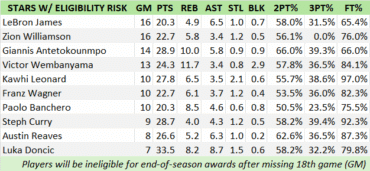
All the players above are somewhere between a couple games to a couple weeks away from being knocked out of contention. The likes of Anthony Davis, Joel Embiid and Trae Young are already ineligible.
Herein lies another problem. Players who become ineligible earlier in the season with no hope down the stretch are only more likely to be rested late in the season unless their team is jockeying for playoff positioning. Give them incentive to be eligible and roll the dice, believing the voters will largely get it right anyway.
65-Game Tweak That Can Make Big Difference
In a world where everything is increasingly presented as black or white, I think what’s needed here is nuance.
Let’s introduce a tier system to award eligibility. If the league has already identified 65 games as its happy medium then I’m not going to add another paper to the pile in saying the number is too high. What I will advocate for is removing the all-or-nothing doomsday effect of the current rule by making 65 games be a marker of whether someone is eligible for a first-place vote.
In that same vein, I’d also recommend adding 55 games as a marker of eligibility for a second-place vote, followed by 50 games as a minimum required for any voting eligibility. History shows we can trust voters to make the appropriate consideration for a lack of availability for those secondary votes and beyond.
This can be applied to both individual and team awards, as players would need at least 65 games to make a First Team, at least 55 to stand a chance of the Second Team and at least 50 to make a Third Team.
In this hypothetical, Jokic can play fewer than 65 games and still possibly have his season recognized on some level if voters deem it worthy. Let’s say Jokic ends up playing 60 games. Surely, averaging nearly a 30-point triple-double would still be worthy of finishing somewhere between second and fifth in MVP voting and a place on an All-NBA Second or Third Team.
The current problem with the 65-game rule is the punishment doesn’t fit the crime. Adding tiers makes for a more balanced approach.
NBA Needs To Take Accountability For Its True Goal
As a final point of consideration, if the NBA wants to maximize availability and minimize games missed due to rest and injury (load) management, Silver and his staff need to look in the mirror.
Eighty-two games isn’t going anywhere anytime soon, we accept that. What the league needs to accelerate is the progress made in minimizing back-to-backs. In the 2015-16 season, teams played an average of 18 back-to-backs, which has dropped to around 15 the last couple seasons. Surely, extending the schedule by a couple weeks to reduce the strain on players would be well worth it.
Recently, preseason has run nearly three weeks. Boosting the in-season rest factor should also create more reason for a shorter preseason as well.
Jokic’s injury isn’t schedule-related, it was just an unfortunate moment that will cost him around a month. The attention and respect he commands as a three-time MVP makes his likely absence from this season’s awards ballot worth reviewing the fairness of all the others before him who have missed out.