

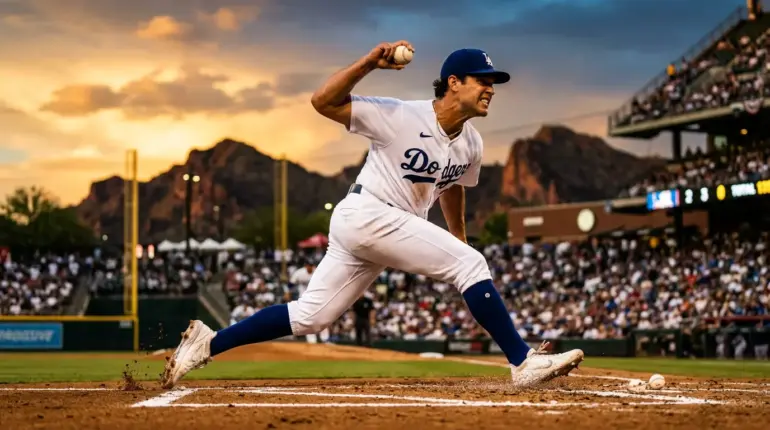
Shohei Ohtani threw six scoreless innings against the Arizona Diamondbacks on Wednesday, went 3-for-4 at the plate, and led the Los Angeles Dodgers to a 7-0 shutout at Chase Field. Through 10 starts in the MLB 2026 season, he owns a 0.74 ERA, a 0.79 WHIP, and a .936 OPS as a hitter.
That combination does not exist anywhere else in baseball. It never really has.
Ohtani’s RealM Start Sets a New Benchmark for Two-Way Play
The term RealM Start – tracking Shohei Ohtani‘s official two-way workload on the mound in live game action – has become its own category in MLB 2026, and Wednesday’s outing against the Arizona Diamondbacks is the clearest argument yet for why. BR Betting analyst Blake Harris framed the historical weight on X after the game, laying out the lowest ERAs through a pitcher’s first 10 starts in the Live-Ball Era: 0.56 by Jacob deGrom in 2021, 0.59 by Juan Marichal in 1966, and 0.74 by Ohtani in 2026.
DeGrom and Marichal got there as pure mound specialists. Ohtani got there while also being one of the most dangerous hitters in the National League.
The supporting numbers are just as staggering. Through 61 innings, Ohtani has 67 strikeouts and has not allowed more than two earned runs in any single start this season – giving up one or zero earned runs in eight of his first nine outings. He surpassed Fernando Valenzuela’s famed 0.91 ERA through nine starts in 1981 earlier this month, a milestone that would have been the headline in any other era.
This is the rare case where the superlatives are not outrunning the evidence. The evidence is generating the superlatives.
What Ohtani Did Against the Diamondbacks
Six innings, two hits, one walk, six strikeouts – the pitching line was clean without being overwhelming on paper. The execution was something else. The Diamondbacks managed just two baserunners through Ohtani’s entire outing, and neither scored.
At the plate, Ohtani went 3-for-4 with three singles, two walks, and a run scored – reaching base five times. He did not need an extra-base hit to apply pressure; his presence in the lineup forces a different kind of attention, one the D-Backs never resolved on either side of the ball.
The win moved the Dodgers to back-to-back victories after dropping Monday’s series opener, and it sets up a potential series win Thursday. This was not a performance where Ohtani was locked in from the first pitch and simply coasted – it was a methodical, low-drama dismantling of a lineup that entered the series as one of the NL’s more dangerous offensive units. That is arguably the more telling version of dominance.
Through 57 games, Ohtani carries a .301 average, 10 home runs, 33 RBI, and 41 runs scored. The two-way player conversation ended a long time ago – this season is about where he ranks all-time.
Ohtani As a Rotation Piece Changes the Dodgers’ Calculus Entirely
There is a version of the Los Angeles Dodgers that goes into October with a deep, well-managed rotation and a dangerous lineup. Then there is the version that has Shohei Ohtani in both.
MLB.com has framed his extended workload against Arizona as a dress rehearsal for October, noting that his lengthening outings signal he is stretched out and prepared for full-workload playoff starts – while his bat stays in the lineup regardless. That is not a luxury most contenders can manufacture. It is a structural advantage that does not show up cleanly in any rotation depth chart.
The comparison to how elite pitching arms reshape a team’s entire playoff calculus is relevant here: a true ace changes how a manager sequences a series, manages a bullpen, and values rest days. Ohtani does all of that and hits cleanup. The Dodgers News cycle around this roster has shifted from ‘can they stay healthy’ to ‘how do you actually beat them in October.’ That is a different problem for the rest of the NL West.
How Ohtani’s Dominance Moves the Betting Market
The market has already begun pricing in what Wednesday confirmed. Ohtani’s NL MVP odds and Cy Young odds have shortened measurably since his scoreless streak extended past 19 1/3 innings earlier in May, and this start – posting a 0.74 ERA through 10 outings with a .936 OPS as a hitter – gives books little reason to move them back.
On the futures side, the Dodgers‘ World Series odds remain among the shortest in the sport. A fully operational two-way Ohtani, stretched out and pitching deep into games against NL competition, is the variable that separates Los Angeles from every other contender on the board. Any sign of fatigue, workload reduction, or role change would move those numbers fast. Right now, there is no such sign.
The Bet: Ohtani’s NL MVP and NL Cy Young both represent value at current odds given the historical pace of this season. A four-time unanimous MVP posting a sub-1.00 ERA through double-digit starts while hitting .301 with a .936 OPS does not get cheaper as the season progresses.
Odds are for entertainment purposes only. Please gamble responsibly.
Bottom Line
Shohei Ohtani is not just having a great season – he is assembling one of the most statistically anomalous starts to a campaign in the Live-Ball Era, on both sides of the ball simultaneously. The Los Angeles Dodgers do not just have the best player in baseball. They have a structural advantage that no other roster can replicate.
The rest of the NL can adjust their game plans all they want. The cheat code does not have a patch.