

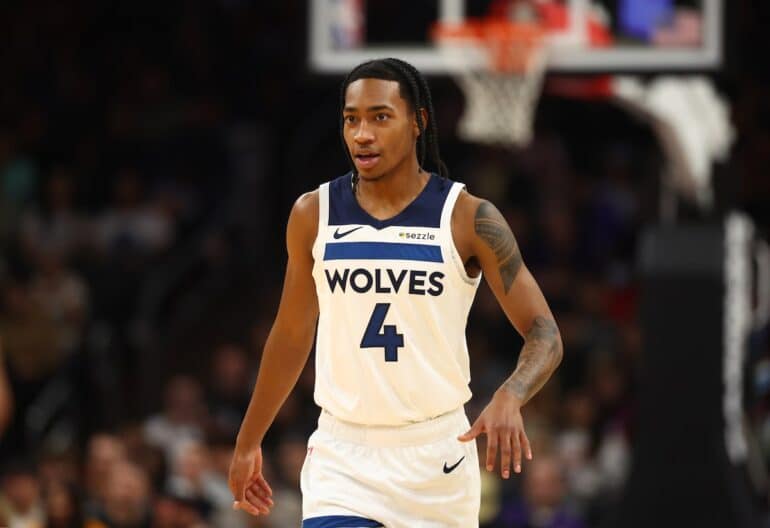
Small guards are going out of style. As players become larger, more skilled and athletic, and offenses become more potent, it’s tougher for short players to survive. Yet some take this idea too far; while less common, plenty of players hovering around 6 feet carve out major roles on great teams.
Players like Rob Dillingham, who entered the NBA in 2024 with one of the league’s slightest frames, must thread a tiny needle toward postseason impact. The eighth overall pick didn’t play consistently as a rookie but his best moments suggest he could break beyond the mold of a microwave scoring guard without much use on great teams.
First-year guards famously feel the translation to the pros more harshly than other positions. Dillingham’s pedestrian numbers (per 75 possessions) — 15.3 points. 6.9 assists and 3.5 boards on minus-7.1 relative true shooting — mirrors plenty of rookies who have since developed significantly on offense.
Jalen Suggs, Darius Garland, De’Aaron Fox, Dejounte Murray and Lou Williams all posted similar scoring volume and efficiency as rookies. Dillingham’s statistical profile, especially on a limited 500-minute sample, requires a deeper dive into the film to contextualize and project forward.
Offensive Juice
Elite dribbling skill and feathery touch are the foundation of Dillingham’s offense and buoyed his scoring game, which largely relied on interior shotmaking. Often the smallest player on the court, he fearlessly attacked the hoop, generating 4.1 rim attempts per 75 possessions (84th percentile among point guards) and converting 62.4 percent of those shots.
He quietly thrived as a slasher, making 52.5 percent of his shots on 186 total drives as a rookie. Among rookies, only Ajay Mitchell posted a higher efficiency on drives. Despite playing just over 500 minutes, he logged the ninth-highest drive totals of any 2023-24 rookie, indicating his long-term scoring upside.
rob dillingham's drive efficiency (52.5% FG, 186 drives) fueled his rookie offense, only ajay mitchell eclipsed his efficiency on drives among rookies
even without any foul drawing, dillingham put pressure on the basket and scored when he got there pic.twitter.com/PEM02GAdwI
— ben pfeifer (@bjpf_) August 31, 2025
Like most undersized point guards, Dillingham carves up defenses with a ball screen. He generated 71st percentile offense (1.026 points per possession) from the pick-and-roll, too shifty and sudden for even strong defenders like Jarrett Allen to contain in drop coverage near the level of the screen:

His excellent playmaking vision boosts his driving value; Dillingham ranked third in assist rate (28.3 percent) among rookies, placing in the 93rd percentile overall. With the threat of a middle ball-screen, he can instantly reject and burst toward the hoop, finding Rudy Gobert on a tight pocket pass:

One of Dillingham’s major strengths as a prospect was his comfort toggling between on- and off-ball roles. This trait quickly translated to the league, as his passing, off-ball driving and keen feel for spacing add value next to other great players. He won’t hesitate to slither his way into the paint off the catch or make an extra pass for easy shots.
Watch how quickly he reads the floor after Anthony Edwards releases from the double-team, zipping the ball down to his fellow rookie Terrence Shannon Jr. for a layup against the scrambling Oklahoma City Thunder defense:

Offensive Woes
Reaching his ceiling as an off-ball scorer relies on his outside shot improving, which is a reasonable bet to make. Dillingham converted an unsustainable 44.4 percent of his threes in college, but his high-volume free-throw shooting and shot versatility were encouraging shooting indicators.
As a rookie, he hit 33.8 percent of his 5.1 3-point attempts per 75 possessions. That’s not outright bad but 6-foot guards must reach higher peaks than below-average shooting on mediocre volume. He attempted just 74 threes as a rookie, far from a statistically significant sample.
While it’s reasonable to expect progress as a shooter, his complete lack of foul-drawing is a far more glaring offensive hole. He marched to the stripe 15 times as a rookie and made eight of those freebies, good for a 7.1 percent free-throw rate that tanks his current scoring efficiency.
Even if he adds muscle as he ages, he’ll always face major limitations because of his lack of height and length. He favors fading away from contact, relying on his exceptional touch to convert contested shots instead of searching for free throws. It’s hard to imagine him ever becoming an above-average foul-drawer.
Last season’s top-50 offensive players in Estimated Plus-Minus (EPM) featured one player, Payton Pritchard, with fewer than two free-throw attempts per 75 possessions. Dillingham’s true offensive star path is fairly narrow because of his size and vertical athleticism but a great intermediate game can help mitigate this to some extent.
A Capable Defender?
His rookie defensive tape pleasantly surprised, as he struggled mightily on that end in college. Collectively, his Kentucky squad wasn’t a stout defensive team. But it would be reasonable to expect a player like Dillingham, who measured at 6 feet 1 inches without shoes and 164 pounds, to sink an NBA defense.
Most rookie guards, especially shorter ones, often bleed defensive value, and many of them improve as they age. Dillingham, however, found ways to compete and survive on that end. Impact metrics like Defensive EPM view him as just below neutral (minus-0.3) and he posted a solid 1.9 percent steal rate.
rob dillingham’s defense was a pleasant surprise in year one, he held up much better in big moments than I expected
his size will always pop up and he needs to get stronger but the screen nav, offball playmaking and general intensity were all really positive signs pic.twitter.com/nBZst13Jnw
— ben pfeifer (@bjpf_) August 27, 2025
Compared to his time in college, Dillingham’s defensive motor revs hotter and more consistently, possibly stemming from less offensive responsibility. While NBA athletes exploited his size, he weaponized his speed, lateral quickness and sharp instincts to add some defensive value on a sturdy Minnesota Timberwolves defense.
Watch him mark Pritchard at half-court before chasing him around the floor, darting through two Boston Celtics and breaking up the Jayson Tatum pass:

Although speed, quickness and feel are bankable defensive traits, Dillingham’s size will always limit him to some extent. He can and will add more strength and grow his defensive technique and experience, but bigger players, especially in the postseason, will force him to work as a switch defender and screen navigator.
In Search Of A Long-Term Answer
Once he earns his spot in a playoff rotation, there will be growing pains whenever opposing offenses target him. But a defensive-minded Minnesota team short on true signal-caller depth behind Edwards would greatly benefit from his development. The Wolves lost critical guard depth this summer when Nickeil Alexander-Walker signed with the Atlanta Hawks.
While Mike Conley Jr. is still a stabilizing force for the Wolves’ offense, he’s declined as a scorer and creator. He’ll turn 38 this season and remains pencilled in as Minnesota’s starting point guard. But as far as established reserve guards go, the Wolves only have Donte DiVincenzo. They may expect the top-10 pick they traded up for last summer to begin contributing in year two.
Great playoff defenses like Oklahoma City’s force the Timberwolves’ offense to sputter by selling out on Edwards. Though he’s already shown his ability to break defensive pressure with his passing, his teammates can’t consistently create and capitalize on those advantages. A realized version of Dillingham alleviates some pressure with his diligent off-ball scoring and creation spark.
Dillingham might not break out in his second season. Head coach Chris Finch’s tendency to limit young players’ minutes should further temper expectations. While Minnesota might need Dillingham to reach its ceiling, it’ll have to build around his limitations and work through the growing pains associated with a fledgling NBA guard.
At his ceiling, Dillingham could evolve into a dynamic offensive weapon capable of relieving pressure from Edwards and creating offense himself. The Wolves haven’t recently rostered a player with the tools to solve multiple defensive coverages and play with and without the ball alongside Edwards like he can.
Dillingham may never reach those heights but he possesses a difference-making offensive ceiling in a position of desperate need for an ascending contender. He’s a player worth investing in. Formidable playoff offense could be the invaluable reward.