
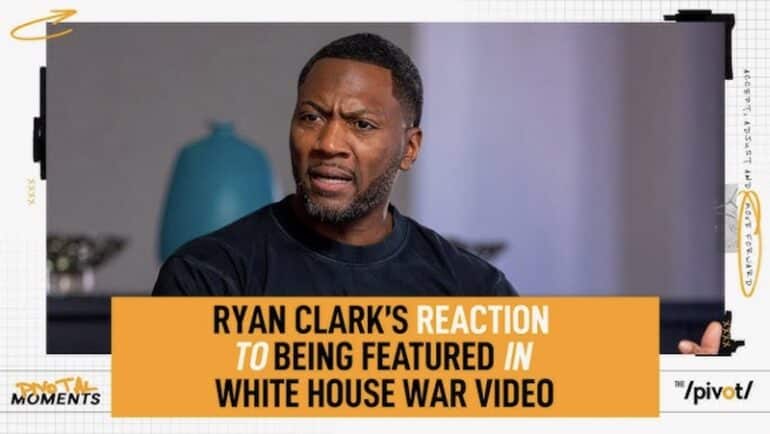
ESPN analyst and former Pittsburgh Steelers safety Ryan Clark didn’t find out he appeared in a White House social media video until reporters told him. What he saw left him furious — and he didn’t hold back.
On March 6, 2026, the official White House X account posted a video captioned “Touchdown.” It cut NFL tackles set to AC/DC’s “Thunderstruck” against footage of U.S. missiles striking Iranian targets, days after the U.S. launched airstrikes targeting Iranian military infrastructure following escalating regional attacks. Clark’s highlights were used without his knowledge or consent.
“The White House post involving myself and other NFL players is absolutely disgusting and despicable,” Clark said on The Pivot Podcast. “War doesn’t deserve a highlight film. War is not a comedy.”
https://twitter.com/WhiteHouse/status/2030051395294941427
The football video was one of roughly a dozen the White House published in the opening days of operations. Others riffed on Grand Theft Auto, Braveheart, Nintendo Wii, bowling, and SpongeBob SquarePants. The campaign, real warfare repackaged as a content carousel, drew condemnation from across the political spectrum.
‘It’s About What One Person Wants’
For Clark, who nearly died playing football, the offense wasn’t just personal. It was moral.
“There are families in this country whose loved ones have given their lives to fight for our freedoms,” he told co-host Fred Taylor. “They don’t see war as a sport.” He described the administration’s approach as “unserious, unprofessional, laughable, and illegitimate,” and said service members were being sent to fight “not for our safety as much as for someone else’s agenda.”
He also drew a sharp line between leadership and performance. “The reality star needs everybody to know at all times — look at me, look at the attention I’m garnering,” Clark said of President Trump. “We’re doing this for me.”
When asked whether he planned to demand the video be removed, Clark declined. He’d given up on the gesture. “I’ve learned about our leadership now. They don’t care about what we think. It’s about what one person wants.”
The Backlash Spreads
Clark wasn’t alone. Hall of Famers Ray Lewis and Ed Reed both stated publicly that they never approved their likenesses being used in the videos. Actor and director Ben Stiller, whose 2008 war satire Tropic Thunder appeared in one of the posts, was pointed: “We never gave you permission and have no interest in being part of your propaganda machine. War is not a movie.”
Clark found the Tropic Thunder inclusion particularly absurd. The film is a comedy about the hollow glorification of war. Using it to celebrate an actual war, he said, was the clearest possible window into how the administration views the whole thing.
The White House was unmoved. Press secretary Karoline Leavitt said the posts had generated over two billion impressions and called that the point. Whether any of the players, leagues, or studios gave permission for their content remains unanswered.
Clark’s larger argument was less about one video and more about what it reveals. When a government’s instinct in the middle of a war is to reach for a highlight reel, a cartoon, and a video game reference, it tells you something. Not about the military. About who’s in charge.
“War is not a comedy,” he said again, making sure it landed.
It did.