
Few players on rookie contracts demand NBA teams accelerate their timelines quite like Victor Wembanyama. Second-year players don’t approach MVP-caliber impact, but Wembanyama did for the San Antonio Spurs before a season-ending blood clot. A dominant two-way force commanding less than nine percent of their cap space presents a golden opportunity to sign other expensive stars.
This approach mirrors how NFL teams operate with great quarterbacks on rookie deals, weaponizing their added cap room to build a juggernaut. The Spurs began that process at last season’s trade deadline, shipping out some assets to acquire De’Aaron Fox. Landing the second pick in a loaded 2025 NBA Draft, granting them the chance to draft Dylan Harper, only expanded San Antonio’s options.
Throughout this offseason, the Spurs paused their aggression and prioritized optionality, only signing one new player in free agency thus far. A league-shifting, all-in move could come at some point but they have a promising enough young core to construct a roster around, despite some possible fit concerns among their feature pieces.
For the moment, the Spurs plan on building around Harper instead of moving him for another top-level player like Giannis Antetokounmpo or Kevin Durant. Harper’s high ceiling as an unstoppable slasher, interior scorer and playmaker render him worth building around as Wembanayma’s long-term running mate, even with Fox and the reigning Rookie of the Year, Stephon Castle, in the backcourt.
The Spurs dealt Castle the keys to the offense in year one, prioritizing his development as a creator; his usage rate (25.5 percent) placed in the 89th percentile league-wide last season. That creates natural questions about their plan for Harper, who spends the majority of his time with the ball in his hands.
While San Antonio spent a top-two pick on Harper for his primary on-ball potential, his underrated off-ball chops will help grease the connection with Fox and Castle. He certainly won’t eclipse a 30 percent usage rate like he did at Rutgers and scaling down off the ball will require adjustment.
despite low offball usage, dylan harper displayed the feel for spacing/timing, spot-up shooting and decisive driving requisite to play without the basketball at the NBA level
harper had to play on ball for most of his career but he will excel next to other stars at the next lvl pic.twitter.com/6NjtKPFEPe
— ben pfeifer (@bjpf_) May 14, 2025
San Antonio’s roster hasn’t changed much through free agency. That will pressure Harper and Castle to develop as 3-point shooters to boost a Spurs offense which ranked 19th (36 percent) in 3-point accuracy last season.
Julian Champagnie, Devin Vassell and Harrison Barnes space the floor on the wings, but it will be challenging for the Spurs to reach their ceiling with Fox, Castle, Harper and Jeremy Sochan as underwhelming shooters. Carter Bryant, whom the Spurs drafted 14th overall last month, finding a role as a 3-and-D disruptor could also help this problem. Yet teenage rookies rarely impact the game positively for winning teams.
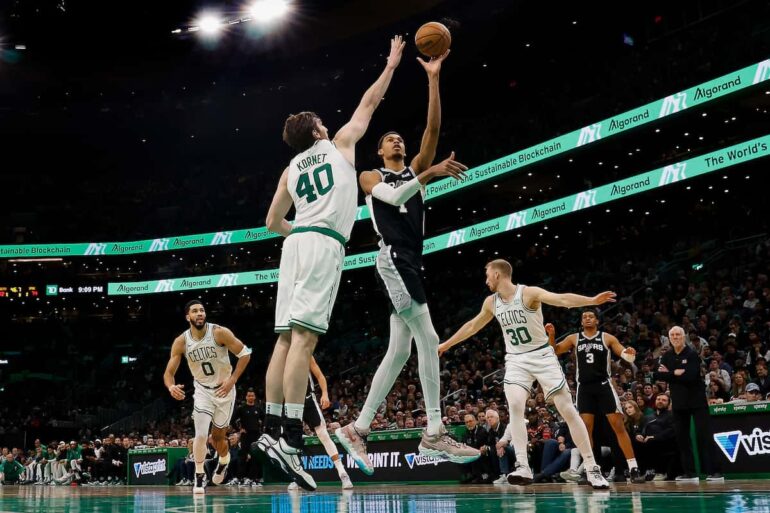
Though they haven’t added floor-spacers. Harper will benefit from the Spurs’ main free agent addition, former Boston Celtics center Luke Kornet. He’s an excellent complementary bigs in the NBA, creating value for Harper with powerful screening and connective passing. He and Wembanyama are both gifted big man passers, opening up plenty of synchronized movement and passing between the two centers.
i'm excited to watch the big-to-big passing between luke kornet and victor wembanyama next season in san antonio, kornet will be the best NBA big he's played with
among centers last season, kornet ranked in the 99th percentile for potential assists per minute. awesome processor pic.twitter.com/R87RM9sDQ5
— ben pfeifer (@bjpf_) July 1, 2025
Despite pedestrian counting stats (6.0 points, 5.3 rebounds, 1.6 assists per game on 68.1 percent true shooting), impact metrics deem Kornet one of the NBA’s better role players. Estimated Plus-Minus and DARKO both viewed him as a top-50 player in 2024-25. His scoring efficiency ranked 10th among NBA players last season and led the league in 2024 (73.6 percent true shooting).
Beyond Kornet’s status as an analytics darling, his presence will plug one of San Antonio’s leakiest holes in the (brief) Wembanyama Era. Without their wunderkind anchor on the court, the Spurs haven’t found a way to stay afloat defensively. Kornet presents a solution; the Spurs haven’t rostered a center nearly as impactful as him since Wembanyama’s arrival.
Through two seasons, with Wembanyama on the floor, a Spurs defense lacking overwhelming talent aside from him played like an above-average defense (2.0 points better per 100 possessions than the league average defensive rating). When Wembanyama sat, that defense plummeted to plus-6.2.
Charles Bassey, Bismack Biyombo and Zach Collins couldn’t approach Kornet’s impact as an interior defender. Opponents shot a staggering 11.9 percent worse than their average at the hoop with Kornet contesting last season, ranking ninth in the NBA. Wembanyama, of course, was one of the eight defenders more impactful at the rim (minus-13.6 percent).
Offenses will labor just to shoot at the basket against Wembanyama and Kornet. Last year, opposing units’ rim frequency dipped by 3.8 percent (92nd percentile) when Wembanyama was on the floor and fell 2.2 percent (82nd percentile) with Kornet on the court. Those two will force offenses away from the basket, dictating the areas they can and can’t attack.
defenses will struggle immensely to penetrate and score at the rim against luke kornet and victor wembanyama, both ranking inside the top 6 in rim pts saved/100 last season
so much potential for single and double big lineups with both fucntioning as anchors and roamers pic.twitter.com/gqWI9Y3d4t
— ben pfeifer (@bjpf_) July 4, 2025
Wembanyama’s unicorn versatility unlocks double-big lineups with Kornet, as his floor-spacing and ground coverage defensively mask the weaknesses of most traditional centers. Though Kornet primarily acts as a paint-bound finisher (73.2 percent at the rim last season), he began his career as a floor-spacer and the Spurs could tap into that.
While Kornet’s presence will boost the floor of non-Wembanyama groupings, we’ve seen double-big lineups post supercharged differentials. A second capable, portable big helps San Antonio match up with teams like the Houston Rockets and Oklahoma City Thunder, which often turn to two-center lineups.
Kornet’s athletic profile and statistical indicators paint him as a drop big, but a creative Boston defense sent him all over the floor. He spent 35.9 percent of his time on defense guarding centers last season, good for the fourth-lowest share among 42 centers.
Similar to the Celtics, San Antonio can pair roaming rim protectors with versatile perimeter defenders. Wembanyama and Kornet providing backline help will let Castle, Sochan and Bryant swarm offensive players out front.
The Spurs have created an ecosystem for young players like Bryant and Harper to thrive on both ends and still experience defensive development. Wembanyama, Kornet, Castle and Sochan should help San Antonio’s defense approach a top-10 ranking for the first time since 2018.
There’s no forecasting how far a healthy Wembanyama could carry the Spurs in his third season. Consensus seems to view Oklahoma City, Houston and the Denver Nuggets as the Western Conference’s three best teams. San Antonio, in its current state, could push toward that tier, mostly fueled by internal development.
If a trade too enticing to pass enters the picture, the Spurs have plenty of ammo to acquire a player like Antetokounmpo without gutting their entire roster. But the Spurs’ measured activity this offseason prioritized flexibility and growth around their young bedrock players. That should be good enough to take another step forward in this rebuild, led by Wembanyama and everything he brings.