
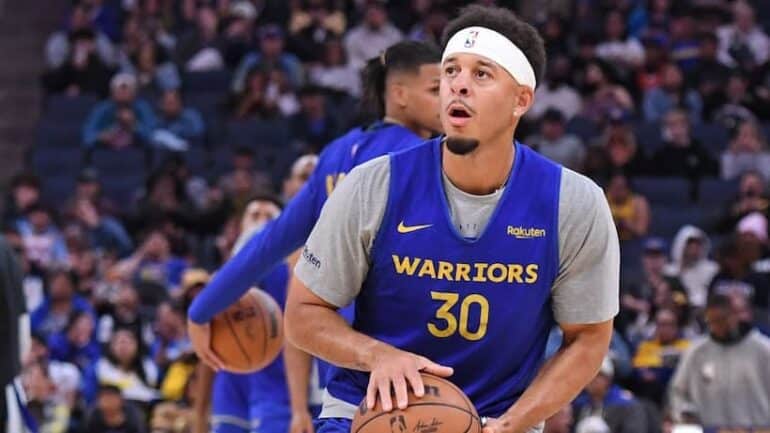
During the Golden State Warriors’ 124-112 defeat to the league-leading Oklahoma City Thunder — in a game they were threatening to rally back from — the newly acquired Seth Curry was inserted on the floor by head coach Steve Kerr, with his presence quickly evolving in notice through a sequence the Warriors sorely needed to happen.
With Jimmy Butler having the left side of the floor to operate, he makes his move and immediately draws multiple Thunder defenders toward him. It was this lowkey but somewhat pivotal moment that has defined the Warriors’ offense this season, through the lens of the difficulty it has had to face in terms of generating a consistent stream of points.
What Seth’s Debut Brought To The Warriors’ Offense
This season, the Warriors have had little to show for from these moments of advantage creation, most of which have taken the form of either a Butler perimeter/post isolation or Stephen Curry either drawing two to the ball or two off the ball, courtesy of running around one or multiple screens (and, occasionally, being a screen setter himself).
These advantages do manage to create open looks for Curry and Butler’s teammates; however, they have had trouble converting those looks. One need only to look at the discrepancy between the Warriors’ 3-point-attempt rate (46.5 percent, first in the NBA) and their actual 3-point-success rate (36.6 percent, 12th in the NBA) to realize the amount of missed opportunities that have plagued their offense.
With that in mind, when Butler’s drive draws attention and multiple defenders, it was a sight for sore eyes to see the Warriors actually take advantage of a defense scrambling in rotation. Butler initiates the swing-swing sequence when he kicks out to Gary Payton II on the left slot, who then swings the ball once more toward the man occupying the opposite slot area: Seth.

It is no secret shooting the basketball at an elite level is the defining trait of the Curry bloodline. Steph is the greatest to have ever shot the basketball, a skill inherited from Dell Curry, considered one of 90s basketball’s preeminent shooters. Despite being overshadowed by his more accomplished older brother, Seth is far from being a slouch himself in terms of shooting: 43.3 percent on threes for his career, which is actually a full percentage point higher than Steph’s career mark of 42.3 percent (with the caveat Steph averages more career attempts than Seth).
Curry’s Off-Ball Movement Vs. The Thunder
Seth profiles as not only a much-needed source of shooting talent on a roster seemingly in dire shortage of it (while continuing to shoot at an alarmingly high frequency) — it is also his ability to finish plays off of advantage situations that flashed its value against the Thunder. For the most part, his role will approximate the one he played in the possession above: convert open looks and slip through the proverbial (and literal) gaps created by Steph and Butler.
However, with Steph sidelined due to a quadriceps contusion and Butler having to sit out the second half of the game against the Thunder due to a sore knee, Seth had to somewhat scale up his role during his second-half minutes. In that regard, he was forced to pantomime his brother’s role as an off-ball mover and primary focus of half-court sets and actions, particularly as one-half of two-man actions that involved either a handoff or an away screen.
One of which was on one of the Warriors’ patented low-post split action — a set Kerr calls “5 Out” — through which Curry attempted his first three of the game. While Seth was well defended around the split-cut screen and wasn’t able to get a shot off (with the possession ending unceremoniously on a moving screen, representative of the team’s turnover woes this season), the thought process behind using Seth as a substitute for Steph was intriguing to witness:

Moreover, empty-side actions involving simple handoffs can become an occasional part of Seth’s offensive diet with the Warriors. An example occurs on the possession below, with Jonathan Kuminga intentionally seeking out Seth in order to execute a two-man dance. It allows Seth to turn the corner and score up close (peep at the “Pistol” screen Seth initially sets — truly, much like his older brother):

The Thunder — which are typically excellent with screen navigation, as is expected of the league’s best defense (allowing a stingy 104.3 points per 100 possessions, six points better than second place) — need to be nearly perfect when defending a dangerous movement shooter such as Seth. One slip-up, such as during this empty-side dribble handoff by Payton for Seth, can have massive consequences:

Chasing Seth around dribble handoffs and away screens with a single defender — without committing the screener’s defender to a more aggressive step up — is one poison defenders have to choose. The other, as mentioned, is sending two to the ball around the screen. Again, these choices are not dissimilar from the conundrum defenses are faced with while defending Steph.
When the Warriors take the ball on the sideline, they execute one of their go-to sideline out-of-bounds (SLOB) sets: “Quick” action, which is a simple away screen by Payton for Seth coming from the right corner. When Chet Holmgren chooses to lift up to take away shooting space, Seth makes the read to the rolling Payton. Even while the pass is a beat late — allowing Jalen Williams to rotate on the backside — Payton still manages to get the ball in the hoop:

Is It Enough To Fix The Warriors’ Woes?
These quick-hitting actions are paramount in the fact they all are decisive and incisive, unlike most of the Warriors’ half-court actions that have been plagued with indecision.
Per inpredictable, the Warriors tout one of the highest average times elapsed before a shot is put up (12.0 seconds, 26th in the NBA). That’s a marker of how often their primary and secondary actions/progressions have been ineffective at generating points, including whenever Steph and/or Butler are on the floor. While Seth is far from being the ultimate solution to such woes, he — along with the returning De’Anthony Melton — are bolstering a two-guard rotation that has revealed itself as a major roster weakness.
Time will only tell if their return will be enough to boost the Warriors. But at this juncture of the season, they will take whatever help they can get.