
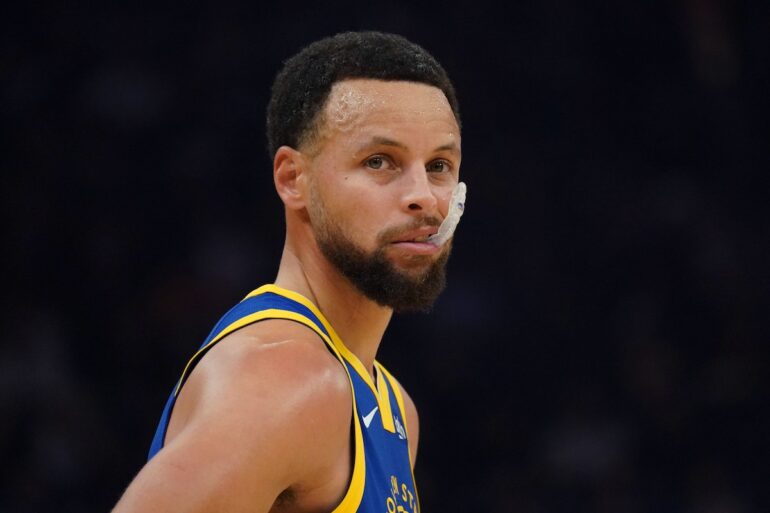
In what was a dominant victory by the Golden State Warriors over the Portland Trail Blazers, Stephen Curry was anything but. Finishing the game with seven points on 2-of-9 shooting, Curry darted around the floor with heavy legs and a somewhat lethargic cadence to his movement — perhaps, a natural consequence of being a 37-year-old who turns 38 in two months.
That isn’t to say Curry contributed nothing to the Warriors’ victory over the Blazers. He finished the game with 11 assists, one of which came on a possession during the 1:30 mark of the second quarter. With the Warriors running a high pick-and-roll for Curry, Draymond Green comes over to set a drag screen for his decade-long partner in crime, with Jimmy Butler sauntering toward the right wing, rookie Will Richard occupying the right corner and Brandin Podziemski stationed in the left corner.
Curiously, Butler opts not to park himself on the right wing. Rather, he continues toward Richard and runs past him, in an effort to cut along the baseline and clear toward the opposite side of the floor. Additionally, not parking himself at the wing meant both wings were unoccupied, clearing any potential driving lanes for Curry in the process.
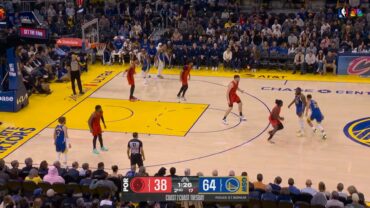
After Green changes the direction of his screen a couple of times, Curry finally makes his move by driving to his right, all while Butler moves toward the baseline and Richard lifts ever so slightly farther from the corner and closer toward the wing. With Donovan Clingan playing a high drop of sorts and Jrue Holiday chasing over the screen, Shaedon Sharpe — guarding Richard — has a choice to make.
- Stay home on Richard, potentially allowing Curry to turn the corner on Clingan toward the rim and putting pressure on Toumani Camara to help, which would leave Butler open.
- Help off of Richard on the strong-side corner, making Curry’s read on the drive a one-pass-away endeavor.
Sharpe chooses option two, with Curry virtually having three defenders actively guarding him on his drive. However, Sharpe loses eyes on Richard, who stops short of his lift toward the wing. Sharpe is in no position to recover in a timely manner on the pass, leaving Richard (shooting a respectable 38.1 percent on threes this season) with an open look:

Having Clingan commit to a conservative coverage with Sharpe providing additional help is somewhat of an unusual coverage choice against Curry, who typically sees two to the ball around most screens set for him. On another high pick-and-roll possession — with Al Horford setting the screen, Podziemski occupying the left corner, De’Anthony Melton trailing toward the right wing and Gui Santos parked in the right corner — the Milwaukee Bucks opt to send two bodies toward Curry.
As is often the case when it comes to these aggressive coverages, the rationale is teams would prefer the decision-making and scoring opportunities come from any other Warrior not named Curry — which, in the process, prompts Curry to pass to Horford in the short roll, while Gary Harris sticks close to Podziemski in the corner, with the need to help off eliminated, due to the on-ball coverage.
However, take note of the change in positions of the two weak-side players: Melton occupying the dunker spot and Santos lifting from the corner toward the wing:
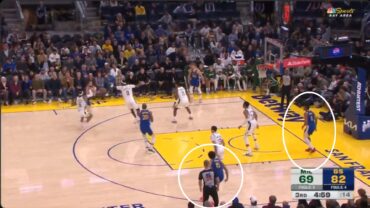
With Horford getting the ball on the short roll, a simple glance toward Melton in the dunker spot moves Ryan Rollins away from Santos on the wing, prompting Horford to kick out to the Brazilian forward. This triggers an additional rotation: Gary Trent Jr. helping off of Curry from the opposite wing toward Santos, who then sees the open Curry at the top of the arc.
More often than not, the sight of an open Curry is the death knell of a defensive possession:

What do the possessions above mean with regard to Curry’s 2025-26 season? At 37 years old, Curry’s impact on the floor remains at a level worthy enough to be considered among the league’s absolute best, despite being well past his physical and athletic peak — a distinction worthy of consideration to be selected as an All-Star starter in the Western Conference.
The Statistical Case For All-Star-Starter
Many have compared Curry’s current season to that of Minnesota Timberwolves guard Anthony Edwards, the latest as a result of a nitpicking exercise over who deserves the theoretical final spot in the Western Conference’s All-Star starting lineup. Make no mistake — both Curry and Edwards are having All-Star-caliber seasons; putting one over the other as a starter shouldn’t garner any wild disapproval (that is, outside of their respective rabid fandoms).
I’m not here to disprove Edwards’ claim but instead to make the case for Curry’s selection. Averaging 31.8 points, 4.2 rebounds, and 5.1 assists per 75 possessions, Curry is putting up a true shooting percentage 6.1 percentage points higher than league average (i.e., a relative true shooting percentage — rTS% — of 6.1). Contrast those numbers with Curry’s last season, in which he was selected as an All-Star starter: 26.9 points, 4.9 rebounds and 6.6 assists per 75 possessions, on an rTS% of plus-4.2.
Moreover, the impact he provides with regard to his teammates’ shot quality has been stratospheric. BBall Index’s proprietary statistic that measures a player’s offensive impact affecting teammate shot quality has Curry ranked in the 99th percentile and second overall league-wide. The numbers wholly support the eye-test evidence and vice-versa, as the aforementioned possessions have shown.
(However, Curry’s teammates have not been converting on such looks at a consistent rate. Per BBall Index’s Teammate Overall Shot Making metric, Curry ranks 278 out of 280 players.)
Per Dunks & Threes’ Estimated Plus-Minus metric (EPM), Curry (plus-5.5) is sixth in overall EPM, with an offensive EPM (plus-6.4) that is fourth, behind only Shai Gilgeous-Alexander, Nikola Jokić and Giannis Antetokounmpo.
Taking all of these numbers into account, Curry’s case for being a starter boils down to this reasoning: at an age where the majority of NBA players have long since declined from being impactful contributors, Curry is still providing All-Star-level impact — let alone, All-NBA-level impact — despite being surrounded by a supporting cast that has, in the aggregate, failed to take advantage of the shot quality he creates almost as naturally as breathing, using the gravity he generates on virtually every offensive possession in which he is involved.
Curry’s Evergreen Gravity
As soon as the NBA released its proprietary metric measuring a player’s “gravity” — that is, how much a player pulls defenders towards them above a certain baseline amount — many expected Curry to be at the forefront of the list. Lo and behold, as of this writing, Curry does indeed lead the NBA in overall gravity.
In particular, it is Curry’s gravity off the ball comprising the bulk of his overall gravity ranking. Despite shooting “only” 38.8 percent on threes this season — which, excluding his 2019-20 season when he played five games, is on track to be the second-lowest 3-point percentage of his career — teams continue to defend Curry based on reputation rather than form (as they should).
That has led to quintessential possessions of chaos and confusion, often involving Curry drawing multiple defenders while running off of screens. On a baseline out-of-bounds (BLOB) set called “Triangle” that involves screen-the-screener action, Curry sets the screen for Moses Moody to cut toward the basket, before coming off of a screen toward the wing by Quinten Post. The Atlanta Hawks switch the initial screen but opt to send two toward Curry around the subsequent screen, leaving Post open on the slip toward the rim:

The example above was a rare instance of a clean switch against Curry (at least, during the first screening maneuver by Curry). However, most instances have involved confusion at the point of the screen, in which a screener causes havoc simply by slipping the screen. Curry’s defender is hesitant to switch off of him, while the screener’s defender jumps out to take Curry around the screen. That leaves the screener open on the slip, where either he has an easy layup or creates an open shot for another teammate:

Despite having a teammate literally named “Moses,” Curry has been the Warriors’ figurative Old Testament prophet through the manner in which he parts the defensive waters for his teammates to reach the promised land that is the rim:

While fully understanding All-Star selections are fundamentally a popularity contest, there is plenty of empirical and statistical evidence to support the campaign for Curry being a starter for what would be the 11th time in his career, out of 12 total selections. In all likelihood, Edwards may have Curry beat in that regard, an accolade the 24-year-old guard would wholeheartedly deserve.
But if narratives and storytelling are what voters would take into account when it comes to voting starters in, the idea of a legendary guard in his twilight years proving he can still hang with the young guns— let alone, even best some of them in terms of impact — is too good of a story to pass up.