
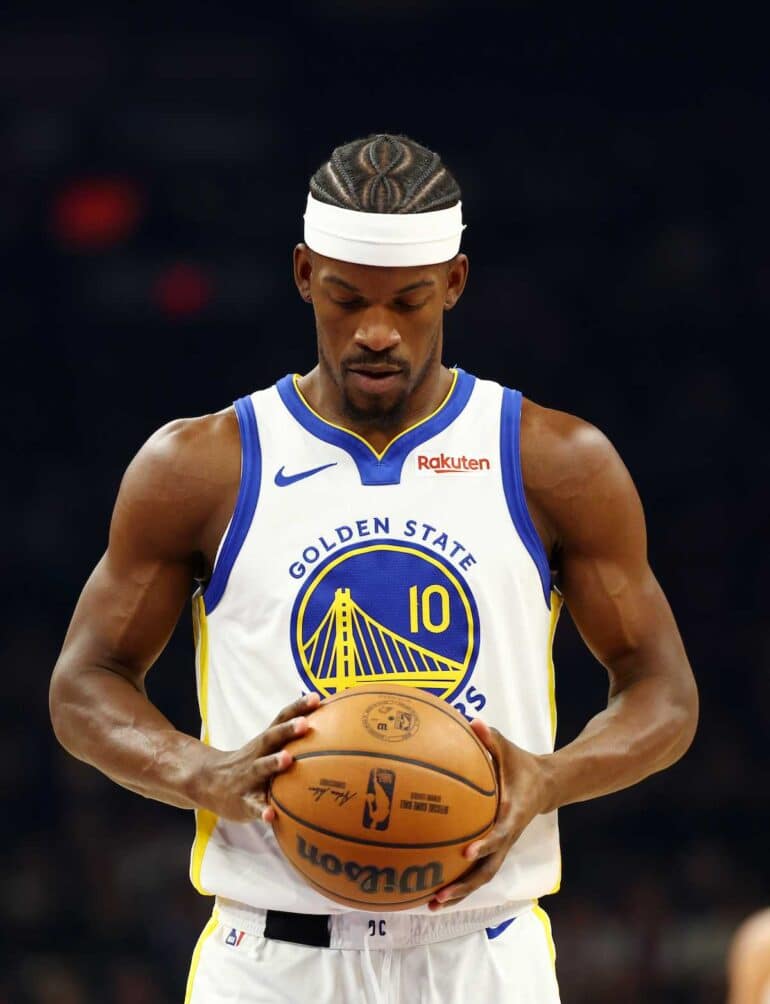
The play developed with the speed and pace of a fortuitous flash of lightning.
With just under two minutes left in the seventh vs. eighth seed game of the 2025 Western Conference Play-In Tournament, the Golden State Warriors were holding on to a precarious two-point lead over the Memphis Grizzlies. With Jimmy Butler bringing the ball up along the sideline, Stephen Curry positioned himself at the nail, closely guarded by Scottie Pippen Jr. Seemingly uninvolved save for being a “spacer” of sorts, Draymond Green parked himself on the left corner, “guarded” by Zach Edey, who chose to position himself close to the rim in lieu of worrying over the non-existent shooting threat that Green represented.
Almost simultaneously as Butler begins his move to his right, Curry lifts slightly from the nail toward the top of the key to set an “inverted” ball screen on Desmond Bane. Worrying about the possibility of Curry “ghosting” or slipping into three-point space, Pippen chooses to maintain contact with Curry instead of switching onto Butler, who shakes off Bane with help from Curry’s screen. With Butler given a straight-line drive toward the rim, Edey steps up to act as the last line of defense, remaining unbothered by a potential kick-out to Green in the corner.
As expected, Butler does indeed spray the pass to Green in the corner — but not for Green to shoot what would be an open three, a shot attempt the Grizzlies would be content to acquiesce. Instead, the Grizzlies find themselves falling into a perfectly concocted trap that the trio of Butler, Green, and Curry had lured them into — hook, line, and sinker:

At the time, Butler was still a relative newcomer, new to the whims and preferences of Curry and Green, both of whom have a connection rivaled by few duos in the history of the NBA. To insert a third man not named Klay Thompson into their tandem would risk disturbing the mind meld that has been at the forefront of the Warriors’ dynasty.
But as the thunderous outcome of the sequence above displayed, Butler wasn’t just a non-disturbance — he was an enhancer of the chemistry between Curry and Green, providing a north-south element that boosted the east-west movement that comprised Curry’s dash toward the corner, receiving Green’s flip of the ball in the process, and pulling up for a three that would secure their spot in the playoffs.
It had seemed, at very long last, that the Warriors had found the elusive second fiddle to Curry in the post Kevin-Durant era, a sidekick who could very well play the role of main character, the Watson to his Holmes but with equal amounts of incisiveness required to deduce outcomes from the smallest of details. It was a calculated risk, one that could pay dividends if they played their cards right.
For a time, the Warriors did play their cards right. They overcame a young Houston Rockets team in the first round and would’ve had a shot to advance to the Western Conference Finals if not for an untimely Curry hamstring strain. They retained Butler — given the extension he was seeking — for a full training camp. Despite a slow start to the season, the Warriors had won 11 of their last 15 games heading into their tilt against the Miami Heat, with momentum that was steadily building toward a crescendo.
But all of it was, in the end, a fleeting flash of lightning, a crest that toppled them toward a trough of dismay and disappointment — all because of a rather unfortunate landing on what was an otherwise routine sequence.
A Feat That May Never Be Replicated
For the majority of Curry’s tenure as the featured superstar of the Warriors dynasty, one problem has always plagued head coach Steve Kerr and his staff: surviving the minutes in which Curry had to sit down. From the 2014-2015 season to the 2020-2021 season, the Warriors torched opponents in Curry’s minutes, outscoring them by a combined 14.2 points per 100 possessions. In the minutes Curry had to sit down, however, the Warriors were outscored by 2.6 points per 100 possessions — a monumental difference of 16.8 points per 100 possessions.
Things were slightly better from the championship season of 2021-2022 up until the 2023-2024 season: from a plus-6.5 point differential with Curry to a minus-0.2 without him.
Butler’s mid-season acquisition during the 2024-2025 season wasn’t enough to tip the scales, with the Warriors outscoring opponents by 5.6 points per 100 possessions in Curry’s minutes and being outscored by a point per 100 possessions without him. Kerr was also in the process of tinkering with lineups and seeing which combinations brought the best out of the minutes in which Butler was the featured offensive player.
It took Kerr time to find the perfect blend surrounding Butler. Despite being a perfect fit in an offense that preached ball and personnel movement, he was at his utmost brilliance as an isolation and pick-and-roll ball handler surrounded by shooting and given plenty of space to work with. The Warriors obtained what Butler needed most during the offseason, in the form of De’Anthony Melton (a secondary ball-handling guard with defensive chops), Al Horford (a floor-spacing five), and Will Richard (a high-basketball-IQ rookie).
With Melton and Horford, the full arsenal of Butler’s offensive repertoire was unleashed — from having the option to spray passes to capable spot-up shooters:

To having clear driving lanes produced by the threat of spot-up shooting that enveloped him:

The trio of Butler, Melton, and Horford formed the backbone of the Warriors’ 2025-2026 second unit, one that not only survived the minutes without Curry and Green on the floor — it thrived and became a force of its own. In 74 non-low-leverage minutes, this configuration outscored opponents by a whopping 16.3 points per 100 possessions, with an offensive rating (123) better than the best offense in the league (the Denver Nuggets’ 121.5 offensive rating) and a defensive rating (106.7) that would rank second behind only the Oklahoma City Thunder (105.2 defensive rating).
In the aggregate, the Butler-only minutes proved to be lightning captured in a bottle, a fortunate circumstance that was ultimately a flash in the pan, an occurrence that is more than likely impossible to replicate. In 568 non-low-leverage minutes of Butler on the floor without Curry, the Warriors outscored opponents by 9.6 points per 100 possessions — a previously unheard-of number. For reference, Durant lineups without Curry from 2017-2019 could only muster a point differential of plus-3.0.
Not to mention, Butler’s low-turnover nature and knack for drawing contact were highly valued traits for a team that has an excessive turnover problem and has had minimal success getting to the free-throw line. This season alone has been proof: from a sixth-percentile turnover percentage and sixth-percentile free-throw rate team with Butler off the floor, they transform into a 57th percentile turnover percentage and 82nd percentile free-throw rate team with Butler on the floor, per Cleaning the Glass.
Butler represented a rare player profile that doesn’t readily grow on the proverbial NBA tree. No mistake-free player exists, but Butler was arguably the closest to that ideal. He was the ultimate connector, capable of bridging the gap between advantage creation and play finishing. Yet he also was capable of both creating advantages and finishing plays. The former shined brilliantly during his lone minutes as the team’s offensive engine, while the latter was a much-needed weapon unleashed by having one of basketball history’s greatest advantage creators as a teammate. Such was the value that Butler brought to them by being an extremely scalable star whose unicorn nature lay not in outlier athleticism or physical traits, but in his ability to maximize his team’s possessions while also boosting his team’s shooting efficiency.
And I haven’t even mentioned his defense — highly disruptive, with schematic intelligence and preternatural instincts that have become hallmarks of his stopping ability:

These traits combined to formulate the profile of a player who, at 36 years old, can be considered a top 15-20 player in the NBA. Several advanced all-in-one metrics agree in that regard: 13th in Estimated Plus-Minus (plus-4.4), 12th in Box Plus-Minus (plus-5.5), 19th in DARKO Plus-Minus (plus-2.8), and 16th in Regularized Adjusted Plus-Minus (plus-3.7).
Butler’s presence and positive impact, while leading the Warriors to a string of wins after a bout of struggle, also gave the team incentive to further surround their core with supporting personnel that could’ve launched them into bonafide championship contention. With Butler’s ACL injury, not only will the on-court product suffer and revert to the dark ages of a team counting on Curry to perform superhuman feats (the Warriors have been outscored by five points per 100 possessions without Curry and Butler on the floor) — they’ve lost what leverage they had in trade talks, placing them in a moment of reckoning that could herald the final nail in the coffin of the Curry era.
Where Do They Go From Here?
The Warriors will have just over two weeks before the February 6 trade deadline to decide how to proceed with Butler and his contract, as well as the situation concerning the embattled Jonathan Kuminga. Butler has two years remaining on his contract: $54.1 million owed this season, $56.8 million owed next season. Warriors’ general manager Mike Dunleavy Jr. has stated that he has no intention of trading Butler this season, stating a preference for waiting for Butler to complete rehab and return next season.
While that may seem like a sound strategy, the risk is magnified considering the team’s current predicament. Curry will turn 39 years old next season in a league that is becoming more unforgiving toward its older stars. He continues to provide positive impact this season, but without an equally impactful running mate, there is the danger of his decline being accelerated — to the point where it may be too late.
Butler’s theoretical return to the Warriors will come a full year from now, halfway through the 2026-2027 season, during which he will be 37 years old. History — backed by medical studies — hasn’t been kind to aging players returning from ACL injuries. The odds heavily skew against Butler, and therefore, skew heavily against the Warriors.
In all likelihood, all the Warriors will have left is to trade Kuminga, their trove of draft picks, or both. But even that seems like an exercise in futility, with the need for a second scorer alongside Curry resulting in Kuminga being re-inserted into the rotation. While Kuminga is indeed an NBA-level player, he will find it difficult to be a facsimile of Butler — nor would it be fair to expect him to scale up to that level.
Thus, the Butler era in Golden State — in all likelihood — comes to an unceremonious and tragic end. Its consequences will be profound for a team that has attempted to stave off its dynastic death for as long as it could. The end will certainly come at some point; Butler’s acquisition delayed that end, with the intention of extending the Curry era for at least two more seasons.
But with an injury that happened as quickly as a bolt of lightning, whatever was left in their bottle of fortunate circumstance has fizzled out, with the Warriors left with nothing but darkness at the end of a long tunnel.