
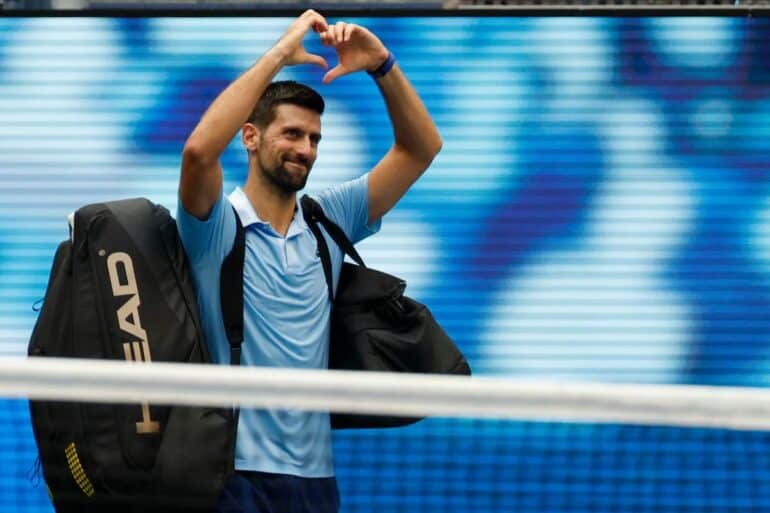
Novak Djokovic is still motivated to win another Grand Slam no matter how unlikely Carlos Alcaraz and Jannik Sinner make it seem.
In what is considered a down year for the 24-time Grand Slam champion, Djokovic went 4-1 against Alexander Zverev, Taylor Fritz, Alex de Minaur and Lorenzo Musetti — all players currently in the top 10. The only defeat came when he was forced to retire due to a hamstring tear.
He made the semifinals of all four Majors and the main stain on his resume is a 1-3 record against Sinner and Alcaraz.
“I’m happy with my level of tennis, it’s just the physicality of it,” Djokovic said. “It’s something at this point in time in my career I can’t control. I can do only as much as I can do and, yeah, it will be very difficult for me to overcome the hurdle of Sinner, Alcaraz in a best-of-five at Grand Slams.
“I think I have a better chance in best-of-three but best-of-five, it’s tough. I’m not giving up on Grand Slams in that regard. Having said that, I’m going to continue fighting, try to get to the finals and fight for another trophy at least.”
Venus Williams just played the US Open at 45. She may not be accustomed to getting the results she is now but she still loves competing at this level. As long as Djokovic is having fun — which he said he is — there’s every reason to.
Can the 38 year old still find a way to another Major trophy? Let’s take a deeper look.
What’s Changed With Djokovic?
To figure out if and what needs to happen for Djokovic to win another Major, we need to understand where he is right now.
There are two key markers of Djokovic’s decline: his endurance and return game.
Over the last two years, Djokovic has sustained a torn meniscus at the 2024 French Open, a torn hamstring at the 2025 Australian Open and and an adductor injury at 2025 Wimbledon. He is clearly running out of gas the deeper into a Slam he goes. He has won 60 of 70 sets played leading up to the semifinals and lost all 10 sets he’s played in the semis.
Ever since sorting out a severe gluten problem in 2011, Djokovic has been the epitome of both mental and physical endurance not just in tennis but across sport. To see him look this physically weary is jarring. It’s also the reality of a man who has pushed the limits of his body to now age 38.
Then there’s his return game which was once unmatched. Djokovic created only one break opportunity in his US Open semifinal against Alcaraz. Sinner had a streak of 45 consecutive games holding serve against Djokovic that ended at this year’s French Open. Over the course of his prime, Djokovic won around 43% of the return points he faced. This year, he sits at 40.3% which is his lowest mark since 2007.
It may sound like a small percentage change but that’s the difference between being No. 3 and No. 1.
Being unable to put pressure on opponent’s serves has also impacted his usually pristine tie break record. Even as recently as 2022 and 2023, Djokovic had a combined record of 50-13 in tie breaks. In 2024 and 2025, he has gone 18-19 including just 1-6 in his last seven tie breaks.
He needs his clutch factor back.
Can Djokovic Be Fitter In 2026?
One of the biggest conundrums Djokovic now faces is striking the balance between match fitness and match freshness.
Between 2011-2016, Djokovic averaged just over 80 matches per calendar year. More recently between 2018-2023, he averaged around 60 matches per year. The Serb played just 45 matches last year and currently sits at 38 for 2025.
“I have to address that with my team,” Djokovic said when asked if he’d enter more best-of-three tournaments. “That’s the sentiment, definitely, after the Grand Slam season this year. Not to say that I will skip Grand Slams, I still wanna play the full Grand Slam season next year.”
Djokovic played just seven tournaments this year outside the Slams. What didn’t help matters was failing to go deep in a number of them. He lost before the Round of 16 in Doha, Indian Wells, Monte-Carlo and Madrid. He needs to go deeper in these tournaments to get his legs under him. At the same time, he needs to put in enough work to ensure his body doesn’t break down when playing.
It’s crucial that Djokovic plays at least a couple of the remaining tournaments this year between the Shanghai and Paris Masters as well as the ATP Finals. So far, he’s only committed to an Athens tournament which has replaced the tournament he used to play in Belgrade.
He is not playing in the Davis Cup nor the Laver Cup.
Can Djokovic Evolve In 2026?
Fitness is one thing, but Djokovic likely needs to modify aspects of his game to get back to the top.
He can draw inspiration from Roger Federer in this regard. The Swiss legend went four years without a Major title between the ages of 32 and 35 and then reinvented himself. He became even more aggressive and added the SABR (an uber aggressive return strategy). The result was three Major titles across 2017 and 2018 as well as two semifinals and a final at 38 and 39.
Can Djokovic adopt a more aggressive playing style moving forward? It would certainly preserve his body better than grinding out as many points as he does. His ball striking is still as pure as it gets, it’s more a question of how long it can last.
If he is going to win another Major, Djokovic has to find a way to get his return game back to an elite level. In recent times, he doesn’t seem to be reading and reacting as quickly and that may just come down to age. Does he need to tinker with his return position?
These are the things he’ll need to explore.
Djokovic’s first serve has generally still been very good but it’s his second serve that is being punished more often. When he defeated Alcaraz in Melbourne earlier this year, he won 58% of his second serve points. In New York, that number dropped to 48%. When Djokovic lost to Sinner in straight sets at Wimbledon, that number was a miserable 17%.
What Is The Path To No. 25?
Ken Rosewall was 37 years and two months old when he won the 1972 Australian Open. He is the oldest man to win a Major in the Open Era. That means Djokovic is looking to become the first man 38 or older to win a Grand Slam title.
The odds are clearly stacked against him and he’ll need the stars to align.
Djokovic is effectively playing a bit of a lottery at each Major. He needs both his body and level of tennis to last two weeks, and perhaps have someone upset Sinner or Alcaraz if not both along the way. The Serb will surely remember how Federer got the slice of luck he needed in 2017.
Djokovic and Andy Murray were the top seeds in Australia that year. However, both were shocked before the quarterfinals as Federer marched to his 18th Major after going 17 Slams without a trophy. At the following Wimbledon, Djokovic and Murray were both eliminated in the quarters while Nadal exited in the fourth round. Federer did what he needed to do once again in beating everyone in front of him.
At the end of the day, that’s why they play the game. Despite the dominance of Sinner and Alcaraz over the last eight Majors, there are no guarantees that things will play out exactly the same way next year.
On the other side of the coin, it’s entirely plausible Djokovic’s level slips further. Instead of finding a way to ascend, he may fall behind the likes of Zverev and Fritz.
Ultimately, it all makes for a fascinating final chapter in Djokovic’s career. Back where he started trying to better than third place, only this time with the comfort of knowing he’s been the last man standing more than anyone.