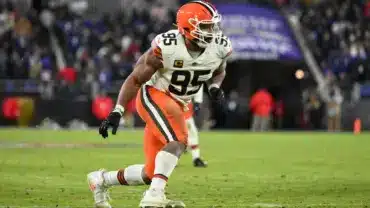

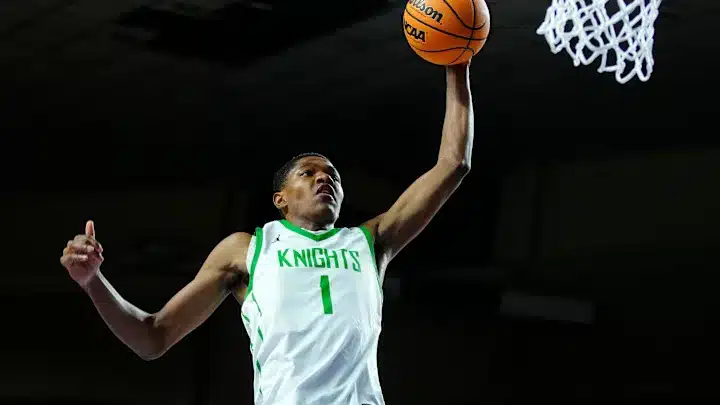
While the 2026 high school class doesn’t feature as many high-end star prospects as other classes, there’s plenty of exciting talent for programs to pursue. This piece will feature my top 25 prospect ranking for this high school class, with full write-ups on each prospect (updated as of October 4th with 12-25).
Even without obvious stars, productive college and NBA players will inevitably develop from this draft class. The orders of different rankings may vary more widely than usual, as prospects in this class are more closely grouped than many other high school classes.
For this top-25 ranking for the 2026 high school recruiting class, we’ll order players based on their long-term NBA potential. Players will shift based on their play throughout the high school season, so this ranking can function as a benchmark after the summer and before the season starts in full.
1. Dylan Mingo, Guard, October 2008
Consensus rankings for the 2026 high school class almost unanimously feature Tyran Stokes as the top player in the class and have for multiple years now. Dylan Mingo, who ranks seventh in 247’s composite class rankings, snagged the top spot on my rankings. For the moment, defense is Mingo’s specialty; he’s averaged at least two steals per game in every AAU and high school setting over the past year.
Listed at 6’5 with a reported 6’10 wingspan, Mingo’s physical tools resemble elite NBA wing defenders. Mingo leans on special lateral movement and reflexes to shut down opposing perimeter stars, guarding point guards and bigger wings with similar efficacy. His length facilitates his turnover creation via pass-lane jumping and high-level off-ball rotations.
As stellar as Mingo’s defense is, top-ranked perimeter players, especially guards, must project as strong offensive players. Mingo’s offense will require significant development. In 13 EYBL games this summer, he averaged 17.8 points and 2.5 assists per game on 52% true shooting and made 22.5% of his threes.
On-ball centric guards without reliable jumpers often struggle to translate at the college and NBA level. Why do I have Mingo atop his class, then, and ahead of the widely-touted Stokes? While I view the top-three players in this class interchangeably, Mingo’s blend of age, physical tools and feel for the game are all positive signals.
Mingo is a year younger than Stokes (and our third and fourth-ranked prospects) and given the vast differences in mental and physical maturity at the high-school level, I value his youth greatly. His physical tools fuel impressive driving upside, evidenced by Mingo’s excellent 57% free-throw rate and 38.1% half-court rim frequency.
His flexibility and bend are Mingo’s most unique driving traits, generating deeper leverage than most defenders can handle. Even against shorter defenders with lower centers of gravity, Mingo’s ability to hinge his torso near parallel to the ground creates consistent advantages, allowing him to draw a foul here:

A usually loose handle, which forces frequent early pickups, paired with poor functional strength, means Mingo isn’t an efficient slasher yet. He’s still able to generate consistent paint touches, though, even with these obvious weaknesses. When Mingo can dip his shoulder beneath almost any defender, it’s hard to keep him from the basket:

Young, lanky perimeter players often struggle with balance, ball control and shot selection, but these traits often improve with time and physical development. Mingo’s flexibility and burst, however, are valuable for how challenging they can be to develop and he has them from a young age.
Despite Mingo’s clear driving promise, he must balance that slashing with outside shooting development. Underwhelming 3-point volume and efficiency, coupled with clunky shot mechanics, give Mingo plenty of room to grow as a shooter, though he hovers around 75% at the line and made 37.4% of his 91 3-point attempts this past high school season.
He’s a promising playmaker, sporting live dribble vision and passing chops with both hands and a growing understanding of how to capitalize on his driving gravity. Mingo’s offense is a significant projection, but Mingo’s baseline of physical tools, athleticism and two-way production make him my top player in an underwhelming class.
2. Tyran Stokes, Forward, October 2007
Stokes, the consensus top prospect in the 2026 class, builds an obvious case as the best player in this group. He looks the part of an NBA wing, standing at 6-foot-7, 230 pounds with a seven-foot wingspan. After bursting onto the prospect scene as a 15-year-old, Stokes dominated EYBL’s 17u circuit in 2023 and maintained elite production for the next two summers.
Despite breaking out early, Stokes’s development has stagnated over the past year, though he still excelled in EYBL play. In 17 games this summer, Stokes averaged 22.4 points and 3.7 assists per game on 58% true shooting, eviscerating high school opponents as a slasher.
Few high school players match Stokes’s athletic and physical tools regardless of their age or size. He’s a powerful straight-line athlete, blending an elite first step and vertical explosiveness to consistently touch the paint. Stokes attempted 38.5% of his half-court shots at the rim at an excellent 61.1% clip and sported a dominant 69% free-throw rate.
He’s a bowling ball moving downhill, clobbering through defenders in his way to the basket. Stokes flashes occasional moments of handling brilliance, changing directions and snaking his drives, though he primarily drives in straight lines and at one speed. To dominate as a driver at the next levels, he’ll need to diversify his approach.
Stokes’s immense talent with the ball projects him as a special slashing prospect when everything gels together. In his best moments, where Stokes blends his scoring gravity, ball-handling and passing, it’s easy to envision a high on-ball creation ceiling.
threw together a few tyran stokes passes i enjoy from this summer. he continues to showcase impressive vision and anticipation at times as a playmaker even if there’s plenty of refining to do. pic.twitter.com/BuoQGET55u
— ben pfeifer (@bjpf_) September 7, 2024
Ability isn’t Stokes’s major concern; rather, his consistency, motor and intensity, which wax and wane more than scouts and coaches would like to see. While this most consistently limits his defensive impact, Stokes too often settles for difficult pull-up jumpers instead of his bread-and-butter drives.
Stokes is an efficient shooter off the catch at this stage of his development, making 51.3% (41-80) of his spot-up 3-point attempts across his previous 47 games. He’s an incredibly inefficient pull-up shooter, though, making 25.4% of his off-dribble twos and 20.3% of his threes over that same sample.
Off-dribble shooting efficiency often increases with age and low numbers aren’t glaring red flags, but Stokes likely must reach a high efficiency bar with his current tendencies. Too many of his offensive possessions look like this, idling with the basketball before rising into a contested off-dribble jumper, often early in the shot clock:

His inconsistent motor and awareness more frequently show up on defense. Stokes generates a solid 2.8 stocks per game, leaning on his exceptional tools for defensive impact. While elite physical tools often project defensive excellence, he must improve significantly as an off-ball defender to reach his ceiling.
Earlier in his career, Stokes expended much more defensive energy, but doesn’t show much defensive effort now. He’ll often ball watch and let his man cut in front of and behind him and doesn’t often switch onto quicker defenders despite possessing the tools to do so.
Stokes’s weaknesses make it challenging to project him forward. It’s certainly possible I’m overthinking his evaluation and talent wins out, but his motor and feel for the game on both ends are notable concerns with murky development avenues. Stokes has no doubt top-pick potential, but his variance and range of outcomes are wider than most players of his caliber.
3. Arafan Diane, Center, November 2007
Diane is the closest this class comes to a one-man offense. He’s a lethal post creator, posting historic efficiency as a scorer and counterbalancing with snappy processing out of double teams. True seven-footers with Diane’s skill, feel, size and coordination aren’t frequent in the modern era of stretched-out bigs, but unique players often become stars.
His defense is a limiting factor to that ceiling, as his massive frame causes inherent limitations as a perimeter defender. Diane’s shot-blocking motor isn’t always consistent, resulting in lower block numbers than his athleticism and size suggest. Offense is the primary driver of this aggressive top-three ranking and his size and rebounding open doors to defensive impact.
For more in-depth analysis on Diane, read our breakdown here.
4. Caleb Holt, Wing, November 2007
After multiple seasons playing up an age group or two, Holt has refined his skillset and developed into the class’s premier two-way wing. Standing at 6-foot-5 with a reported 6-foot-9 wingspan, Holt averaged 2.5 steals per game in 13 Adidas 3SSB games and 2.7 per game in the FIBA U19 World Cup.
He’s a ball hawk on the defensive end, doubling as an NFL cornerback to intercept passing lanes that he shouldn’t be able to reach. Exceptional speed, length and range make Holt an off-ball defensive weapon from close and long-range. When he’s away from the ball, Holt pounces on long passes and rotates to cover big space. If he’s closer, Holt blows up handoffs and digs out loose handles.
caleb holt’s size, speed and range offer impressive defensive upside, he’s consistently generating 2-3 stocks per game from jumping passing lanes and stealing weak handles pic.twitter.com/BOx4vpoIio
— ben pfeifer (@bjpf_) August 7, 2025
His offense has recently caught up to his excellent defensive play, leading to significant statistical improvement from 2024. An improved 3-point shot helps facilitate Holt’s on and off-ball offense. For more analysis on Holt’s offensive potential and possible creation ceiling, read our breakdown here.
5. JJ Andrews, Wing, March 2008
Andrews led his Brad Beal Elite squad to a Peach Jam title, winning his second-straight EYBL championship after claiming the 16u crown last summer. He starred on both ends throughout the summer, averaging 18.3 points (58.8% true shooting), 5.6 rebounds, 1.9 assists and 2.0 stocks on defense.
The 6-foot-6 wing slashes through defense with rare explosion and movement skills, contorting and shifting his body to create advantages downhill. He projects as a solid shooter and passer while bringing NBA-quality driving and defensive upside on the wing. There’s no reason Andrews should rank as low as he does in consensus projections.
For more analysis on Andrews, read our breakdown here.
6. Babatunde Oladotun, Forward, December 2008
Babatunde Oladotun just reclassified to the 2026 class, though I’m a bit lower than the consensus top player from the 2027 class. The 6-foot-9 forward played with Team Durant’s 17u squad on the EYBL circuit and held his own in a complementary role, averaging 13.8 points and 5.9 rebounds on 56.3% true shooting.
Three possessions early in his game against Team Takeover, all of which resulted in missed shots or turnovers, exemplify Oladotun’s immense perimeter potential and areas of growth. Despite developing ball control, he’ll attempt spin moves and dribble with pace, waiting to split two defenders before coughing the ball up:

Most young, spindly handlers like Oladotun drive at a single speed, whereas he varies his timing, as we saw above. He turns to the hesitation drive again a few minutes later, creating a driving lane before buckling in traffic, losing his balance and missing the shot:

Later in the first quarter, Oladotun matches up with Jordan Smith Jr., arguably the best perimeter defender in the country. A massive weight differential doesn’t deter Oladotun from applying his tools and driving Smith back near the restricted area, but he can’t convert the hook shot in the lane:

Oladotun’s ball control, decision-making, and balance are all significant areas for improvement. He’s clearly growing into his body and learning how to navigate the court under control, but Oladotun’s coordination, movement and creativity offer an impressive perimeter foundation. That size and athleticism let him convert nearly 60% of his 2-pointers and an excellent 66.7% of his shots at the rim.
As we’ve discussed, Oladotun doesn’t profile like a typical star wing on offense, isolating on only 6.5% of his possessions. Without sharp decision-making or a refined handle, Oladotun struggles to create separation without screens or movement. He relies on his off-dribble mid-range shooting, often turning over either shoulder or stepping back over smaller defenders; Oladotun made 55% of a tiny sample (11-22) this AAU season.
He’s an excellent closeout attacker, though, decisively attacking tilted defenses to score and pass. Most tall wings at this level, especially ones as young as Oladotun, hesitate off the catch, but Oladotun usually finds the creases his teammates created, presenting significant upside as a second-side attacker.
top 2027 prospect baba oladotun looks mighty comfortable playing a lower usage role with the 17u squad. some scary coordination, ball skills and passing on the move
6’9 16-year-old with these traits, easy to see why he’s so highly regarded pic.twitter.com/t1loMbOCkV
— ben pfeifer (@bjpf_) July 20, 2025
To thrive as an off-ball wing at the NBA level, Oladotun must crystallize his outside shot. Across the past two AAU seasons, he converted 27% of his 152 3-point attempts and 60.5% (86-142) of his free throws. Though his volume (4.3 threes per game) is solid, especially for his size, Oladotun’s outside shooting projection is far from a guarantee.
Shaky floor spacing and inconsistent defensive play, especially defending the ball, provide a few roadblocks for Oladotun to reach his high potential. He’s still an easy top-10 player in a weak 2026 high school class, as his age and perimeter skill flashes are strong baseline tools to build and develop from.
7. Bryson Howard, Wing, August 2008
Unlike most efficient, high-volume bucket getters at this level, Bryson Howard finds his offense primarily through off-ball scoring. The 6-foot-5 wing tallied 20.7 points per game on 64.2% true shooting without spamming ball screens and isolations like many talented perimeter scorers, especially ones as young as Howard.
He scores within the flow of the offense, rarely demanding stationary pick-and-roll or isolation chances. Howard generated 46.2% of his scoring offense through transition, spot-up and put-backs, often pouring in points while blindsiding defenses. His spectacular shooting facilitates this playstyle; Howard converted 48.8% (40-82) of his catch-and-shoot threes this season.
2026 wing bryson howard shot 45.4% from 3 for pro skills this summer and made 48.8% of his catch and shoot threes. he’s a ridiculous off-ball shooting talent with great touch, balance and rmechanics pic.twitter.com/4fsq9VPu6J
— ben pfeifer (@bjpf_) July 30, 2025
Howard’s unorthodox offensive profile synergizes with other great offensive players who primarily dominate the ball. Though Howard isn’t a high-volume passer, his decisive off-ball scoring, rebounding and off-ball movement amplify other potent isolation and pick-and-roll creators.
A smooth lefty release lets Howard rip shots over contesting defenders, rising up and hitting shots over shorter players. Most high-volume high school scorers don’t attack the glass and move off-ball with Howard’s purpose and intensity. He’ll set hard, physical screens, clearing space for his teammates and opening chances to score on the roll:

When Howard has to create against sole defenders, he’ll often turn his back to them to hide his weaker handle. Mediocre ball skills and first-step explosiveness hinder Howard’s one-on-one creation, which could cap his eventual NBA ceiling. He’s still an effective slasher, varying his strides and covering space efficiently, resulting in a sturdy 38% half-court rim frequency.
His complementary projection improves with his defense; Howard generated turnovers constantly, logging two steals and just under a block per game in 21 EYBL games this summer, unleashing his reported plus-seven wingspan to jump passing lanes, contest shots and pluck away loose handles.
While his intensity can lead to overextensions and fouls on defense, a high-revving motor is undeniably a point in Howard’s favor. His easily projectable scoring volume and efficiency, elite motor and defensive production all make Howard an easy prospect to bet on, especially considering his youth.
8. Jordan Smith Jr., Guard, September 2007
A noisy summer filled with dominance in Peach Jam and FIBA play, Jordan Smith Jr. is solidifying his place as an elite player in his class. In 19 games for Team Takeover on the EYBL circuit, Smith averaged 19.2 points, 3.4 assists (2.2 assist-to-turnover ratio), 7.1 rebounds, 2.1 steals and a block per game.
He achieved that volume on elite efficiency (61.6%), driving his team’s offense and leading their defense. Smith, listed at 6-foot-2 with a reported 6’8.5 wingspan, attempted 44.5% of his half-court shots at the rim and rarely turned the ball over. His pick-and-rolls generated 95th percentile offense (1.143 points per possession).
Outside shooting is Smith’s obvious offensive red flag — he shot 25% on 1.7 3-point attempts per game and made 67.7% of his free throws this summer. His free-throw efficiency jumped 10 percent from his 2024 EYBL season, indicating some growth as a shotmaker. Excellent mid-range shooting, which often projects off-dribble 3-point shooting development, boosts Smith’s shooting case.
Smith drilled pull-up jumpers all summer against EYBL opponents, making a scorching 51.8% (29-56) of his off-dribble mid-range shots. He’s a throwback scorer who weaponizes his elite first step and speed-to-power to shed defenders easily, finding his spots in the in-between to rise up for a high-release shot:

His high release and robotic energy transfer aren’t conducive to 3-point accuracy and he must improve his shot to thrive on the ball at the NBA level. Even without much spacing, Smith’s skill and physicality open diverse offensive options. He loves to crash and bruise in the paint, cutting and sealing against weaker defenders:

Physicality, explosiveness and length allow Smith to defend the rim like the best guard defenders in professional basketball. Despite his height, Smith constantly roams around the basket and powerfully leaps from two feet to block and contest shots.
Guarding bigger players is in Smith’s wheelhouse because of his length and lateral quickness. Players with the size to shoot over Smith won’t have the speed to challenge his point-of-attack mirroring. He’s a powerful heat-seaking missile off the ball with lightning-quick reflexes to deflect the ball constantly, suggesting enormous defensive upside.
you won’t see high school guard defenders like jordan smith (’26 5*) often — he’s a dominant POA stopper, nail defender and weak side shot blocker. elite tools, motor and instincts make him a high, high level defensive prospect pic.twitter.com/Qgj7tsj1y2
— ben pfeifer (@bjpf_) April 28, 2025
Shorter guard prospects with weaker outside shooting and good-but-not-great playmaking like Smith often struggle to translate to higher levels of competition. Smith could fall to those same traps, but continued pull-up development offers a path to eventual offensive excellence.
9. Anthony Thompson, Forward, August 2008
Anthony Thompson’s eye-catching physical traits, listed at 6-foot-7 with a reported 7-foot-2 wingspan, can overshadow the level of jump shooter he’s developed into. In 71 games since his previous AAU season, Thompson converted an absurd 45.5% of his 6.3 3-point attempts per game.
While Thompson produced elite shooting results in each of his past three seasons, he’s tightened his mechanics and quickened his release over the past year. In 2024, Thompson brought the ball below his waist and cocked it behind his head before releasing, resulting in a slow, looping shot:

In 2025, Thompson sharpened his release path and energy transfer, no longer expending extra energy moving the ball around. He’s backing up on the catch here, but swiftly organizes his body and flows into a smooth catch-and-shoot jumper:

Consistent improvement has been a theme for Thompson, which is exceptionally encouraging for a player who won’t turn 17 for another few days. From his 2024 to 2025 3SSB seasons, despite moving up an age group, Thompson improved his per-game scoring (16.1 -> 22.1), 2-point efficiency (51% -> 61.8%) and assist-to-turnover ratio (0.8 -> 1.8).
Despite increasing his scoring volume by nearly 40%, Thompson’s sparkling true shooting from last summer remained nearly identical (67.6% -> 66%), though he made above 50% of his threes in 2024. He’s learning how to apply his physical tools to generate easy offense, dominating in the paint this summer.
Thompson’s simple interior scoring game primarily consists of transition, cuts, rolls and offensive rebounds with some post-ups sprinkled in. He converted a remarkable 65.7% of his shots at the rim in 2025, up over 10% from last summer. Organic interior scoring maintains the flow of his offense, as Thompson doesn’t demand stagnant touches to score and draw fouls at the hoop.
’26 forward anthony thompson is most known for his shooting, but he’s improved significantly as an interior scorer this summer — 61.8% on 2s, 65.7% at the rim
lot of low maintenance offense here, cuts/rolls/orebs/seals, love how he scores without dominating the ball pic.twitter.com/4gR65bo7Xs
— ben pfeifer (@bjpf_) August 5, 2025
Those impressive physical tools provide a playmaking floor for Thompson on defense, helping him average 3.5 stocks per game for Indy Elite this summer. Heavy knee bend on his jumps means Thompson can’t instantaneously rise up for blocks and contests like the best defensive athletes, but his size, length and speed are more than enough at this level.
His inexperience and age show up on defense, as Thompson’s positioning and anticipation are often sluggish on the perimeter, though it’s wise to bet on athletic wonders like him improving on that end. He’s already adept at keeping out of foul trouble, especially when contesting shots around the basket.
Without advanced ball-skills or passing feel, Thompson’s NBA ceiling has real holes, especially on offense. Thompson still dominated his competition as an extremely young player despite those obvious weaknesses, though. That’s an incredibly encouraging sign for his long-term projection and his rare shotmaking and size blend offer a high future prospect floor.
10. Taylen Kinney, Guard, January 2008
Physicality and contact rarely bother Taylen Kinney, who possesses the rare ball control of a future elite dribbler. Situations like these, where Kinney throws the ball in space with his right hand, snares it with his left hand and threads the ball beneath his legs before regaining control, are commonplace for the teenage guard:

Kinney often splits aggressive defensive coverages, relying on preternatural control and dexterity to slither through gaps. His reported 6-foot-6 wingspan, sturdy lower body and excellent poise in tight spaces help him break through space on the court that few teenage guards can access.
Pick-and-roll splitting features heavily in the repertoires of many elite guards, boding well for Kinney down the line. He’s creative and manipulative with the ball, jarring open windows to drive and pass with subtle ball, head and body fakes:

Perimeter prospects without rigid handles, which likely form a majority, can progress into competent dribblers with time and repetition. Players with the best dribbling packages usually establish that strength at an early age. Kinney’s results are encouraging — he posted a phenomenal 2.0 assist-to-turnover rate and generated excellent offense (1 point per possession) from his pick-and-roll chances.
Kinney is more than a dribbling specialist, leaning on his power and feel to dominate his peers. Despite his listed 6-foot-1 height, he routinely barrels downhill to attack the basket, leading to plentiful rim attempts (35.8% half-court rim rate) and foul shots (40% free-throw rate). While Kinney’s athleticism hovers below the truly special physical talents, he’s plenty fast, strong and explosive to win with the ball in his hands.
When defenses react to Kinney’s potent slashing, he’s a solid enough shooter to keep defenses honest. Kinney made 36.6% on 3.3 3-point attempts per game across his previous two AAU seasons, though defenses will occasionally sink under screens and bait his jumper. He leans on highly efficient mid-range shooting (49.1%), which often predicts future shooting growth.
It’s hard to find major weaknesses in Kinney’s projection. His great passing numbers may slightly oversell his ability there, as Kinney relies on standstill playmaking, often struggling to find open teammates on the move. Kinney understandably throws himself at the basket recklessly, which often generates positive results at this level but likely won’t in the future.
Second-level processing and good-but-not-great shooting may render Kinney a combo guard who moonlights as a lead initiator at times. Despite those nits we picked, Kinney is athletic, young, productive, creates efficient offense on the ball and flashes high-level defensive traits. He’s a no-brainer top-10 player with bankable NBA qualities and room to grow as a lead guard.
11. Jaxon Richardson, Forward, October 2007
The 2026 high school class features several physically gifted wings with shaky shooting projections (we’ll get to them eventually), but Richardson’s nuclear athleticism places him atop that shortlist. He’s a lockdown transition defender, powered by a supercharged motor that leads to disrespectful transition blocks like this one:

Richardson is a potent wing rim protector, averaging 1.3 blocks per game in his 13 EYBL games this summer after averaging 1.6 blocks his previous high school season. Ridiculous vertical athleticism helps compensate for Richardson’s 6’6 frame, letting him masquerade as a primary interior defender at the high school level.
He’s a sharp, controlled shot blocker, often timing up his blocks after stopping on a dime from a full sprint. That’s evident on this transition block, where Richardson immediately decelerates, reacting to the pump fake and spiking the shot away:

Exceptional versatility buoyed by elite tools makes Richardson an easy bet to translate defensively to the next level. He’ll switch onto the perimeter and remove top scorers from the offensive menu. If Richardson is stationed off-ball, he’ll dig down to steal loose handles and jump passing lanes for transition chances.
His motor is the foundation of his defensive greatness, allowing his exceptional athleticism and instincts to shine. The NBA’s best defenses are full of long, rangy wings with deep defensive toolkits and Richardson fits that description. His offensive projection, though, is more challenging than on defense.
A weak outside shot currently limits Richardson’s perimeter viability, forcing him to play as a wing-sized big. Across his previous AAU and high school seasons, Richardson attempted under two threes per game and shot under 60% from the line. Teammates assist the vast majority of his field goal attempts and he didn’t draw many fouls (21% free-throw rate) despite his athletic gifts.
Richardson leans on his motor to impart value on offense, eating high school defenses alive on cuts and putbacks. Even without developed ball skills or high-end touch, Richardson made 62.7% of his 2-point attempts and lives around the basket on offense. He snagged 2.7 offensive rebounds per game this summer, generating extra possessions without many on-ball chances.
At his ceiling, Richardson has the tools, motor and mental acumen to become an All-NBA defender. His viability in high-leverage games will depend on offensive progression, whether that’s adding more to his off-dribble package. Richardson’s solid feel and processing with the ball offer some hope and his truly special athleticism provides more room for error than many other forwards like him.
12. Colben Landrew, Wing, February 2008
In his final AAU season, Landrew’s Game Elite squad didn’t feature him offensively like a star prospect. He shared the floor with consensus five-star Caleb Holt and conceded touches to teammates Moustapha Diop and Kevin Savage. The built 6-foot-6 wing had no problems spacing the floor away from the ball and Landrew sank 38.1% (59/155) of his threes across his past two AAU seasons.
Despite not receiving on-ball usage like many other perimeter players on this list, Landrew is an undeniably talented creator and was one of the Adidas circuit’s most effective scorers — 15.4 points per game on 61.2% true shooting.
Over 60% of his plays came from transition, spot-ups and offensive rebounds, profiling like a complementary, play-finishing wing. But how many ancillary prospects can size up their defender, blow by with a quick move and scoop in a reverse like Landrew does here?

Does a garden-variety third option beat a pressuring defender off of the dribble before evading help defense in midair and dropping a pass off for a layup at the last second?

I can’t tell you why Game Elite didn’t unlock Landrew on the ball, but there’s an easy case that they could and should have. Mostly working out of the flow of the offense, Landrew pressured the basket whenever he wanted and shot a sizzling 65.3% at the basket. He maintained a 1.6 assist-to-turnover ratio despite attempting challenging passes.
Landrew is a strong defensive player, weaponizing his lower body strength, lateral quickness and long wingspan to defend multiple positions. He’s a solid weak-side rim protector with plenty of size to moonlight as an occasional paint protector with the instincts to thrive as an aggressive off-ball defender.
It’s certainly possible that Landrew would struggle in a scaled-up role, facing limitations from his good-but-not-great explosiveness and limited off-dribble shooting. His willingness to play as a piece of a larger machine bodes well for his future playing with better and better teammates in college and the NBA.
His 3-and-D skillset provides Landrew a reasonable floor, but his creation flashes boost his ceiling higher than most. There won’t be much doubt about his ability to fit next to other high-level offensive players, but his advanced handle and craft suggest he could take on more offensive responsibility down the line.
None of his traits reach special territory, but his combination of skills are extremely valuable in modern basketball. And in an environment where his coach hands over the offensive keys, Landrew could explode and fly higher up the rankings.
13. Abdou Toure, Wing, August 2007
Toure is a human stick of dynamite capable of athletic feats most professional wings can’t replicate. The 6-foot-5, 200-pound Toure has incredible speed, power and body control with rockets in his shoes, resulting in some absolutely ridiculous highlight plays in transition (and a great pass from his teammate Alex Egbuonu, who we’ll talk more about later):

His athletic gifts allow for far more than open-floor highlights, though —Toure’s physical tools fuel dominant slashing and enormous long-term driving potential. In 14 games this summer on the Adidas circuit, Toure generated a huge 47.1% of his half-court shots at the rim with a strong 0.44 free-throw rate overall.
Especially effective driving towards his left, high school defenders simply can’t match Toure’s blinding first step. If they can, he’ll dip his shoulder and bash through defenders if he can’t cleanly run around them:
2026 wing abdou toure has NBA-level athletic traits, equipped with a blinding first step, great balance, flexibility and power. these driving flashes are dominant
scored 15.7 on 63% TS, fueled by hyper efficient driving and solid outside shooting pic.twitter.com/wuyZ6JQDaH
— ben pfeifer (@bjpf_) August 5, 2025
While high-octane driving is the bedrock of Toure’s prospect case, he’s not solely a one-dimensional slasher. He counterbalances his explosive downhill game with respectable outside shooting, converting a solid 35.5% of his threes this summer on mediocre volume (2.2 attempts per game)
Despite his low volume, which often predicts future shooting growth (or a lack thereof), Toure is an 85% free-throw shooter. Similar to his shooting, Toure is a fine but unspectacular playmaker, capable of seeing and throwing basic passes but struggling more while processing on the move or against pressure.
Toure’s BABC squad almost exclusively played an aggressive, pressure zone as the roster lacked healthy frontcourt players. The zone certainly inflated Toure’s excellent stock numbers (2.9 per game), but his instincts should translate to man defense, especially off the ball. He has the physical tools to defend the ball and the vertical pop, especially off of two feet, to protect the rim from the perimeter.
His unrefined offensive process — Toure can fall into a cycle of picking matchups and recklessly attacking — must improve to reach true NBA prospect status. But Toure’s special athleticism means he needs to clear a lower shooting and playmaking bar than many other players. As long as Toure can draw closeouts, that should be enough for his off-dribble creation and defense to shine.
14. Fred Smith Jr., Forward, October 2007
Consensus rankings for the 2026 high school class view Smith Jr. as a mid-four-star, ranked in the 80s per 247’s composite board. If Smith Jr. didn’t play on a weaker and less heralded Under Armour circuit, his name would appear in more top 20s. Otherwise, this 6-foot-7 point forward with elite passing chops, drive creation and defensive playmaking potential wouldn’t be overlooked at all.
Smith Jr.’s profile features one glaring weakness: a complete lack of 3-point shooting. Despite handling the ball on the perimeter for much of his time on the court, he attempted just 17 threes in 19 AAU games this summer, making just three of those deep shots. His extremely poor free-throw shooting (57.1%) doesn’t inspire tons of confidence in his shooting development.
Unlike many of the other shooting-limited wings and forwards in the class, Smith Jr.’s playmaking is a bona fide star trait. He dished out 5.2 assists per game with a sparkling 2.1 assist-to-turnover ratio, logging 10 or more assists in each of his final three games, showing off his best-in-class processor.
In the half-court, Smith Jr. functions as an offensive hub, with shooters and cutters spiraling around him while he threatens handoffs, passes and drives. Most high schoolers struggle with decision-making in some capacity with the ball, but Smith Jr. is a savant for his age and size, consistently punishing defensive mistakes with the pass, especially from the middle of the floor.
If I had to guess, I’d bet Smith Jr. holds the ball for less time than maybe any other prospect before passing the ball. His elite processor helps him form a minimap of the court in his head and zip the ball around to open teammates in soft spots:

While Smith Jr.’s best passes at this stage come in the open floor and as a quick connector, he’s plenty comfortable passing the ball on the move from post-ups, drives and pick-and-rolls. In the half-court, 64.3% of his assists lead to 3-pointers, his tape littered with perfectly timed and placed sprays from his forays to the rim:

At the AAU level, he’s a dominant driver, especially against weaker Under Armour competition. Smith Jr.’s size, handling craft and pace made him unstoppable this summer; he posted an excellent 42.9% half-court rim frequency at a 66.5% clip and a 0.39 free-throw rate on mostly self-created attempts.
Without elite vertical athleticism, Smith Jr. could struggle to maintain his elite driving volume and efficiency at higher levels. But if he can, that could fuel a unique offensive impact even with a poor outside shot and plenty of defensive questions. His competition level and shooting issues bring inherent risk, but his rare offensive skills suggest an extremely high ceiling.
15. Deron Rippey Jr., Guard, August 2007
I can’t remember a player who consistently makes plays while falling down to the ground like Rippey Jr.’s does. This speaks to his great balance, poise and audacity present in many of the best playmakers. Seriously, watch him thread this layup pass through two defenders into a non-existent window while at a 40-degree angle with the floor:
i still can’t believe this deron rippey pass after 10 watches, he’s smothered and effectively falling over while he rips this into a nonexistent window with two defenders in the paint
absolute madman pic.twitter.com/kg8OwI2Qqc
— ben pfeifer (@bjpf_) October 4, 2025
Sometimes these falls, also fueled by Rippey Jr.’s unending aggression and intensity, don’t even claim his dribble. He drives to his right but slips after beginning his attack, only to keep his dribble on the ground and find his screener popping for a three:
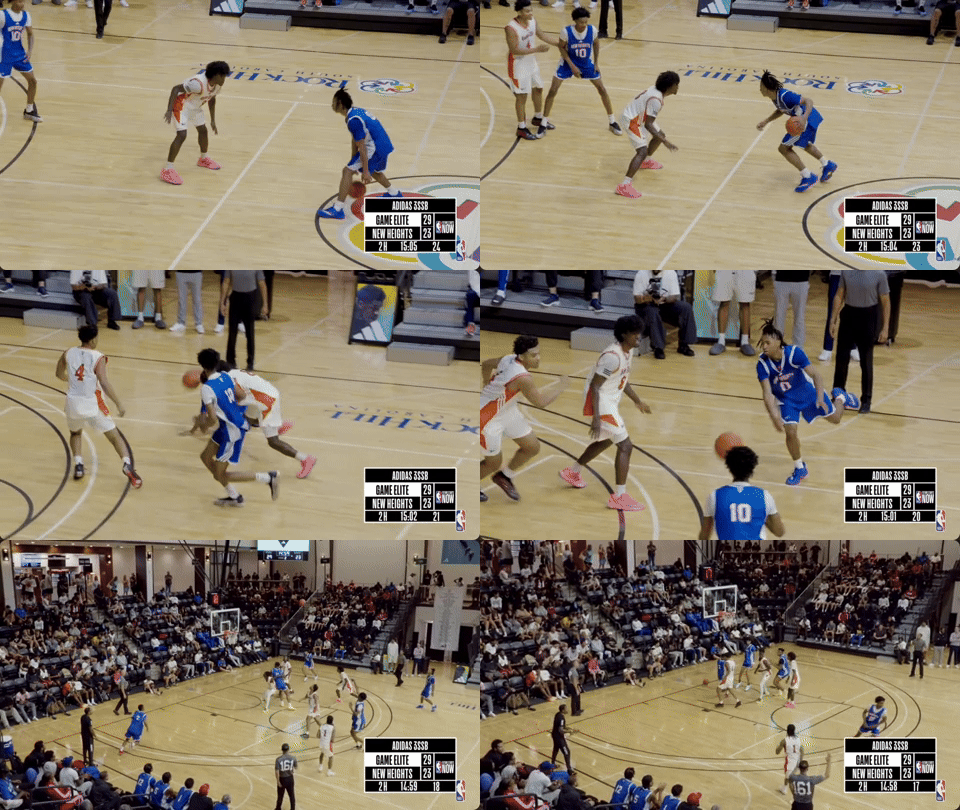
Or this drive, where he blows by his defender and dips his shoulder so low to the ground that he can’t maintain balance through contact, but he still draws a foul and earns another possession:

These idiosyncrasies underscore Rippey Jr.’s comfort in chaos and out-of-structure creation and playmaking. He was a consummate floor general in his final Adidas 3SSB season, averaging six assists a night on a sparkling 1.9 assist-to-turnover ratios. He’s constantly attempting high-end passes and limiting turnovers, a hallmark of future NBA playmakers.
Rippey Jr.’s burst and inventive handle pry open passing windows and drive his scoring game, which relies on a strong pull-up jumper. He shot just 31.8% on off-dribble threes in 2025 but off-dribble shooting effectiveness at high school levels means far less than volume and shot versatility, which he has in spades.
While his burst and handle allow access to the hoop, Rippey Jr. struggled to score on the interior this past AAU season, making 44.5% of his shots at the rim with a free-throw rate south of 0.3. Despite impressive athleticism and skill, it’s tough to score at the basket as a 6-foot-2 (or shorter) point guard.
Most shorter guards bleed value on defense at higher levels, especially ones with offensive loads as high as Rippey Jr.’s. He’s an outlier here; Rippey Jr. is an elite small guard defender with exceptional lateral quickness, strength and physicality to defend the ball and erase screens.
He nabbed an elite 2.9 steals per game in 2025, jumping passing lanes like an elite corner. His ability to defend away from the ball, adding value as a perimeter helper and even an occasional rim protector, makes him one of the best short guard defenders I’ve watched in recent memory.
great finish from taylen kinney but deron rippey is an absolute maniac for making this rotation, how many shorter point guards are exploding off of two like this? pic.twitter.com/4md4mTqqZ4
— ben pfeifer (@bjpf_) October 4, 2025
As he enters the college and eventual NBA game, he’ll need to harness his aggression and slow down in the intermediate. Even considering some of his scoring woes, Rippey Jr. is a special enough defender and playmaker to consider an elite prospect with a bankable enough 3-point shot.
16. Maximo Adams, Forward, January 2008
Adams was one of the better players on the EYBL circuit in 2025 and fits an archetype that college and NBA teams covet. The 6-foot-7 wing can take over games with his shotmaking, averaging 20.5 points on 62.5% true shooting in 17 games with Vegas Elite this summer.
A quick, high-release and veteran pre-jumper organization renders Adams a nightmarish shooter to contest. He sank 42.2% of his 5.3 triples per game in 2025 and can heat up in a hurry, punishing defensive mistakes with quick jumpers.
2026 wing maximo adams is an NBA caliber off-ball shooter — 6’7 with beautiful mechanics, a quick release and great efficiency this summer:
42.2% on 5.3 3pa/g
38% on 4.2 c&s 3pa/g
55.5% on 1.1 otd 3pa/g pic.twitter.com/TKssogZJCA— ben pfeifer (@bjpf_) October 4, 2025
He was just as devastating scoring inside the arc, converting 58.2% of his 2-point shots, most of those coming at the basket. Most of his rim attempts stem from transition, cutting and offensive rebounding rather than self-creation, but he’s a phenomenal play finisher with size and touch.
While Adams isn’t a full-fledged creator, he’ll occasionally flash some off-dribble shooting prowess, which could boost his long-term offensive ceiling. He attempted 41 total off-dribble jumpers and made 43.9% of them, including 55.6% of his 18 off-dribble 3-point attempts.

Adams is a stout defender who influences actions with live hands and great instincts. He racks up deflections, especially dangerous gapping and defending one pass away from the ball. Quick reaction speed and size let him turn defense into offense and defend multiple positions on the ball.
Those defensive traits result in some highly impactful defensive possessions, like this one where Adams racked up a deflection and two blocks in under 10 seconds of real time:

He seems like the kind of player who people will underrate, not a flashy on-ball creator or big-time vertical athlete, but his consistent impact stands above that. Size, high-level off-ball shooting, defensive aptitude and solid passing feel all provide Adams with a relatively high floor for impact at the college and possibly NBA levels.
17. Brandon McCoy, Wing, November 2007
I appreciate when prospects like McCoy, whose tools and athleticism sit at the top of every scouting report, level up athletically. Already a wiry, strong, explosive athlete, his added core strength increased his functional athleticism this season. He’s incredibly strong and explosive now, his physicality and burst good for some impressive half-court creation moments:
brandon mccoy jr.’s strength and explosiveness look much improved from last season. he’s moving at a different speed with the ball
through 7 eybl games so far — 55 FTr, 33.3% half-court rim freq, 84% atr, averaging 21.6 on 64% TS. small sample but improvement is encouraging pic.twitter.com/jKNSaUt682
— ben pfeifer (@bjpf_) July 19, 2025
Functionality is key here, as McCoy is better equipped to turn his athletic gifts into basketball impact. Those tools most obviously pop on defense, where McCoy is one of the best players in the country. Added strength lets McCoy defend more kinds of players, now bulky enough to bruise with more wings and forwards.
Standing 6-foot-5 with a reported 6-foot-10 wingspan, he’s always been a disruptive playmaker and a havoc specialist. He’s a solid rim protector, though he thrives as a dig and stunt defender, weaponizing his length, twitchy movement to pounce on loose handles:
brandon mccoy (’26) is the best dig defender in the country pic.twitter.com/UVJojRbAS1
— ben pfeifer (@bjpf_) October 22, 2024
Like a few other prospects previously discussed (and one more coming very soon), McCoy lacks the offensive consistency, specifically 3-point shooting, to extract the most from their stellar defense. He slightly increased his deep range efficiency from 2024 this season (21.3% on 4.2 per game -> 30.4% on 2.6 attempts per game), but low volume and extremely poor free-throw shooting (52.6% across 2024 and 2025) are worrying indicators.
McCoy’s decision-making warts compound these shotmaking issues, as he’s always willing to spray contested pull-up jumpers early in the clock. It’s possible he improves as a shooter and becomes a closeout-worthy threat, but that ceiling, if it hits, likely comes years down the line.
For his notable spacing problems, McCoy improved significantly from 2024 this summer (when he played with the 17u squad), increasing his scoring (16.6 -> 19.7 points per game), efficiency (45.1% -> 59.8%). As previously discussed, he leans on his athleticism to pressure the rim, converting a ludicrous 78.9% (56-71) there.
Where his passing levels out might swing his projection. If McCoy sharpens his decision-making and slows down in the pick-and-roll, his solid vision and advantage creation could blossom. His range of outcomes is as wide as any in this ranking, but unlocking his downhill advantage creation might unearth a huge two-way ceiling.
18. Christian Collins, Forward, September 2007
Collins boasts an NBA-ready physical package, standing 6-foot-8 with a 7-foot-1 wingspan. His movement and athleticism resemble modern perimeter defensive aces, capable of covering tons of ground in seconds before stopping on a dime and sprinting the other way. His tape features some remarkable closeouts, where he speeds up and slows down like an oversized free safety:

While Collins has the tools requisite for elite off-ball defensive impact, his motor and awareness limit that at the moment. He posted underwhelming steal and block numbers (1.9 stocks per game) in 22 EYBL games this summer, imprinting himself as a playmaker a bit less often than his tools suggest he could, though he did snag 8.3 rebounds per game.
He’s most impactful as an on-ball defender, with the size and mobility to guard multiple positions and the tools to forcefully recover when defenders create advantages on him. Those advantages frequently never come with Collins on the ball, though. Watch him blanket fifth-ranked JJ Andrews:

Like his former St John’s Bosco teammate Brandon McCoy, Collins currently struggles to influence winning on offense. He averaged 12.5 points and 1.5 assists (0.6 assist-to-turnover ratio) on 49.2% true shooting and made 20.8% of his threes. He primarily functions as a play finisher who cuts, rebounds and spots up on the perimeter.
At the moment, Collins hasn’t produced like an elite driving prospect, but when it comes together, it really comes together. How many 6’8 wings can pull off a high pickup into an explosive finish like he does here?

Collins hasn’t yet figured out how to apply his athletic tools functionally on offense. He lacks the ball control, ball skills and scoring feel to slash as effectively as his physicality should suggest. Though he isn’t a black hole passer, capable of solid connective plays, his handle holds back his passing as well.
It might take a few seasons of college basketball for Collins to develop into a star NBA Draft prospect. If he does get there, his incredible athleticism, physical tools and two-way flashes all are pathways to high-level impact and upside.
19. Jason Crowe Jr., Guard, July 2008
Crowe Jr. has a strong argument as the classical “purest” scorer in the class. He’s been dropping 40 points in games since he was a freshman and led the EYBL in scoring in 2025, averaging 23.8 points per game on 55.5% true shooting and 31.5% from deep.
Listed at 6-foot-3 (but likely closer to 6-foot-1), Crowe Jr.’s size doesn’t keep him from huge scoring numbers at this level. He’s a nuclear off-dribble shooter with exceptional range and his high-volume pull-up shooting (22.7%) deflates his percentages. He’s a catch-and-shoot flamethrower too, making 49% (24-49) of those threes this summer.
To score at the NBA level, Crowe Jr. must improve other areas of his game. He’s made some progress as a pick-and-roll playmaker, but weak vertical athleticism and strength neuter his rim-scoring and defensive potential.
passing will be a major swing skill for jason crowe jr at the college and pro levels — he’s wired to score, leading to fairly low passing volume
he has some flashes against pressure/big window interior passes, but he’s at 1.4 hc assists per game (0.5 a:to) so far in EYBL pic.twitter.com/rsScIWjOTH
— ben pfeifer (@bjpf_) July 10, 2025
Click the link to read our previous analysis of Jason Crowe Jr.’s game.
20. Alexander Egbuonu, Forward, April 2008
Egbuonu’s size and ball skills are immediately intriguing and he produced this summer on the Adidas 3SSB Circuit, averaging 17.6 points, 6.4 rebounds and 1.4 assists per game on 54.2% true shooting. At 6-foot-6, his handling dexterity and command of pace resemble a shorter guard.
2026 wing alex egbuonu is a mismatch nightmare on the perimeter, too skilled and quick for most bigs and too strong and large for most smalls.
he’s an enticing slashing creator prospect who deserves more buzz pic.twitter.com/WoOW6kPHaS
— ben pfeifer (@bjpf_) September 15, 2025
He was one of the most productive defenders across all circuits in 2025, ranking seventh in stocks per game (3.4) on the 3SSB circuit. His team’s pressure zone inflates those numbers, but there’s upside to project as a rim protector and off-ball helper.
Motor and decision-making hold back Egbuonu’s impact at the moment. For every impressive drive or rim contest, he’ll settle for a difficult off-dribble jumper or let a driver easily fly by him. Still, Egbuonu’s size, offensive talent and youth form one of the most interesting ceilings in the class.
Click the link to read our previous analysis of Alex Egbuonu’s game.
21. Cameron Williams, Big, October 2007
Across the Nike, Adidas and Under Armour circuits, nobody racked up steals and blocks like Williams. He led all circuits in stocks per game (4.4) among qualifying players and tied his Adidas 3SSB circuit’s lead in blocks per game (3.3). It’s easy to see how the gargantuan Williams, listed at 6-foot-11 with a towering 9-foot standing reach, makes life hard on offenses.
Shooting over Williams is the basketball equivalent of putting a golf ball through a colorful windmill, except the windmill runs at ceiling fan speed. He rarely looks bothered while swatting away shots at the rim or out on the perimeter:

This chasedown block deserves its own GIF. No analysis needed, this is not normal stuff:

Williams clearly possesses the physical tools and mobility to dominate as a paint protector and switch onto the perimeter at times. He’s not quite strong enough to hold position inside, but, more worryingly, he isn’t always willing to play physically and embrace contact, leading to some problem matchups against thicker bigs.
Even considering those issues and some over-eager attempts at blocks, it’s easy to envision him reaching his defensive ceiling. Those same limitations, notably his physicality, limit Williams on the offensive end, where his impact is more theoretical than his defense at the moment.
He posted a concerningly low 0.26 free-throw rate for a player of his physical stature, reflecting his comfort zone away from the basket. Williams is an excellent finisher on lobs and quick catches, but defenders can push him off of his spot and force difficult shots and turnovers. He averaged 14.2 points and 0.8 assists (0.5 assist-to-turnover ratio) on 53.2% true shooting this past AAU season, rarely passing out of his scoring chances.
For a near seven-footer, Williams shoots a beautiful jumper and he’s confident letting it fly from downtown. His shooting numbers were pedestrian in 12 3SSB games, converting 31% of 3.5 3-point attempts per game and shooting 60.5% at the line. Solid volume and a smooth, high release look good on tape and he’s tough to stop when the threes fall:

Williams has a way to go on the offensive end before he consistently impacts winning and that impact will depend on where his 3-point shot levels out. If he becomes a threat from deep, Williams could fit a coveted modern archetype as a floor spacing shot blocker that every team seems to want.
22. Caleb Gaskins, Forward, August 2008
Gaskins has a few traits that should project favorably to college and eventually the NBA level. He’s listed at 6-foot-9 with a 7-foot-1 wingspan and his touch is excellent, especially in the paint and intermediate area. In his 2025 EYBL season, Gaskins made a respectable 32.6% of his 46 off-dribble mid-range attempts.
When he hops off of two feet and pivots around on his strong base, he accesses high-release jumpers that most high schoolers can’t contest. Gaskins made just 27.8% of his threes, but his mid-range prowess and solid free-throw shooting (75.2%) are promising shooting indicators.

He carried a heavy offensive load for his Nightrydas squad this season, scoring 16.6 points per game on 52.8% true shooting in 20 games this summer. His penchant for tough pull-up jumpers deflates his efficiency and his impact as an on-ball creator. If Gaskins hunts his bread-and-butter pullups, he often isn’t collapsing defenses.
As a primary creator in EYBL, Gaskins struggled to process the floor on the ball (0.6 assist-to-turnover ratios) and he often passed up open cutters or shooters for lower percentage off-dribble jumpers. Gaskins was a more effective playmaker with his Columbus and Montverde high school teams, where he thrived as a connective passer.
the offensive flashes are notable too, gaskins has nice touch, ball skills and flashes some real passing ingenuity and floor reading ability. awesome prospect pic.twitter.com/hH8lmWT0SP
— ben pfeifer (@bjpf_) October 20, 2024
While Gaskins wasn’t as impactful on defense for his EYBL team as he was in high school, his athletic tools help us project favorably on defense. He’s an impressive mover in space, capable of covering ground on big rotations and recovering back to protect the rim or contest shots.
There’s clear potential for Gaskins to develop as a rim protector given his size and easy vertical athleticism. He blocked just 14 shots in 20 games, though, compared to 43 personal fouls. That’s an overall theme describing Gaskins as a prospect, oozing with potential but raw around the edges.Gaskins is one of the youngest players in his class and won’t turn 18 years old until next August. For all of his flaws, he’s already an impressive offensive prospect who gets buckets in bunches. Improvement as a 3-point shooter could help Gaskins impact winning on offense early on while he rounds out his defensive and creation chops. There’s a wide range of outcomes with Gaskins, but his most valuable traits are worth betting on.
23. Tajh Ariza, Wing, March 2008
Ariza only played in six EYBL games this summer and recorded pedestrian stats, though his physical tools and flashes carry his prospect value. He’s an impressive defensive player with a high motor, weaponizing his 6-foot-9 frame and open floor speed to create turnovers and gum up offense.
He hasn’t scored efficiently to this point, but Ariza will flash off-dribble shotmaking and passing ability at times. His handle and footwork need plenty of refinement, but Ariza’s projectable jumper and athleticism suggest he could develop into a valuable two-way wing down the line.
Click the link to read our more in-depth analysis of Tajh Ariza’s game.
24. Austin Goosby, Guard, November 2007
Goosby was one of the better two-way players on the EYBL circuit this summer, averaging 16.1 points, 2.8 assists and 5.8 rebounds per game on 55.2% true shooting. Beyond an already solid slash line, he’s a menacing defensive player who creates tons of turnovers and havoc; Goosby ranked fourth among qualifying EYBL players in stocks per game (2.9).
Listed 6-foot-5 with a 6-foot-9 wingspan and a wiry frame, Goosby is a physical, confident defender who never shies away from contact. That makes him an effective perimeter rim protector (1.3 blocks per game). He’s a seasoned low-man defender with great instincts that let him sniff out openings and alter shots at the rim.

He’s a strong perimeter defender with excellent hands that help him poke out loose handles and dig at the nail to close driving lanes. Goosby’s ball-hawking and rim protection beget a high defensive ceiling if he can add strength to absorb bumps and contacts from bigger players at the point of attack.
Physicality and explosiveness are the center of his offensive game, fueling Goosby’s potent off-dribble slashing. He generated 42.6% of his half-court shots at the basket and finished an excellent 65.2% there while posting a solid free-throw rate (0.36), thriving as a finisher with excellent touch, balance and aerial coordination.
As he does on defense, Goosby weaponizes his burst and explosiveness to knife through defenses and explode off of two feet to score at the rim. His scoring variety is impressive for an athlete of his caliber, willing to try complex handle strings for pull-ups and mid-range shots.
Goosby has a fairly wide array of moves in his arsenal, but he doesn’t rely on them for his creation. This is where his physicality and power pay dividends; he’ll back down and bash through smaller defenders whenever he gets the chance:

He made just 25% of his threes this summer, which could limit his ability to work off of the ball and space the floor. Even without a great 3-point shot, Goosby could become a valuable two-way starter built around driving and impressive positional playmaking
25. Maxime Meyer, Center, January 2008
Meyer is the best pure rim protector in his high school class, only trailing Cameron Williams in stocks per game (4.3) and ranking third on the Adidas 3SSB circuit in blocks per game (3.2). At 7-foot-1 with a 7-foot-3 wingspan and a 9-foot-5 standing reach, Meyer blocks out the sun with size alone but plays with the technique of a veteran backstop.
Offenses consistently avoid shooting around Meyer in the paint and when they do, his timing and arm flexibility help him block shots and jar balls loose. Like many great rim protectors, Meyer targets the basketball on the way up, keeping the ball in bounds and boosting the odds his team gains possession:

His mobility, especially changing directions in short areas, is an inevitable weakness for a giant with hips as high as his. Without sharp movement skills or strength in his core, stronger posts can work him down in the post and offenses benefit from forcing him onto the perimeter.
Switching won’t be a strength for Meyer but his instincts and awareness generate deflections and steals. And when drivers beat him off the dribble, he’s always a threat to recover and block a shot from behind:

Weak core and lower body strength limit his offense more severely than his defense. Despite his staggering size, Meyer averaged 9.1 points per game on 49.4% true shooting with a free-throw rate (0.18) more commonly found in small guards. In 18 AAU games this summer, he shot 54.2% at the hoop.
While Meyer’s touch is solid, especially on lefty hooks and drop steps, extremely limited vertical athleticism and functional strength limit how deep he can catch the ball and how much pressure he can handle before crumbling. But his Brookwood Elite team was seemingly aware of his limitations and extracted value from his perimeter skills.
Meyer has an impressive handle for a seven-footer and operates as a dribble-handoff hub with shooters and cutters swirling around him. As a weak scorer, he’ll lean on a deft handle and tight window layup passing vision to fit around other offensive stars:
2026 center maxime meyer might be the best pure rim protector in his class and placed second among the major shoe circuits in stocks per game (4.3)
but his passing really impressed me, he has real vision, live dribble chops and will take tight window risks pic.twitter.com/B0qRaPDZ2P
— ben pfeifer (@bjpf_) October 5, 2025
Limited scoring at the center position has made Meyer an overlooked prospect, but elite rim protectors with perimeter skills are valuable players and for good reason. If he adds strength and learns to handle contact more effectively, Meyer could surprise some with his two-way ceiling.