
As mid-August approaches and NBA training camp sits fewer than two months away, a quartet of 2021 draftees — Josh Giddey, Quentin Grimes, Jonathan Kuminga and Cam Thomas — find themselves without homes for 2025-26. All of them are talented players whose drawn-out employment statuses stem from a mix of their own shortcomings, tricky cap situations involving their 2024-25 teams and the cruel, hamstringing nature of restricted free agency itself.
To assess their situations, some of the Sportscasting crew teamed up and broke down each player’s game while offering a price point they’d feel comfortable landing upon with a new contract. Let’s get to it.
Josh Giddey
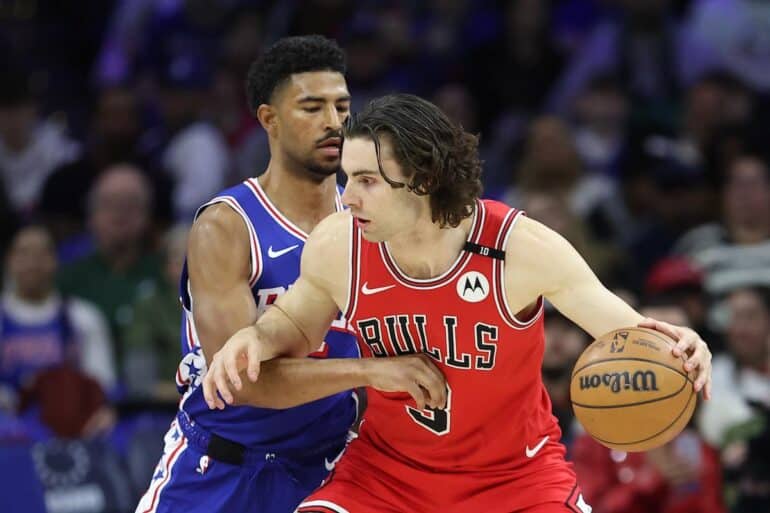
Like all of the players in this year’s restricted free agency conundrum, Giddey is a complex player to assess. On one hand, his pure talent and feel for the game are undeniable. He’s a sideline-out-of-bounds passing wizard with a real intuition as a facilitator, which only became heightened in the Chicago Bulls’ run-and-gun offense last season. He uses his size well; Giddey is a plus rebounder for his position and gets to the rim frequently. But his lack of burst and general athleticism cause struggles there. He shot just 58 percent at the basket last year.
Giddey’s overall scoring leaves a lot to be desired. Limitations as a shot-creator, particularly in the half-court, are notable hurdles to becoming a truly dynamic offensive player. That said, he is trending in the right direction and finished his first season in Chicago strong, averaging 21 points, 10.7 rebounds, 9.3 assists and 1.5 steals on 50/46/80 shooting splits in 19 post-All-Star Break games. He shouldn’t be expected to continue producing like that, especially beyond the arc, but the growth and comfort he displayed are significant.
How significant is the crucial question as it pertains to his next contract. How much do the Bulls buy (literally!) what he displayed over that small sample, especially when there are legitimate concerns about how he’ll continue to hold up defensively?
In an NBA with constantly increasing emphasis on ground coverage and guarding in space, Giddey’s lack of foot speed and mobility stick out like a sore thumb. He was one of the worst defenders on a subpar Bulls defensive unit last year. What is the upper limit a team is willing to spend on a flawed, yet intriguing young player?
Anything under $25 million annually should be considered fair value for Giddey. Anything above that would seem rich for a player who has lots of important, looming questions about his game. -Es Baraheni
Quentin Grimes
Most seasons, Quentin Grimes’ trade from the Dallas Mavericks to Philadelphia 76ers would be the steal of the deadline. The 2024-25 NBA season was no ordinary year, but Grimes still lit aflame after joining the Sixers in February. Across 28 appearances, he poured in 21.9 points, 5.2 rebounds and 4.5 assists per game on 59.2 percent true shooting for a decimated Sixers team while moonlighting as a viable primary initiator.
Philly’s offense wasn’t particularly efficient with Grimes on the court, sitting a bit below league average in offensive rating. We shouldn’t expect a long-time complementary player like him to carry low-level units, but Grimes flashed some lead guard creation, attempting over a quarter of his half-court shots at the rim and converting 57.4 percent of them.
We’ve seen Grimes excel before in different situations, notably thriving as a complementary two-way wing with the New York Knicks during his sophomore season. Paying the 25-year-old should be a no-brainer, but the Sixers’ cap situation complicates things. Massive contracts to Joel Embiid, Tyrese Maxey and Paul George clog their cap room over the next three years.
Beyond Maxey, Jared McCain briefly played like an ascending star and they spent the third overall pick on VJ Edgecombe, another guard. The depth in that room could make Grimes more expendable, especially because of the corner Philly painted itself into. Finding a way to retain Grimes, even on the qualifying offer, would be wise. If the two sides can reach a long-term agreement, something in the ballpark of $18-22 million per year seems reasonable, too. -Ben Pfeifer
Jonathan Kuminga
Despite the Golden State Warriors’ search for more size, athleticism, front-court scoring and general talent, the 22-year-old Jonathan Kuminga remains in limbo five weeks into this year’s free agency period.
Kuminga certainly presents some welcomed elements for Golden State among his finishing (70th percentile or better at the rim every year, per Cleaning the Glass), mismatch scoring and vertical explosion. But he’s also a tricky player to fit into their system, desires a larger feature role than the Warriors can offer and wants to paid at a number reflecting that feature role.
For years, Golden State has tried to assuage his fit, emphasizing the need for traits like sound, snappy decision-making and ferocious rebounding alongside Stephen Curry — even more pressing with last season’s arrival of Jimmy Butler as another offensive focal point.
Those efforts haven’t proven fruitful thus far and Kuminga’s ball-dominant ethos to maximize his impact make for a tenuous partnership. He’s an excellent cutter and roller, but is a career 33.2 percent 3-point shooter, touts a 1.26:1 career assist-to-turnover ratio — reflective of limited passing feel and execution — and doesn’t leverage his size and bounce enough as an interior help defender or rebounder.
Kuminga won’t overtake Curry or Butler within Golden State’s offensive hierarchy, so he’s left needing to hone in on all those aforementioned skills, which he’s struggled to embody. That’s seemingly created a disconnect between the two sides in negotiations and has me hesitant about what I’d be willing to pay the young, talented, springy, flawed forward.
Kuminga’s driving, finishing and post scoring are undoubtedly useful tools, hence why’s averaged 20.5 points per 36 minutes on 58.3 percent true shooting for his career. But the incongruent off-ball game, poor playmaking and spotty defense (he *can* do some good stuff as an on-ball stopper!) are substantial hindrances for the outlook of his next contract. I’d be dubious about paying him more than $13-15 million annually, even as the league’s salary cap swells every year. -Jackson Frank
Cam Thomas
At a glance, the fact Cam Thomas — a player who has averaged over 22 points per game each of the last two seasons — remains unsigned by the Brooklyn Nets seems like a confusing conundrum.
However, further inspection reveals Thomas is more of a one-trick pony, struggling in the disciplines of defense (third percentile Defensive Estimated Plus-Minus) and playmaking (never averaged more than four assists per game). And while he is a scorer, he isn’t distinguished enough in this category to warrant overlooking his shortcomings. Over his first four seasons, only once has Thomas ranked above league average in true shooting.
All of this has led to the standstill we’re currently witnessing. Thomas wants to get paid, but his true value is hard to ascertain. I find it difficult to build a winning team in the long-term with a player of Thomas’ extreme strengths and weaknesses eating up a large part of the salary. But as the Detroit Pistons taught us last year, it does help to have adults in the room to develop your young talent. The Nets wouldn’t go wrong retaining Thomas, but it has to be at his true market value.
Collin Sexton, a player I deem slightly better than Thomas, was treated as a negative value contract when he was traded to the Charlotte Hornets. Next season, he is set to make 12.3 percent of the salary cap.
With that logic, to make Thomas’ deal a neutral value contract, you would want to pay him slightly less than that. For the sake of simplicity, let’s just say that’s 10 percent of the cap, which would mean he’d be owed roughly $15.5 million next season. -Mat Issa