
The Boston Celtics and Los Angeles Lakers may have more banners hanging up in their rafters but neither city compares to New York when it comes to their love of basketball. When the New York Knicks are good, nothing compares to it. The NBA is just straight-up better.
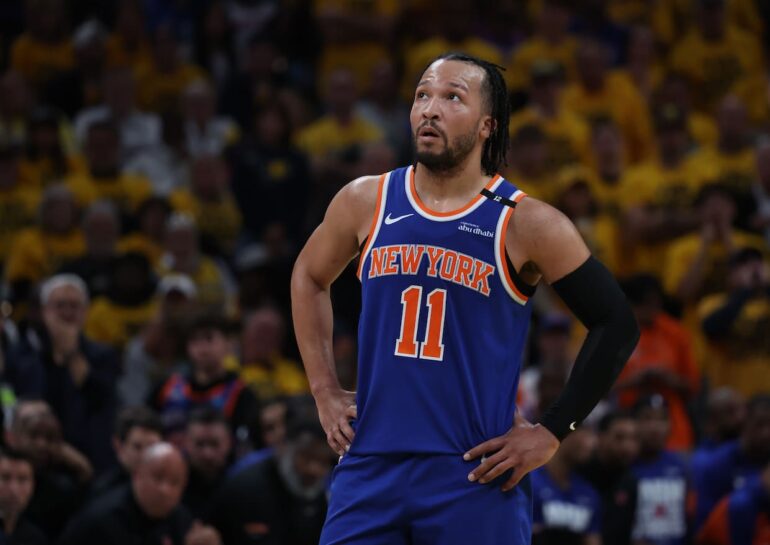
After years of misfortune and poor resource management, the Knicks added Jalen Brunson in the summer of 2022 and haven’t looked back. Not a single season has ended without at least one playoff series victory and last year, they celebrated their first Eastern Conference Finals appearance since 2000.
Still, even that team was not worthy of ending their half-century-long championship drought, as New York ultimately fell to the Indiana Pacers in six games.
Now, with the Eastern Conference in a diminished state due to season-ending injuries to Jayson Tatum and Tyrese Haliburton, the Knicks seem to view this as their chance to finally breakthrough. And as a result, they have been working tirelessly to bolster their roster this offseason. But is it enough?
Knicks’ Offseason Additions
After trading for Mikal Bridges and Karl-Anthony Towns last offseason, New York put together one of the better starting lineups in the Association. Unfortunately, this came with the consequence of a weak bench. Last year, they were dead last in bench points per game (per NBA.com).
So, this offseason, the front office prioritized adding credible reinforcements to the second unit. For a long time, that initiative was headlined by the signings of Guerschon Yabusele and Jordan Clarkson.
In Yabusele, New York gets someone who can reasonably appropriate Towns’ ability to space the floor (38 percent on threes in 204-25) and attack closeouts (97th percentile true shooting on drives, per Thinking Basketball) at the four/five spot. This not only allows the Knicks to play 48 minutes of unicorn basketball but it also enables new head coach Mike Brown to field double-big lineups (something New York had a lot of success with in the playoffs) even when Towns is on the bench.
Meanwhile, Clarkson gives them a bigger version of Cameron Payne (who they’ve yet to re-sign). Like Payne, Clarkson knows how to get a bucket in a pinch (88th percentile in points per 75 possessions, per Dunks & Threes). The only functional difference is Clarkson has a 6-foot-10 wingspan (Payne’s is 6 feet 7 inches), which makes it easier to hide him on defense — something the Knicks struggled to do with Payne last season.
Given how limited they were financially, those two signings alone would have made for a positive offseason. However, the Knicks had another few tricks up their sleeve. And on Friday, they finally showed their hand, adding Malcolm Brogdon and bringing back Landry Shamet* on a one-year deal. They also gave Garrison Mathews a camp deal.
*Note: As of right now, the Knicks can only keep one of Shamet or Brogdon. However, they can make a trade before the start of the season to keep both.
Mathews is a career 39 percent 3-point shooter who loves to lay his body on the line defensively. He regularly sits at the top of the leaderboards in charges drawn. I’ll be rooting for him but he doesn’t factor super heavily into this particular analysis.
Anyway, anyone who follows my work knows how much I love Shamet as a low-cost signing. He’s always been a very good outside shooter (38.5 percent for his career) and over the last few years, he’s grown defensively — making him a legitimate two-way role player off the bench.
Brogdon represents the most accomplished member of the newcomers. When healthy, he’s an excellent distributor and pull-up shooters (in 2022-23, he shot 44.8 percent on pull-up triples) — the exact type of player you want anchoring Brunson-less units. He’s also taller and stronger than Clarkson, making him the more desirable option between the two.
The issue is he isn’t always healthy. In fact, over the last few years, that’s hardly ever the case (he’s missed 101 games the last two seasons). That’s why it helps the Knicks also brought in Clarkson as insurance. And thanks to Brogdon’s shooting ability, the two can also coexist on the floor for short periods.
What Does New York’s Strong Offseason Mean?
The Knicks clearly did a good job improving their roster this offseason. But how good are they now?
I’d be willing to wager a good amount they won’t repeat as the worst bench scoring team in the league. So, that will already be an improvement.
From a conceptual level, this group has a lot more lineup versatility than it did the year before. Along with being able to offer relief to their best players, the Knicks can also mix and match. Like I said earlier, instead of always having to go with Towns and Mitchell Robinson in double-big lineups, they can also work Yabusele into that configuration.
Thanks to his emergence as a two-way wing, Shamet (or Miles McBride) can theoretically close games when teams aren’t respecting Josh Hart’s outside shot. They can also play defensively slanted lineups featuring one of Towns or Brunson and some combination of OG Anunoby, Bridges, Robinson, Hart, McBride and Shamet.
Despite becoming a deeper team, the issues that plagued them against Indiana still persist. They don’t have a true point-of-attack stopper or the requisite defensive infrastructure to hide Brunson and Towns against high-level playoff offenses.
Shamet is a vastly improved defender but he’s still more of a net neutral/slight positive than an absolute game-changing force. McBride is a pest but he’s vulnerable against bigger ball-handlers. Meanwhile, all the other offseason additions discussed are clearly more slanted toward offense.
As I see it, there are only three real ways to resolve these issues with their current roster (outside of trading Towns). One, they become enough of an elite offensive team that their defensive shortcomings aren’t as damaging. That is a high bar to reach, though. When I say an elite offense, I’m talking Seven Seconds Or Less Phoenix Suns.
Two, Towns takes a leap defensively. Brunson is always going to be a limited defender because of his size and stature. So, the onus is on Towns to improve on that end of the floor. In fairness to him, he has been around a neutral each of the last five seasons. However, spending most of his time at center means he needs to be better than a neutral, especially when his star point guard is also a moving target.
And third, Bridges needs to get back to being the All-Defensive Team stopper he was during his days with the Suns. This would kill two birds with one stone. It would give the Knicks their elite point-of-attack stopper and it would create a defensive ecosystem — among him, Anunoby, Hart, and Robinson — to properly hide Brunson and Towns. This may be the most likely of options because we have tangible evidence of Bridges reaching those heights.
I’m a fan of all the signings the Knicks made this offseason. I think each of them adds a different wrinkle that will ultimately make New York a better team than it was last year. Still, none of those moves change the team significantly enough for me to feel better about history not repeating itself. And so, while I think the Knicks could certainly reach the Eastern Conference Finals again in 2026, I’m leaving them out of my inner circle contender tier until further notice.