
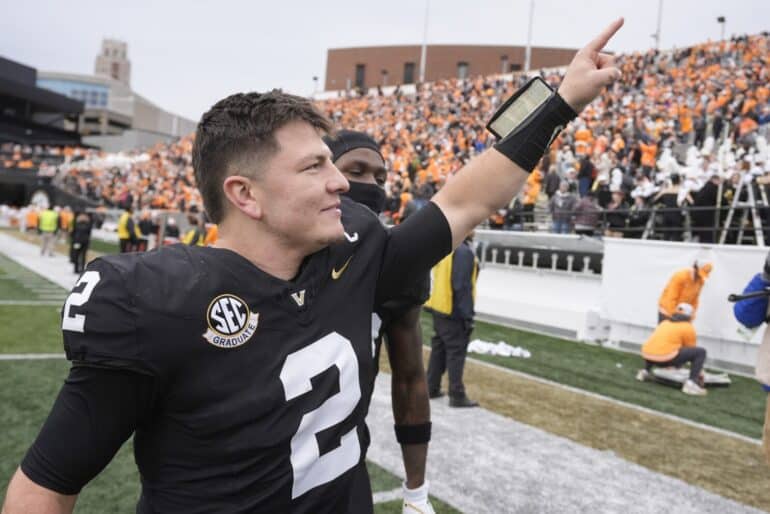
Diego Pavia’s legal challenge for a seventh year of eligibility is about more than one quarterback trying to extend his career. It’s a test case that could reshape how the NCAA handles eligibility, redshirts, and athlete rights for years to come.
Why Pavia Went to Court
Pavia, now at Vanderbilt, argued that the NCAA’s rules unfairly counted his junior college seasons toward his eligibility clock.
Under the current framework, JUCO years burn the same as Division I years, leaving players with fewer opportunities to redshirt or recover from setbacks. His lawyers claim that setup violates antitrust law by limiting how long players can participate and earn NIL money.
The Court’s Response So Far
In December 2024, a federal judge granted Pavia a preliminary injunction, which cleared him to play the 2025 season. The NCAA also issued a blanket waiver for players in similar situations, essentially admitting its rules created unintended roadblocks for JUCO transfers.
That decision gave Pavia his sixth year, but it also cracked the door open to a possible seventh.
Could Pavia Play a Seventh Season?
His attorney has floated the idea of another injunction that would allow him to suit up again in 2026. Legally, that path remains on the table. But Pavia himself posted on social media, “this my last year,” signaling he doesn’t plan to take the fight that far.
If that holds, his case could end without him ever playing a seventh season, but the precedent could still stand for others.
Could Pavia Transfer Again?
The ruling doesn’t just keep Pavia on the field, it also keeps him in the transfer market. Because he’s already a graduate, he would be free to enter the portal again without penalty.
That means a bigger program in need of a veteran quarterback could still come calling. If his legal challenge extends into 2026, the idea of Pavia finishing his career at a Power Five contender becomes even more realistic.
Why This Case Matters Beyond Pavia
- JUCO athletes: Players who start in junior college could gain more flexibility without being penalized for taking a less direct route to Division I.
- Redshirt rules: The challenge questions why athletes can’t preserve a year if they’ve already played four seasons, even in fragmented stints across different schools.
- Antitrust precedent: If the court agrees the rules violate the Sherman Act, it could further erode the NCAA’s control over player movement and eligibility.
- NIL impact: More eligible seasons mean more time for athletes to profit off their name, image, and likeness rights.
The Bigger Picture
Pavia may walk away after 2025, but the legal pressure won’t. Athletes have already used antitrust lawsuits to dismantle amateurism and cap restrictions. If his case forces the NCAA to rewrite eligibility limits, JUCO athletes and late bloomers stand to benefit most.
Whether Pavia plays in 2026 or transfers again isn’t the real story anymore. The question is how many athletes will have new opportunities because he challenged the system when almost no one else did.