
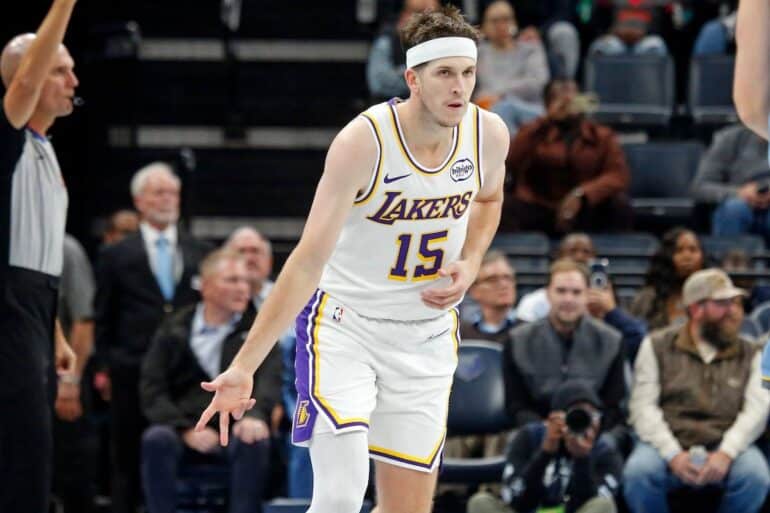
Fanfare around the Los Angeles Lakers is as loud as ever following the Luka Doncic trade and uncertainty regarding LeBron James’ future. To open 2025-26, Doncic has played as brilliantly, leading the NBA in per-game scoring, but Austin Reaves isn’t far behind. The undrafted guard is ascending to stardom in year five, averaging 31.1 points. 9.3 rebounds and 5.1 rebounds per game on plus-7.4 percent relative true shooting.
With James sidelined to begin the season, Reaves has taken on more primary offensive duties than ever. The Lakers are 7-2 with a top-10 net rating (plus-3.6) and top-six offense (119.6 offensive rating), largely thanks to the growth of Reaves alongside Doncic. And his scoring is far from a product of Doncic; his scoring rate jumps from 19.4 to 36.6 points per 75 possessions when he mans the offense without Doncic on the floor.
His on-ball rate spiked from 29.7 percent last season to 39.4 percent now, slotting him 13th in the NBA. He ranks 15th in usage rate (30.8 percent) and every healthy player with a usage rate of 30 percent or higher made last season’s All-Star Game. Among the top-25 highest-usage players, only Giannis Antetokounmpo and Donovan Mitchell are scoring more efficiently than Reaves. A career-low 42.4 percent of his makes are assisted, ranking in the 11th percentile.
A Playmaking Evolution
Point guard duties require higher levels of passing acumen and Reaves leveled up his playmaking to meet the moment. His 9.3 assists per game rank him fourth in the league and his 15.4 potential assists are a 91st percentile mark, creating shots at an elite rate regardless of teammate shooting.
Despite the uptick in passing volume, he’s improved his assist-to-turnover ratio (2.4 -> 2.7) and his assist-to-usage rate (1.1) is the highest of his career. His reads aren’t always complicated, as he leans on his elite handling, ball-screen manipulation and advantage creation to crack open passing windows.
He’s leading the NBA in midrange assists per 100 possessions (5.1), largely thanks to pick-and-rolls with DeAndre Ayton. Reaves reads the floor as he weaves through defenders, finding Ayton and other Lakers in soft spots for easy rhythm jumpers.

That’s not to say Reaves can’t convert big-time pick-and-roll passes on the move when the moment calls for it. He runs the eighth-most pick-and-rolls (including passes, according to Synergy) per game in the NBA (18.3) and the Lakers’ offense is a buzzsaw on those plays (1.242 points per possession).
Ludicrous passes like this skip pass on the move through the waving arms of three Miami Heat defenders are partly to thank for that efficiency:

With sky-high playmaking confidence, Reaves is trying passes into smaller windows than ever before. I’m still not exactly sure how he squeezed this pass through to Jaxson Hayes while twisting his body in midair. The margin of error isn’t more than a few inches on a pass like this and Reaves placed it perfectly:

Dominant Driving
Reaves ranks ninth in the NBA in drives per game (16.1), finishing those plays on white-hot 67.9 percent true shooting. Until Antetokounmpo down the list at 11.7 drives per game, no high-volume slasher aside from Doncic (18.2 drives, 73.4 percent true shooting) approaches Reaves’ efficiency. Last year’s most efficient volume driver, Shai Gilgeous-Alexander, drove 20.6 times per game, scoring on 65 percent true shooting.
His poise and veteran craft counter the NBA’s current defensive meta, laden with pressuring defenses. Those aggressive defenses, none more so than the Portland Trail Blazers’, aim to speed up handlers and force lower-percentage intermediate shots. Incessant pressure can flip control of the game to defenses, a deviation from the tradition of offenses typically dictating action.
Fortunately for the Lakers, that’s Reaves’s comfort zone. He’s a tough player to disrupt and bother, even for elite players like Toumani Camara, who Reaves swats away before picking his spot and firing to the hoop:

He’s always been a masterful midrange scorer and foul-drawer but he’s taking those skills to new heights this season. Those short midrange pockets have become automatic — Reaves is converting a smoking 58.3 percent of those shots this season. And if defenders contest his floaters and hop-step jumpers too aggressively, he’ll punish them with two free throws.
A scaled-up version of Reaves morphed into a foul-drawing monster, ranking fourth in the league in free-throw attempts per game (10.3). That more than doubles his five attempts per game last season, vaulting him into star scorer territory.
It’s worth noting fouls are up league-wide and teams are shooting 4.3 more free throws per game on average than last season. Reaves has made 90.3 percent of his free throws so far, rarely leaving points at the stripe. He’s a career 86.6 percent free-throw shooter, indicative of the feathery touch that lets him access shots in tight windows against strong defenders.
In late clock situations against stagnant defenses, Reaves isn’t beholden to his tricky creation. He’ll blow straight by strong isolation defenders to crack the paint before scoring or spraying out passes toward teammates. Most wing defenders can’t change directions and out-leverage Reaves, who’s quick enough to win off the dribble.
austin reaves is living at the line (9.8 fta/75) and winning off of the dribble against top perimeter defenders on a career low assisted rate (42.4%). constant off-dribble blowbys for paint touches and kickouts
this is no frills, primary initiator stuff pic.twitter.com/WlrR7JL6Ze
— ben pfeifer (@bjpf_) November 6, 2025
But smaller, low-center-of-gravity perimeter defenders with excellent hands have been most effective in slowing down Reaves so far. He’s struggled at times to control pace against defenders like Davion Mitchell and Keon Ellis, who stab at his handle and mirror his movements. Reaves can score over the top against stout, smaller defenders but it’s tougher for him to access those sweet spots off the dribble.
Austin Reaves turnovers pic.twitter.com/MpblPz76GC
— bjpfclips (@bjpfclips) November 7, 2025
Can Reaves Maintain This?
There’s plenty of room for Reaves to fall back to Earth from his searing hot start. Maybe, his foul-drawing returns to previous levels or defenses adjust to his herky-jerky creation style. I’m doubtful of that, though. He also has some room to progress to his mean 3-point shooting efficiency, which is down to 34.4 percent this season from 36.8 percent for his career (on career-high volume).
For now, Reaves is playing like a Western Conference All-Star. He must continue this level of play to make a team in the loaded West but 31 and nine on plus efficiency will lock you in for any year in any conference. More critically, a genuine leap for Reaves not only boosts LA’s title odds this season but establishes a long-term running mate for Doncic, assuming Reaves re-signs this offseason.
At the highest levels, playoff offenses can still exploit Reaves’s lack of speed and explosive twitch on defense and the Lakers won’t be a defensive juggernaut. As James returns to the floor, Reaves will likely see his absurd counting stats dip but his efficiency in some areas, notably from deep, could continue improving.
Reaves has played a complementary role for most of his NBA career and excelled. A leap into primary offensive airspace makes him one of the league’s most valuable offensive backcourt players, which has certainly been the case to open 2025-26.