

Entering the 2025-26 season, there was reason to believe in the Toronto Raptors’ defense.
After last year’s All-Star break, the Raptors had the league’s second-best defensive rating behind only the Golden State Warriors. There was a lot of good ball pressure and perfectly timed defensive rotations, even if the opponents were mostly sub-.500 teams.
From a statistical standpoint, there was not much to think Toronto had the makings of a passable offense. The Raptors, during that same post-All-Star stretch remained a bottom-five offense. They finished 26th for the season and were 24th in 2023-24.
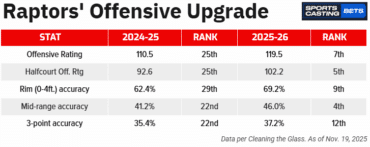
You name it, the Raptors couldn’t do it. Last season, they were second-worst in finishing at the rim and second-to-last in 3-point frequency. They were 22nd in both midrange and 3-point accuracy. Even their transition game, which should have been a strength, ranked 27th in efficiency.
Head coach Darko Rajakovic wanted his team to thrive on passing and movement that would keep the defense shifting. But that’s impossible without gravity both at the rim and 3-point line.
So, when you see Toronto boasts the seventh-best defense this season, that’s fair enough. There was a path to expect that. Ranking seventh in offense as well through the first month of the season? That part should have people turning their heads to figure out what’s going on with a 9-5 Raptors team, which has now won eight of nine and sits third in the East.
Rajakovic’s Scheme Meets Purpose
Beyond the numbers, the Raptors’ offense featured lot of coloring outside the lines last season. Scottie Barnes was hoisting threes at will. RJ Barrett was given all the playmaking responsibilities he could handle. We even got a taste of “Shaqob Poeltl,” with the ever-unselfish (to a fault) Raptors big man taking on a bigger role in the wake of injuries.
Immanuel Quickley played just 33 games and Brandon Ingram — acquired at the trade deadline — never saw the floor. Those absences also allowed for Gradey Dick, Ochai Agbaji, Ja’Kobe Walter and Jamal Shead to get additional reps projected as short-term pain for long-term gain.
That short-term pain meant the Raptors’ halfcourt offensive sets could often start out optimistically, with players cutting and moving for each other as the ball pinged around, but ultimately lacking a real end result in sight. It’s the meme of the horse drawing that starts out perfectly but fades into a cartoonish abomination about halfway through.
Having explored the depths of several player’s games last year, scaling back roles has been a huge boost to the Raptors’ offense this season. Health has played a big part but Rajakovic’s offense is extracting the best of each player’s unique skill-set to make the whole greater than the sum of its parts.
Quickley is pulling up for threes, Barnes is incessantly attacking the basket, Barrett’s opportunities are primarily off the catch and Ingram is the release valve in the midrange when things start to stick. Each of those characteristics has unlocked the gravity of this team in a fascinating way.
Ingram Has Added Necessary Hierarchy
The biggest aspect of simplifying everyone’s roles has been the acquisition of Ingram. Acquiring a primary scorer who still operates within the confines of Rajakovic’s team dynamic has allowed the Raptors to pick and choose how they attack a defense based on what’s presented to them.
Sets for Ingram have been rather straightforward, consistently having him curling through actions to read and react off the separation he gains from screens. Oftentimes, the midrange jumper is there for him to take. He’s made 54.2 percent of his attempts between 10-16 feet and 52.8 percent between 16 feet and the 3-point line. He’s not settling either, with 30 percent of his shots coming within 10 feet. When he gets all the way to the bucket, Ingram has converted a career-high 76.5 percent of his attempts between 0-3 feet.
The Raptors are #1 in the NBA at scoring “off screens” scoring 1.28 points per chance.
They’ve done a great job of incorporating sets for Ingram to get easy opportunities in the mid-range area. pic.twitter.com/Fbi8hLiFKs
— Esfandiar Baraheni (@JustEsBaraheni) November 18, 2025
Everyone else slots in seamlessly around him rather than behind him. Barnes has been the Raptors’ second-leading scorer and over half of his field-goal attempts are within 10 feet of the basket. He’s also shooting a career-high 77 percent at the basket.
Quickley got off to a frigid start the first five games, so he trails Barrett in scoring but his floor-spacing as an on- and off-ball shooter are proving invaluable. Barrett is looking more efficient with a more refined role while Poeltl can be both a play initiator and finisher.
The way Rajakovic’s offense is built, the hierarchy isn’t about prioritization but rather efficient configuration. Ingram naturally gets his share of plays called for him but the offense consistently has a natural team-first flow and ranks 27th in isolation frequency. Everyone is going to touch the ball and have their opportunities. But when the shot clock is winding down, Ingram’s presence means the Raptors will always have a go-to scorer.
Bench Adds Vital Spacing, Energy
The Raptors have played 155 possessions with Shead, Dick and Sandro Mamukelashvili on the court and produced a plus-23.8 net rating. They don’t have great floor-spacing options beyond Quickley but Dick and Mamukelashvili deliver that in spades. Surprisingly, Shead has also been a very good 3-point shooter to start the season but we have to see if that’s a temporary trend or a key area of growth.
Really enjoying what Jamal Shead has brought Toronto this season with his defense, passing, driving and shooting.
46% from 3, 27.1 potential assists per 100 (100th percentile), Raptors are 12.5 points better per 100 w/him on the floor. Excellent start to 2025-26. pic.twitter.com/gKwfimH8as
— Jackson Frank (@jackfrank_jjf) November 15, 2025
Toronto’s starting five of Quickley, Barrett, Ingram, Barnes and Poeltl has a very different identity to the secondary units, largely because of the elements Shead, Dick and Mamukelashvili bring. Shead is more of a natural passer than Quickley, Dick is a more natural outside shooter than Barrett. Mamukelashvili contrasts Poeltl’s power and touch around the basket with 45.2 percent shooting beyond the arc and a pleasantly surprising ability to attack off the bounce.
Rajakovic’s principles remain but different types of weapons produce different kinds of damage.
The Raptors don’t predicate their offense on one particular aspect. Their expected effective field goal percentage based on shot location is league average, according to Cleaning the Glass. Because of the tools now at Rajakovic’s disposal to maximize his schemes, though, they rank ninth in rim finishing, fourth in midrange efficiency and 12th in 3-point accuracy.
Can The Raptors’ Offense Stay Hot?
Toronto has the fifth-most efficient half-court offense and lead the league in fast-break points. This offense hurts teams in every which way.
Most encouraging through the first four weeks of action is nine of the Raptors’ 14 games have come against plus-.500 teams. It’s not a case where they’ve just beat up on bad teams. A 126-113 win over the Cavaliers in Cleveland on Nov. 13 was their best performance thus far. Some may argue the Cavs were on the second night of a back-to-back but both Donovan Mitchell and Evan Mobley sat out the previous night’s win over the Miami Heat.
They have also picked up two convincing wins over the Atlanta Hawks, one a resounding blowout in the Hawks’ home opener and the other also on the road with Young missing. The Hawks have been so good without Young it’s left some asking if there’s a better path forward without him.
Bigger tests will follow and opponents will surely ask different questions of the Raptors that will need to be answered. Some of the individual shooting numbers, like Barnes shooting 40.4% from three, may not hold up over a larger sample.
Still, Rajakovic has built a system and culture that encourages trust and playing for one another. When future tests come, those pillars will be at the core of how the Raptors respond.