

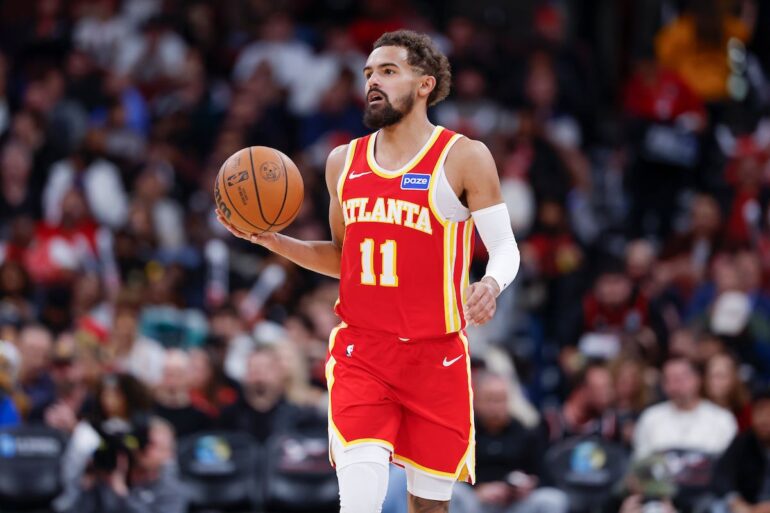
The relationship between Trae Young and the Atlanta Hawks never appears completely settled. Atlanta hasn’t agreed to an extension with Young, much to his chagrin, and its current success while he’s sidelined isn’t helping his case. As Young nurses a sprained MCL, his Hawks are one of the NBA’s hottest teams.
Since his last game on Oct. 29, the Hawks have notched a 7-2 record and the league’s ninth-highest net rating (plus-9.5). Normally, Young’s absence craters Atlanta’s offense but that isn’t the case right now. The Young-less Hawks have managed a ninth-ranked offense (118.3 offensive rating) alongside a top-five defensive performance.
Young’s absence means the Hawks are running more than ever in transition and they’re bashing teams in the open floor. Since he went down, Atlanta leads the NBA in transition points added (6.5), is second in points per 100 transition plays (145.6) and owns the seventh-highest fast-break frequency.
Atlanta’s ball-hawking defense, spearheaded by Dyson Daniels, creates countless run-out and breakaway chances for its cavalry of high-flying athletes. None are more devastating in the open floor than Jalen Johnson, who can grab and go to dribble through entire defenses before finishing himself or finding open teammates.
The Hawks lean on transition but still have generated an effective half-court offense across this nine-game stretch, ranking 13th league-wide. Even without Young’s pick-and-roll mastery, they are finding ways to tread water and win games offensively without fully relying fully transition play.
They’re the league’s most efficient cutting offense, maximizing their connective playmaking feel and collective athleticism in spite of weaker handling and off-dribble scoring. Atlanta ranks first in points per possession on cuts (1.39) and eighth in frequency (eight percent), weaponizing off-ball movement as well as any team in the league.
Ball watch against the Hawks at your own risk. They’ll cut behind or right in front of a defender’s face, both within and outside of head coach Quin Snyder’s offensive structure. Johnson might be the NBA’s deadliest cutter as a playmaker and slasher, boasting the athleticism to soar above the rim and the vision to pick out teammates in tight windows.
He ranks in the 99th percentile for rim volume (6.9 attempts per 75 possessions) at an excellent 79.5 percent clip and in the 100th percentile for rim assists (3.8 per 100 possessions), both stemming from timely dives to the rim via Johnson and his teammates.
Nickeil Alexander-Walker has stepped up in Young’s absence to stabilize the offense, leaning on his funky, deceptive handle and shot-making goodness. He ranks second among healthy Hawks in usage rate (25 percent) behind Kristaps Porzingis and third in on-ball rate (23 percent), trailing Johnson and Keaton Wallace.
Despite carrying the largest offensive load of his career, Alexander-Walker’s efficiency sits just below league average. When plays break down and Atlanta needs a bucket, he’s one of its most reliable bailout options.
As impressive as some of Atlanta’s overall numbers are, the Hawks haven’t produced a successful offensive output against strong defenses. All seven of Atlanta’s wins have come against defenses outside of the top 10, with three bottom-10 defenses on the slate. The Hawks fell twice to top-10 defenses, producing a fourth percentile offensive rating against the Toronto Raptors and an 11th percentile effort against the Cleveland Cavaliers.
Those two defenses expose Atlanta’s main weakness. Without Young, few, if any, Hawks reliably manufacture advantages and score off the dribble. Alexander-Walker is their most effective nominal point guard but his efforts alone aren’t enough to carry the offensive burden against rangy, aggressive defenses.
Despite their high offensive rating, the Hawks rank 24th in turnover rate (16.3 percent) across this nine-game stretch compared to fourth with Young in the fold (12.6 percent). Three of Atlanta’s four healthy leaders in on-ball rate, Daniels, Johnson and Wallace, aren’t pull-up shooting threats, making it easy for defenses to switch and pack the paint.
Possessions like these occur far too frequently, with the Hawks overpassing and turning down open looks. The Los Angeles Clippers ignore Daniels on the ball, who doesn’t look to shoot, then proceed to ignore Onyeka Okongwu in the corner and Atlanta forces a shot at the end of the clock:
Tighter defenses, especially in a postseason setting, will limit the effectiveness of Atlanta’s currently elite cutting. Cuts and off-ball movement bend and confuse defenses but focus and defensive tactics can overcome these cuts. Some of the Hawks’ better defensive opponents took away these easy points through sharper off-ball awareness.
Johnson’s half-court creation is his primary offensive weakness; he’s posting a minus-11.4 percent relative true shooting percentage on isolations, post-ups and pick-and-rolls. If defenders successfully pressure his handle and take away passing lanes, he can sputter without a reliable scoring method against set defenses.
Without a threatening pull-up jumper or dynamic advantage creation, Daniels shares similar limitations against intact defensive shells. He’s a phenomenal connective player but switching defenses concedes him space and he often isn’t able to generate much aside from contested intermediate shots.
Unreliable creation might lead Atlanta’s currently effective half-court offense to regress throughout the season. It’s found some promising wrinkles with post and handoff touches, weaponizing Porzingis’s mismatch scoring to punish switching defenses. He’s an extremely effective post-up scorer, producing 92nd percentile efficiency on 88th percentile volume.
Atlanta will face its best defensive opponent yet on Tuesday as it hosts the 12-2 Detroit Pistons and their second-ranked defense. Even with Young back healthy, the Hawks haven’t beaten a team with a top-ranked defense yet. Detroit’s potent defense forces tons of turnovers and swarms teams at the basket. It will challenge Atlanta’s cutting and off-ball movement with hard, on-time rotations.
A productive offensive day, regardless of the result, begins to answer Atlanta’s most paramount question: In a post-Trae Young world, where does half-court offense come from? Young’s absence brings undeniable benefits, primarily on the defensive end. But in an eventual playoff series, the Hawks will need a genuine primary option and that player isn’t currently on the roster.
This roster composition only functions with Young covering up for a team-wide lack of dribbling and creation while his teammates cover for his defensive limitations. That formula doesn’t work if Young isn’t playing at an elite level and he wasn’t to begin the season, mustering the lowest scoring rate (21 points per 75 possessions) and efficiency (minus-7.3 relative true shooting) of his career.
Young played fewer than 150 minutes before his injury and was accessing the paint more than in recent years. But it’s fair to worry about how far this version of Young, after his history of lower-body injuries, can carry Atlanta’s offense. Are the Hawks ready for a full-on pivot away from Young, shifting to a defense-first, transition-heavy identity?
That formula has them playing like one of the better teams in the Eastern Conference at the moment. Maybe, Atlanta hopes to turn this stretch into a permanent formula and ship Young off for assets and draft picks. The Hawks own the 2-12 New Orleans Pelicans’ 2026 first-round pick and if that turns into an elite prospect, it could solve their offensive problems. But there’s no guarantee the lottery favors them.
Extending Young, still 27 years old, is the safer play. Even a diminished version of Young ranks among the league’s best one-man offensive engines. Replacing his production in the aggregate will require the addition of multiple creators or a major leap from Johnson or Daniels.
Those two are fueling a fast, fun Hawks team that’s winning games but it’s far too early to press the eject button on the franchise’s longtime centerpiece. When winning NBA titles is the goal, impressive small sample results stemming from a shaky process shouldn’t spark wholesale change — not yet, at least.