
Among the NBA’s top-five scorers this season, three — Luka Doncic (35.3 points per game), Shai Gilgeous-Alexander (32.8) and Donovan Mitchell (30.6) — are perimeter-oriented dynamos who ignite bucket after bucket for themselves with the ball in their hands.
A fourth member, Giannis Antetokounmpo (30.6), is Mr. Elastic meets bulldozer, a 6-foot-11, do-what-he-wants slasher who can toggle between hard-charging drives and simpler play-finishing opportunities. It’s duality borne from his distinct blend of brawn, flexibility, footwork and 7-foot-3 reach.
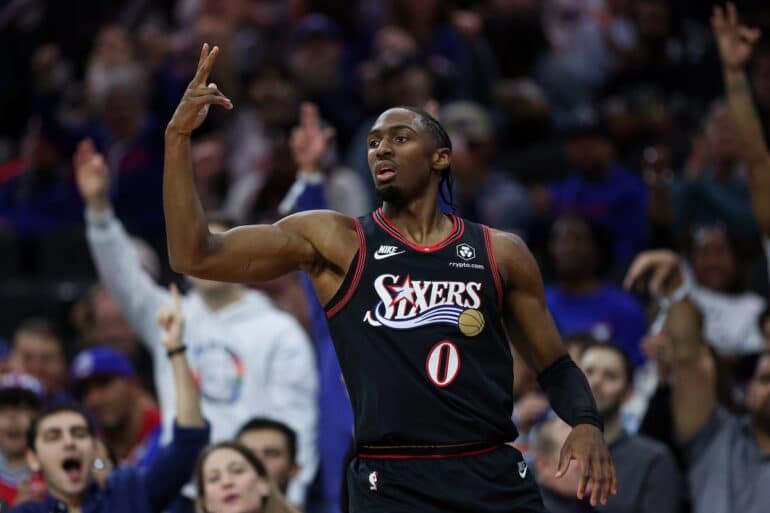
Nestled third in this quintet, however, is a 6-foot-1 lightning bug who treats the court’s 4,700 square feet like his personal pinball machine, ricocheting, darting, pinging and springing into space for a nightly 35 points. Tyrese Maxey is averaging a career-high 32.5 points per game and while he does dominate the Philadelphia 76ers’ offense, 49 percent of his field goals come via assists. That mark is well below Gilgeous-Alexander (18 percent), Doncic (23 percent) and Mitchell (33 percent), and identical to Antetokounmpo, whose physical gifts let him be spoon-fed scores easier than Maxey can be.
This is despite Philadelphia’s barren ball-handling depth and its fellow presumed offensive focal points, Joel Embiid, Paul George and Jared McCain, missing a combined 36 games and spending plenty of the games they have been available either rounding into form and/or on a minutes limit.
Among perimeter players (big men exist in their own, different realm), Maxey has asserted himself as the league’s premier high-volume, off-ball scorer not named Stephen Curry. According to NBA.com, he leads the NBA in miles traveled per game offensively (1.60) for the third straight season. Unlike the prior two years, though, head coach Nick Nurse and his staff have altered Maxey’s deployment to better suit his skill-set.
Maxey paces the NBA in touches per game (105.9) but his on-ball rate (35.7 percent) is actually down from 2024-25 (40.1 percent) and 2023-24 (38.8 percent), even though the Sixers are again plagued by creation and injury woes. Similarly, that share of assisted makes (49 percent) is up from 2024-25 (37 percent) and 2023-24 (43 percent). It much more closely resembles Maxey’s numbers during the James Harden era and his rookie year, which hovered between 47 and 55 percent throughout those three seasons.
To help facilitate Maxey’s improved efficiency (61 percent true shooting this year, 56.8 percent over the prior two seasons) and sustain superstar-level volume, the Sixers are dialing up more off-ball usage. Compared to 2024-25, his pick-and-roll frequency (33.1 percent -> 26.9 percent) and isolation frequency (15.9 -> 13.1) have dipped, per Synergy. Meanwhile, his spot-up rate (11.9 -> 14.6), cutting rate (1.0 -> 3.3) and off-screen rate (5.3 -> 5.7) are all on the upswing.
Maxey’s superlative traits are his speed off of the catch and immense shooting versatility. His weaknesses hinge on a serviceable but not dynamic handle and the general constraints associated with a 6-foot-1 frame. In pick-and-rolls or isolations, the latter foibles are amplified — particularly with ball-screens featuring the Sixers’ poor scoring big men beyond Embiid — and the former skills are negated.
This season, far more possessions truly commence once Maxey is off the ball (sounds like a certain Bay Area baller!). Whether it’s curling around screens and handoffs or freelancing into advantages by wielding his incessant motor, zestful burst and threatening jumper, the 25-year-old is rarely static. He’s at his best in motion, leaving defenders a step behind with no choice but to concede preferable shots or foul the jittery guard.
Although Maxey is atop the league in touches per game, his seconds per touch are at a career-low 4.25 — dramatic declines from 2024-25 (5.04) and 2023-24 (5.06). He’s involved more than ever but no longer resigned to as much ill-fitting involvement. His movement, stamina and shooting gravity are major advantage creation tools and atypical pathways to elite scoring volume.
He can’t spam endless pick-and-rolls en route to an efficient 30-plus points every game like Doncic, Gilgeous-Alexander and Mitchell, nor can they zip around tirelessly to hunt and fashion every exploitable seam in the defense.
Through six weeks, doctoring Maxey’s usage has worked wonderfully. The leap back to above-average scoring efficiency embodies that but is best enforced by the specific ways he’s excelling. According to databallr, he’s producing a 47.4 percent true shooting clip on 11.5 creation attempts per 100 possessions (isolation, pick-and-rolls, post-ups) in contrast to the 68.1 percent true shooting on 7.8 spacing attempts (spot-ups, handoffs, off-screens) and 68.1 percent true shooting on a career-high 12.4 finishing attempts (cuts, transition, put-backs, roller).
A season ago, as Maxey and Philadelphia toiled in a lost campaign, Maxey’s improved strength popped on both ends. He appeared more sturdy as an interior operator with vaster range from deep. Inside the arc, he was capable of comfortably maintaining a live dribble to access fruitful areas, keeping defenders stuck to his hip longer and decelerating/changing paces on balance to locate openings.
That’s translated to 2025-26. He’s shooting a career-high 53 percent on two-pointers and posting a career-best free-throw rate of .344 (.247 his first five years). Fifty-three percent isn’t a drastic spike from the 51 percent of the prior five seasons. But his added strength has made him a more diverse scorer equipped to shoulder a greater offensive load and stress defenses more often. Volume is a skill and Maxey has leveled his up, thanks partly to heightened muscle mass.
A sturdier build has also enhanced Maxey’s screening proficiency. His 0.5 screen assists per game are a career-high, which probably ties into his dangerous shooting and emergence as an elite scorer. Teams are wary of switching to grant him cement-footed mismatches and his movement shooting potential always lurks. All of that intensifies when he consistently sets diligent picks.
The Sixers will leverage his off-ball talents by stationing him one pass away and daring the opposition to help off of someone drilling 47.6 percent of their catch-and-shoot triples this season. When they don’t, driving lanes and creation chances appear for teammates. When they do, Maxey burns them.
He is not the vivacious on-ball engine Curry was at his peak but his off-ball game is eerily reminiscent. In that regard, I’m not sure we’ve seen someone vaguely approach Curry’s level like this since the two-time MVP broke out ~10 years ago. He is an anomaly because off-ball scorers can rarely score enough to clear the 30-point barometer. But Curry did. Now, Maxey is following the same blueprint.
Maxey’s tweaks and steps forward offensively rightfully garner most of the acclaim. He is tracking toward an All-NBA season on the back of a brilliant offensive showing. But man, the dude has become a considerably better defender the past two years. It didn’t make national waves in 2024-25 because the Sixers had plenty of other storylines dominating the news cycle yet it certainly transpired nonetheless.
His newfound strength enables him to wriggle over screens, cut off drives and guard up positionally in a pinch. After half a decade in the league, his positioning and defensive awareness have sharpened to render him a feisty playmaker; those hands are a menacing weapon! His Defensive Estimated Plus-Minus is neutral at a career-high 0.0 (53rd percentile) and his STOP rate (steals, offensive fouls drawn, blocks recovered by the defense) is a career-high 2.9 percent (68th percentile).
He’ll overindulge on those playmaking pursuits to compromise Philadelphia’s defensive shell or doze off to miss crucial rotations. No matter how much strength he gains, he remains a 6-foot-1 guard who opponents can bully for buckets. He has both approach and physical limitations capping his impact. Even so, the tape and numbers intersect to depict a superstar entering his prime playing the finest defense of his career.
Much like Embiid before him, Maxey is buoying the Sixers to relevancy. They’re 11.0 points better per 100 possessions when their superstar is on the floor. They cannot function on either end when he rests, which is never for very long each night.
As George and Embiid shuffle in and out of the lineup, Maxey has suited up for all 20 contests and averages a league-leading 40.1 minutes per game. That would be the most since Monta Ellis (40.3 per game) in 2010-11; Maxey’s 29 minutes during Tuesday’s rout of the Washington Wizards were a season-low.
He has this group ninth in the East at 11-9, just two games back of the No. 4 seed and three games up on 11th. Philadelphia resides on a precarious seesaw liable to vault up or down the standings any time the ball is tipped. The Sixers have played the NBA’s third-most clutch games (14) and are 8-6 in those bouts, with Maxey (66 clutch points, third-most) often determining their fate.
That’s no different than their collective season. Everything seems to hinge on him, their lone max player who’s not befallen by injuries and declining performance. He is delivering in the grandest of ways (11th in EPM, fifth in Estimated Wins) and rising up the league’s hierarchy through unique means — the product of individual growth and necessary schematic adjustments to unlock his optimized self.