

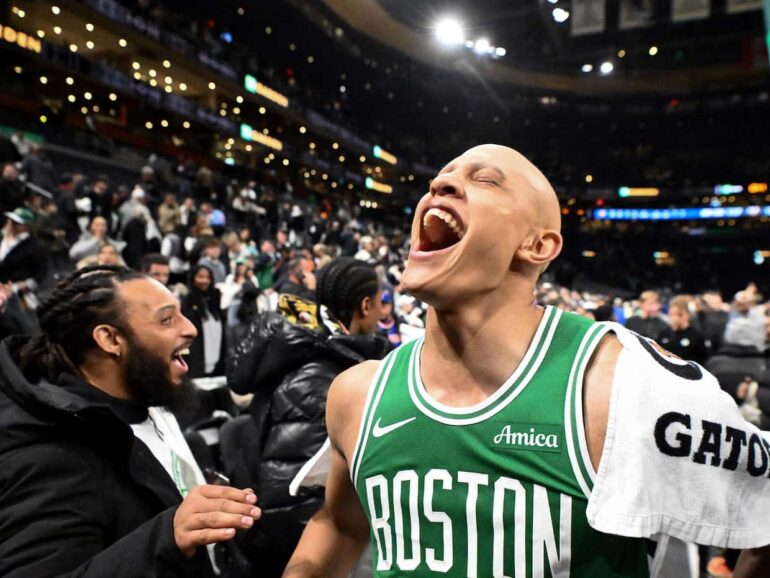
All offseason long, folks talked about the Eastern Conference like it Gotham City without The Joker and The Penguin, as the Boston Celtics and Indiana Pacers would be without their best players for the entire year. There was a power void to be filled at the top and everyone would be vying for the crown.
While new contenders have taken advantage of this opportunity (the Detroit Pistons and Toronto Raptors) and the Pacers’ season has gone of the rails quickly (5-18), the Celtics are still firmly in the mix — sitting at 15-9 and third in the conference standings.
How is Boston playing so well without its best player? Who is stepping up? Are the Celtics legit contenders without Jayson Tatum?
A Jolt Of Youth
Along with Tatum set to miss most/all of 2025-26 while rehabbing from a torn Achilles, Boston also parted ways with Jrue Holiday, Al Horford, Kristaps Porzingis and Luke Kornet. Those four were all among the team’s top nine in minutes played last season. That’s a lot of production to lose. But all four are on the wrong side of 30. In a league where the best teams are getting younger and faster (see the Houston Rockets, Oklahoma City Thunder, etc.), that could have caused the Celtics some issues.
The Celtics had the opportunity to bring in more athletic players without as much wear and tear on their bodies, so they did just that. Last season, their average age when adjusted by minutes was 29.3 (per NBA Age Analysis). This year, that number is down to 27. Jordan Walsh (21 years old), Josh Minott (23), Hugo Gonzalez (19) and Neemias Queta (26) are all getting the most run of their careers and making the most of it.
Being younger allows the Celtics to keep up with the times. After being put on the backburner by us nerds for a few seasons, rebounding has returned — namely, offensive rebounding. Teams have learned you can overcome below-average offensive personnel by having dudes who crash the glass for second-chance opportunities. For instance, the Rockets have the league’s fourth-best offense and it is almost solely powered by their top-ranked offensive rebounding rate.
After years of being an average/below-average offensive rebounding team, the Celtics are top 10 in this category (seventh). And what do you know, they also have the second-best offense in basketball (per NBA.com).
Being younger also helps them make up for losing their three best rim protectors (four, if you count Tatum). Walsh, Minott and Gonzalez are all gangly fellows who move well laterally, can hound people at the point-of-attack and wreak havoc in the passing lanes. They’re all in the 68th percentile or higher in steal rate (Gonzalez and Walsh are in the 90th percentile or higher). As a result, the Celtics are creating more turnovers as a team (13th in opponent turnover rate) than they were last season (23rd).
Jordan Walsh's defensive résumé over a 10-day stretch 👀
💻 @NBCSBoston pic.twitter.com/2BkSi5ahvk
— Taylor Snow (@taylorcsnow) December 7, 2025
Neemias Queta Has Leveled Up
I have a fundamental issue with the way we vote on the Most Improved Player award. We focus too much on increases in scoring that usually come from increased usage/opportunity instead of giving credit to the player who has genuinely leveled up the most as a basketball player. That is why I have spent the last few weeks championing the Queta-for-MIP movement. He almost certainly won’t win the award (he’s only averaging 10.1 points per game) but few players have taken the leap that he has.
Even the folks who carried the largest share of Queta stock in 2024-25 wouldn’t say he was anything more than a backend rotation player. Now, he is playing like a legitimate starting-caliber center. On the season, he ranks 17th in Estimated Plus-Minus. This doesn’t mean he’s an All-Star but it does tell us Queta is excelling in his enhanced role with the Celtics as a rim-runner, short-roll passer, offensive rebounder and paint guardian.
Queta’s emergence has helped quell people’s fears about the team not having a credible five man on their roster. Meanwhile, head coach Joe Mazzula has come up with a creative solution to their backup center conundrum: going small when Queta hits the bench. After trying to make Luka Garza work as the backup five, Boston has deviated from tradition, opting to use Minott in that role instead. During October and November, Garza averaged 14 minutes per game. But in December, he’s appeared in only two of four games and played 5.3 minutes in those contests.
This isn’t a perfect solution but these lineups seem to be working well in short bursts. According to Cleaning the Glass, Boston has a net rating of plus-32.9 in the limited time Minott, Sam Hauser, Jaylen Brown, Anfernee Simons and Derrick White share the floor (30 non-garbage time possessions). And the combination of Minott, Hauser, Baylor Scheierman, Simons and Payton Pritchard owns a plus-74.9 net rating in 25 possessions.
Jaylen Brown Is Ballin’
This doesn’t really fit neatly into the story I’m weaving but I couldn’t in good faith write a story about the Celtics without talking about the play of Brown. I’ve always been pretty low on Brown. He’s a great on-ball scorer and physical on-ball defender but believed he lacked the soft skills to really be the driver of a successful team (as evidenced by his mediocre plus-minus stats over the years). I felt this year would showcase Brown’s inability to be “the guy” and illustrate how much he benefited from Boston’s system.
Man, am I proud to say I was wrong. With no Tatum by his side and all the eyes on him, Brown is averaging career-highs in points per game (29.1), true shooting (58.9 percent) and assist rate (25 percent).
To be clear, Brown isn’t putting a group of bums on his back. Boston has nice complementary offensive players, rangy defenders and an emerging defensive anchor in Queta. This is a good team. But the Celtics need a top option offensively to put it all together. Brown has been that guy for them.
Sticking To Their Roots
Despite all the change this roster has incurred over such a short period of time, the Celtics are still trying to win the math game with Mazzula Ball, which refers to the Celtics’ extreme tendency to live and die by the 3-point shot. Some may have thought they would stray away from this ideology after losing some of their most voluminous marksmen but Mazzulla is as persistent as they come and they still have a litany of great outside shooters.
White, Pritchard, Simons, Brown and Hauser all hoist over five threes per game. As a team, the Celtics are third in 3-point attempts per game and first in 3-point makes.
As we’ve seen in the past, Mazzulla Ball comes with some extreme highs and lows. The Celtics have been on the wrong end of this before, losing to teams they’re expected to beat (see their 2023 series against the Miami Heat). But it also can propel them to a win they had no business acquiring and was key in their run to the 2024 title.
That’s what makes this Tatum-less version of the Celtics so fascinating. Without their best player, they don’t have enough top-end talent to be considered a true contender. But they still have enough to be pretty darn good. Couple that with how hot they can get from downtown and you have the recipe for a team ready to play spoiler in the 2026 postseason.