

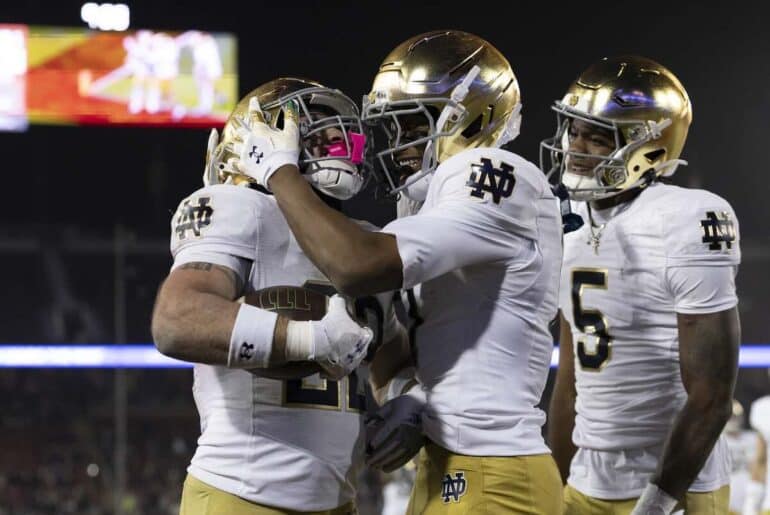
As 2025 bowl invitations roll out, a seismic shift is taking place in college football — one that could threaten the very existence of traditional bowl games. Programs like Notre Dame, Iowa State, and Kansas State have all declined postseason bids despite being eligible, and the dominoes are starting to fall.
Will Opt Outs Force The NCAA To Eliminate Bowl Games Entirely?
The importance of bowl games has been questioned in recent years, largely due to player safety. Many matchups were already seen as glorified exhibitions, and injuries to high-profile NFL Draft prospects have accelerated the trend of top players sitting out, further diminishing the competitive quality and meaning of these games.
Entire programs are now following suit. After being excluded from the expanded College Football Playoff, Notre Dame (10–2) declined a bowl invitation. Iowa State (8–4) and Kansas State (6–6) also opted out, citing coaching transitions and concerns over player health. The Big 12 fined each program $500,000, underscoring that refusing to play carries immediate financial consequences.
The ripple effect was immediate. Bowl committees scrambled to fill open slots, often inviting five-win or lower-profile programs, creating lopsided matchups that further erode competitiveness and fan interest. Fans and alumni have begun to notice — empty seats, mismatched contests, and declining ratings threaten both the spectacle and tradition of bowl season.
What’s happening in 2025 is more than a temporary blip — it could mark the beginning of the end for bowl season, threatening the NCAA’s $1 billion postseason business model.
How Eliminating Bowl Season Could Cost The NCAA $1 Billion
The postseason bowl system is a commercial powerhouse, with payouts surpassing $500 million since the NCAA adopted the College Football Playoff format in 2014–15. Revenue flows through conference distributions, CFP bonuses, travel reimbursements, sponsorships, media rights, ticket sales, advertising, and more.
The remaining Power Four conferences — Big Ten, SEC, ACC, and Big 12 — now receive roughly $100 million each in postseason distributions. The Group of 5 conferences collectively receive about $102.77 million combined, while Notre Dame accounts for $3.89 million and all other independents share a combined $1.89 million in payouts.
On top of base payouts, conferences earn additional revenue, including $6 million for each team sent to a CFP semifinal, $4 million for participation in non-playoff New Year’s Six bowls, and $2.85 million per game for travel expenses.
A single marquee team opting out can cost millions, and multiple programs skipping postseason games compound the impact rapidly.
Title sponsorships for early bowls range from $500,000 to $1 million, while CFP and New Year’s Six games can command between $25 million to 40 million. Add media rights, advertising, ticket sales, and the local economic boost to host cities, and the postseason ecosystem approaches $1 billion per season.
Why Notre Dame’s Opt Out Matters
Every opt-out chips away at the foundation of postseason football, but Notre Dame’s decision carries serious consequences.
The Fighting Irish finished the season 10-2, a record that would normally make them a strong candidate for a high-profile bowl game. Beyond the wins and losses, Notre Dame is one of college football’s most recognizable programs, with a nationwide fan base, historic tradition, and major media draw.
Their absence doesn’t just remove a successful team from the field, it eliminates a brand that drives ticket sales, television ratings, sponsorship value, and national attention.
Lopsided matchups, lost revenue, and diminished fan interest could force the NCAA to rethink an entire $1 billion business model built on games that no longer matter. What was once a holiday tradition could turn into a relic of the past, especially if some of the nation’s top programs believe that there is more to lose than gain by competing.