

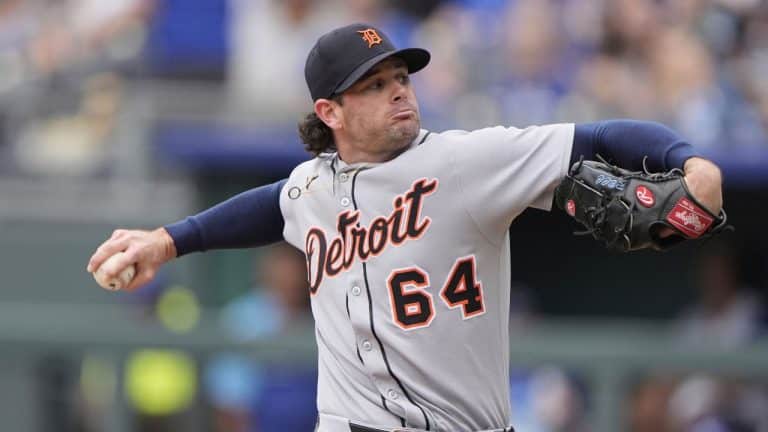
The Detroit Tigers re-sign Kyle Finnegan to a two-year, $19 million contract after his strong 2025 stint.
On December 9, 2025, the Detroit Tigers agreed to a two-year contract with veteran reliever Kyle Finnegan, worth $19 million (with incentives potentially pushing it to $20 million), pending a physical.
Detroit originally acquired Finnegan at the 2025 trade deadline from the Washington Nationals, and he quickly became a key part of the bullpen.
In 16 appearances with Detroit, he posted a 1.50 ERA and four saves over 18 innings, showing sharp command and effectiveness in high-leverage spots.
Tigers, RHP Kyle Finnegan agree to 2-year deal, per multiple reports including @MLBNetwork insider @JonHeyman. pic.twitter.com/NbzolxDskF
— MLB (@MLB) December 10, 2025
Across the full season between Washington and Detroit, Finnegan amassed 24 saves with a 3.47 ERA and 55 strikeouts, a solid rebound from a shaky first half with the Nationals.
For Detroit, a club riding back-to-back postseason appearances, locking in Finnegan’s services offers continuity and trust in the bullpen at a key moment. The club made a statement that it still believes it can compete in 2026.
Why this matters: bullpen value in a win-now window
Relief pitching is notoriously volatile, but experienced, effective arms that inspire confidence are rare. By re-signing Finnegan, the Tigers avoid rolling the dice on the bullpen market or buying younger, unproven arms.
Finnegan’s uptick after the trade, partly via an increased use of his splitter and better strikeout and whiff rates, suggests there’s sustainable upside.
Kyle Finnegan excelled in Detroit so much he wanted to run it back! pic.twitter.com/jjXNuWaZTQ
— Pitch Profiler (@pitchprofiler) December 10, 2025
Given that Detroit’s ace, Tarik Skubal, will likely be a free agent after 2026, preserving bullpen strength is a smart hedge: it helps keep the team competitive even if rotation churn follows. That may become a cornerstone of Detroit’s short-term strategy.
In a division as competitive as the AL Central, late-inning reliability can flip tight games. Finnegan gives Detroit a higher floor in close contests, which may matter more over a full season than sporadic big trades.
What to watch: risks, role, and bullpen dynamic
-
Health and workload: Finnegan missed some time late in 2025 due to a right adductor strain. Keeping him healthy and using him properly will be vital, especially if he resumes high-leverage or closing duty.
-
Role clarity: Last season, Finnegan shared closing and high-leverage duties (including with Will Vest). With a new contract, Detroit must decide whether to give him full-time closing responsibility or stay with a committee approach, a choice that could impact bullpen cohesion.
-
Supporting cast: A closer is only as good as the bridge arms and the rotation’s ability to hand off leads. Detroit may still need to invest further in middle-relief depth or veteran arms to support Finnegan and maintain overall bullpen health.
-
Budget balance: A $19–20M commitment over two years is significant for a reliever. As the Tigers consider possible trades or additions (especially with Skubal’s potential departure), payroll flexibility will become essential.
What this signals about Detroit’s outlook
By bringing back Kyle Finnegan, the Tigers are sending a clear message: they are aiming not just to return to the playoffs, but to stay in the mix.
This move suggests a front office wary of volatility in high-leverage innings and betting instead on known, controllable performance.
Kyle Finnegan fits well in Detroit and his numbers last season led to the Tigers re-signing him for a 2 year/$19M deal
In 18 IP with the Tigers post-trade he put up a 1.50 ERA and an 11.50 K/9. This included 4 Saves & 3 Holds
From non-tender to 2 year contract in 380 days… pic.twitter.com/aITepcJbol
— Baseball Unstitched Podcast (@BaseUnstitched) December 10, 2025
For fans, it’s a reassuring sign of commitment. The core is intact, expectations remain high, and Detroit appears to be playing for more than just reputation; they’re building toward a sustained contender window, maybe even a pennant run in 2026.
That said, this is just one piece. The Tigers will need to manage rotation contracts, bullpen depth, and perhaps add more offense or rotation help if they want to make a serious push. If they can assemble the supporting pieces around Skubal, Finnegan, and the bullpen, this offseason could be viewed as a turning point.
In short: Detroit didn’t just re-sign a reliever. They restocked a fundamental asset, late-game security, as they double down on competing now.