
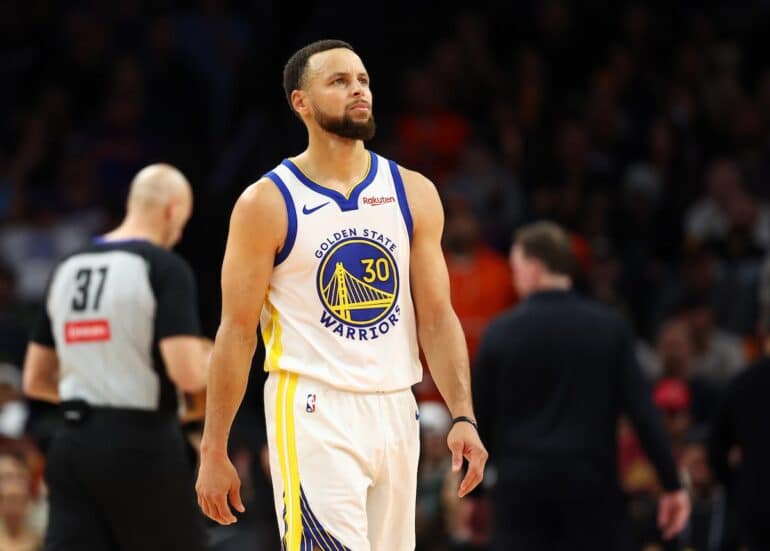
The larger issue for the Golden State Warriors’ offense in their most recent game — as it always has been this season and for what seems like time immemorial — was turnovers.
Heading into Thursday’s game against the Phoenix Suns, the Warriors were turning the ball over on 16 percent of their offensive possessions, which ranked 25th in the NBA (garbage time not included), per Cleaning the Glass. If you watch this team on a game-to-game basis, you’d be surprised there are five teams turning the ball over at a more frequent rate than these Warriors.
Another somewhat surprising stat: opponents average 20.3 points off of the Warriors’ turnovers, which ranks “only” 24th. Again, it’s somewhat of a minor shock there are six teams coughing up more opponent points off of their turnovers, especially on a night where they turned the ball over 20 times (20.4 percent of their possessions), which the Suns were able to turn into 30 points off of turnovers.
The Warriors gave up 30 points off turnovers. If turnovers were a person, they’d be the game’s second leading scorer behind Jimmy’s 31.
— Kerith Burke (@KerithBurke) December 19, 2025
That will be the main talking point behind this loss, and rightfully so. Some turnovers can’t be avoided, while others are solely or mostly due to the defense’s efforts. However, the Warriors are mixing in some questionable decision-making and a glaring lack of common sense, especially with some of the passes they make and given the situation at hand (i.e., the need for ball security being a clear priority over playing fast, the latter of which increases the chances of making mistakes).
An offense that requires incisive decision-making has been anything but. There is no doubt the importance of not turning the ball over has been repeatedly pounded into their minds; either ears are staying deaf or memories have been incredibly short (or both).
There is no deeper analysis required when it comes to the turnover problem. The solution is simple: pass with intention, but intention that makes sense. Balance the need between playing fast and playing with winning the possession battle in mind, in order to make sure possessions are being finished with a shot attempt (preferably an open one, more on this coming up). In other words (and I truly wish there was another way to say this, but words must not be minced when it comes to this issue): don’t play stupid basketball.
The Warriors’ Shot-Making And Play-Finishing Problem
With the turnover issue highlighted, the other prevailing issue is the problem of shot-making and play-finishing. BBall Index’s X account posted a rather revealing list of teams which lead the league in overall shot quality, according to its proprietary metrics. A couple of usual suspects were on the list, such as the Denver Nuggets and Oklahoma City Thunder. The Los Angeles Lakers being on it makes sense, given their plethora of advantage creation. The Atlanta Hawks are somewhat of a surprise inclusion, given the 21-game absence of Trae Young.
The fifth team on the list? None other than the Warriors.
The top 5 teams in Overall Shot Quality
1. DEN
2. LAL
3. OKC
4. ATL
5. GSWWith our team Leaderboard Tool we can look at metrics at a team level
— BBall Index (@The_BBall_Index) December 17, 2025
In short, the Warriors have been generating good, quality looks on offense — the caveat being that, for the most part, those looks simply haven’t been converted at a rate sufficient enough for their offense to be sustainable. One doesn’t need to look further than their place in the league’s offensive hierarchy, in which their 114.2 points scored per 100 possessions is 21st in the NBA. In half-court situations, their 97.7 points per 100 half-court possessions is 13th.
When supplemented with eye-test analysis, the Warriors’ offense does indeed generate good looks, built mostly on the advantage creation Stephen Curry and Jimmy Butler — in tandem or individually — generate. The ideal outcome of any play that involves one or both of them would look like the possession below:
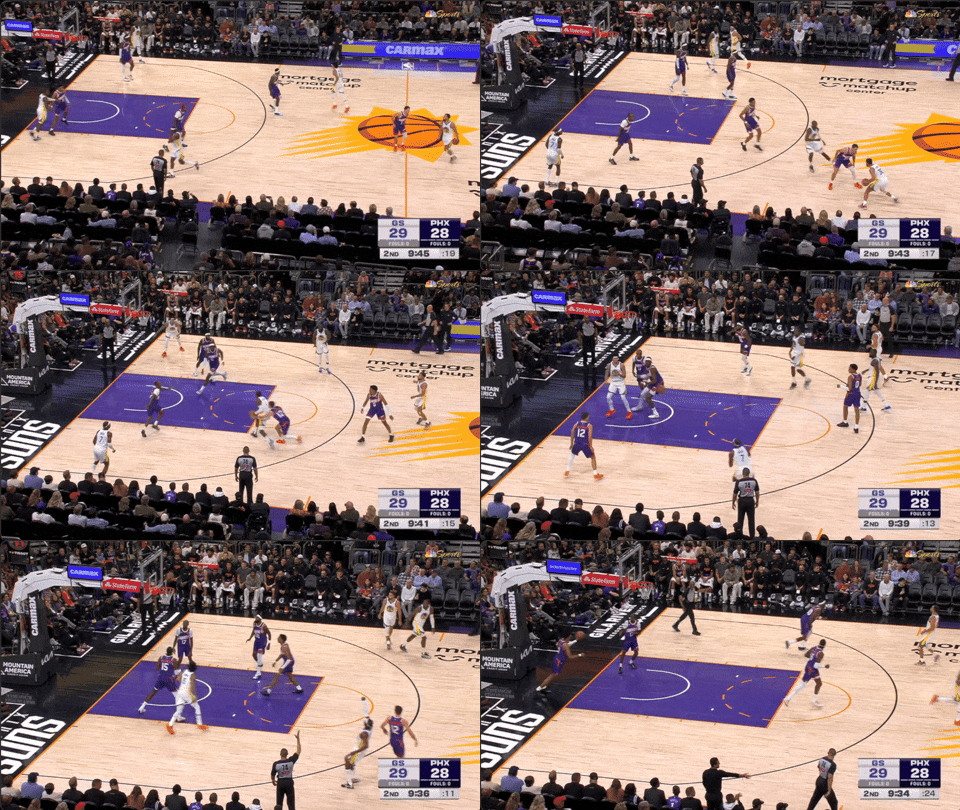
The Suns are put in a blender situation due to Curry drawing two defenders around a screen (set by Jonathan Kuminga in the above instance). Kuminga receives the ball in the short roll, finding Gui Santos lurking along the baseline, and the possession is finished with a Buddy Hield three when Santos kicks out to the open Hield — open because of the spark Curry ignited at the point of the screen.
Hield made the shot above but that has felt more the exception than the norm throughout this season. The Warriors are still the most frequent 3-point-shooting team in the league — nearly half of their shots (46.2 percent) have been beyond the arc. However, they’ve only converted such shots at a rate of 36.9 percent, ninth in the league. Given how many threes they attempt, merely being ninth and around 0.8 percent better than league average isn’t a winning recipe.
Everyone Else Around Curry And Butler Just Haven’t Been Good Enough
Furthermore, Curry profiles as one of the league’s best shot makers, per BBall Index. The problem, as mentioned above, is everyone else that surrounds him on the roster:
we back https://t.co/ebzG0sEvgP pic.twitter.com/AE9qLoEUX5
— Automatic (@automaticnba) December 16, 2025
At 37 years old, Curry is still a shot-making wizard who has been consistently creating advantage after advantage, even on nights where his self-creation and scoring are tempered (such as against the Suns, during which he was limited to 15 points on 3-of-13 shooting). The mere fact Curry is on the floor is an offensive advantage in and of itself, as evidenced by the possession highlighted above.
Substitute Butler in for Curry and that still rings true to a certain degree. While Butler’s form of advantage creation can oftentimes take an altogether different form — his isolation touches end in drives either he finishes at the rim or a bucket from a teammate out of a kick-out pass — the same problem plaguing Curry has also victimized Butler’s advantage creation exploits.
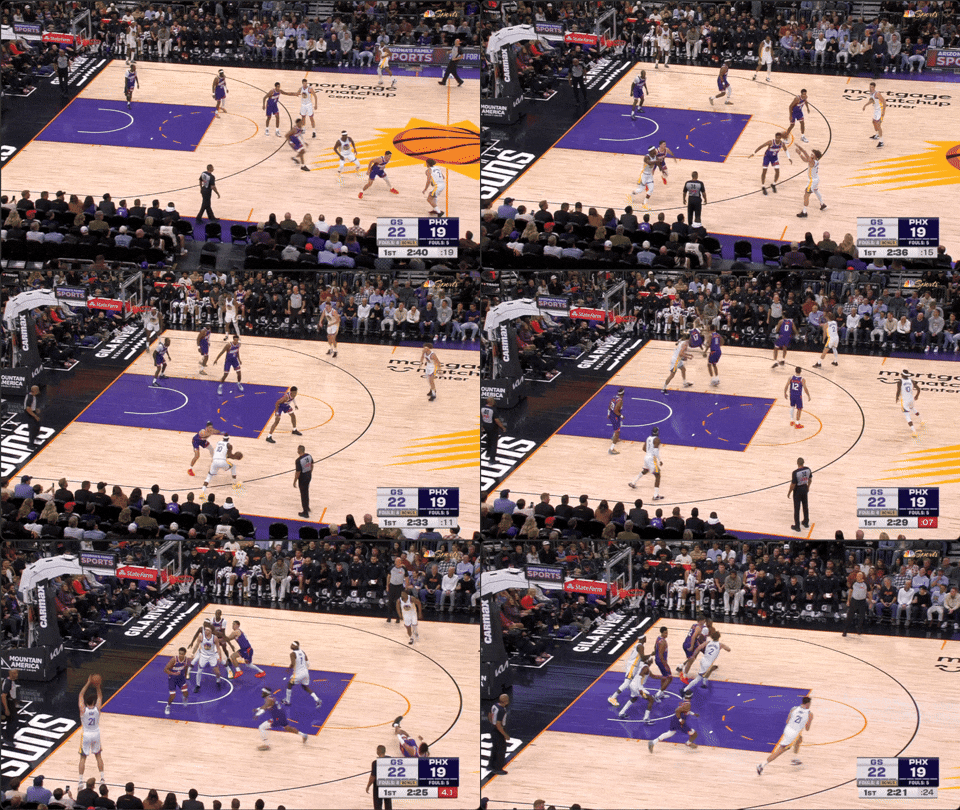
The possession below isn’t an advantage born out of a Butler isolation touch but instead one created off of constant movement (of which Butler is an eager participant). Quentin Post is given a wide-open corner look but the shot doesn’t fall:
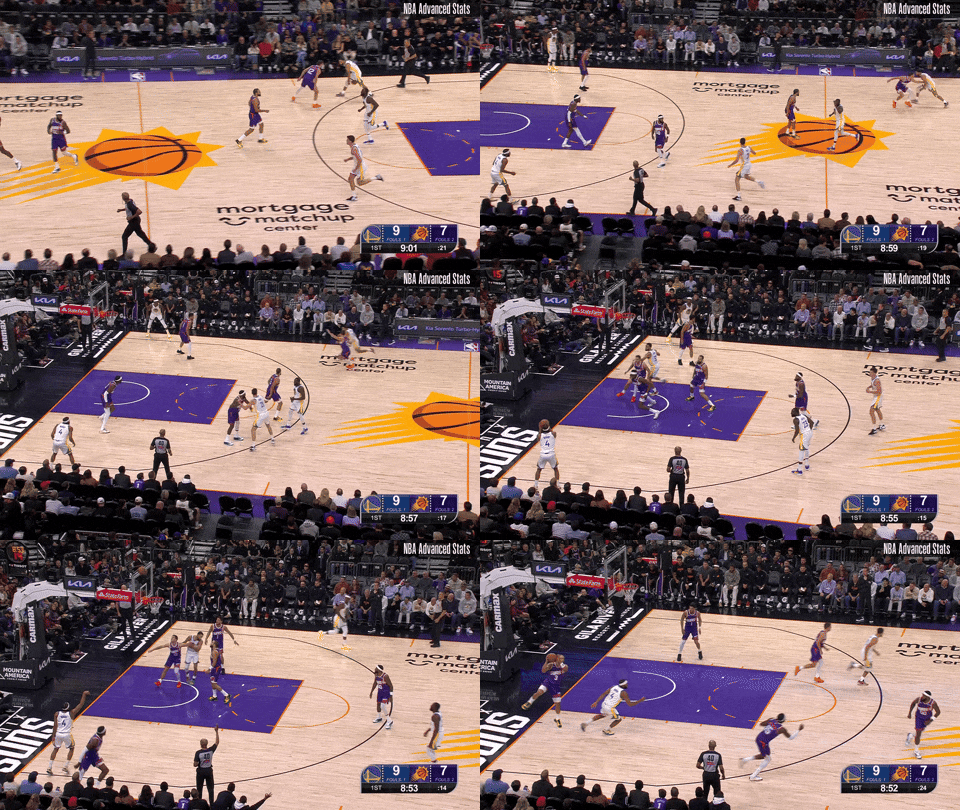
On another possession — a straight-line drive by Curry against Collin Gillespie, in which an off-ball screening action involving Draymond Green and Post provides further clearance — Moses Moody is given a wide-open corner look due to Mark Williams (the low man) helping on the drive. But Moody misses the virtual gimme:
Missed corner threes were a theme against the Suns; it’s a theme which simply cannot continue for a team shooting the second-highest rate of corner threes in the league (12.7 percent) but are only 12th in success rate (38.3 percent). The easiest 3-point look on the floor — by virtue of it being a shorter distance from the rim than any three above the break — has been anything but easy for the Warriors. Never mind Curry and/or Butler creating advantages — even those created from drives by any other Warrior not named Curry or Butler were ultimately for naught:
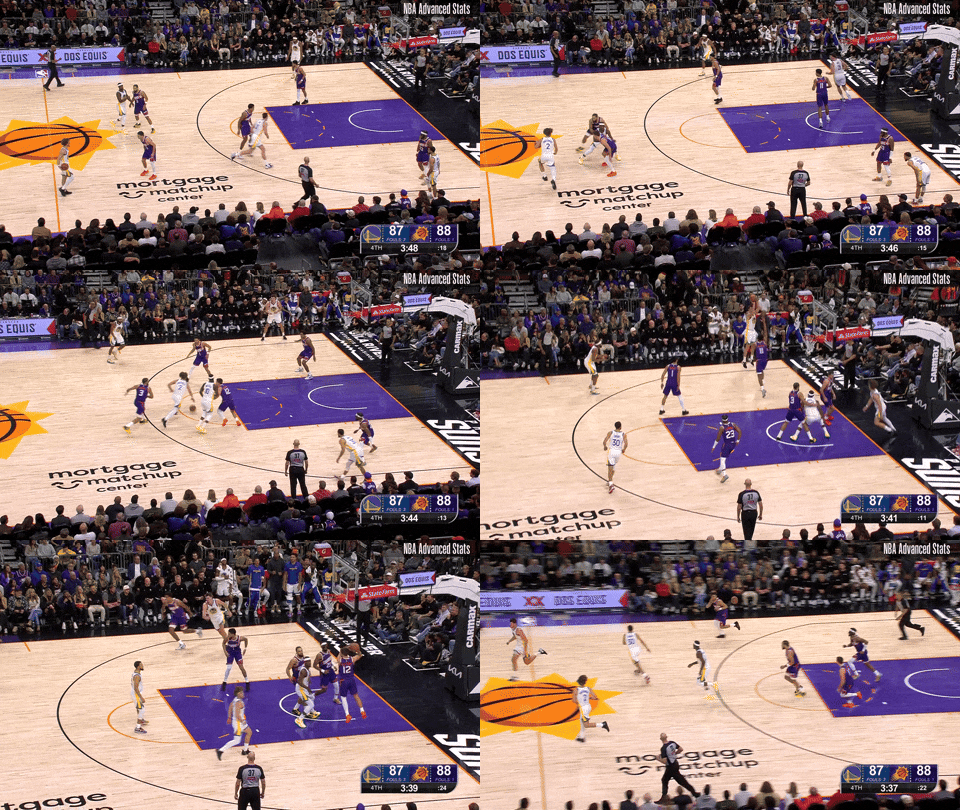
Post clears to the corner, while Brandin Podziemski receives a screen from Butler. Dillon Brooks jumps out to switch but takes a bad angle, allowing Podziemski to attack and touch the paint. Oso Ighodaro helps on the drive, off of Post in the corner. Podziemski dishes to Post, who is given another wide-open corner look but misses again. Post finished the night on a 2-of-10 clip from deep. The entire team attempted 42 outside shots but were only able to drill 12 of them — 28.6 percent.
Games are hard to evaluate on a shoulda-coulda-woulda basis, given the myriad of factors that affect each and every possession. But despite turning the ball over wantonly, a few made 3-pointers here and there may have changed the outcome of this game. Apropos to that sentiment, this team can best be described as a shoulda-woulda-coulda team.
This team should be a better one, given the top-end talent. It would’ve been a better team if mistakes were avoided and if the team had any sort of consistency, both in terms of on-floor execution and lineup stability. Some things are out of the Warriors’ control but those that have been (i.e., simply pushing the “play better” button) could’ve garnered them a better record and standing in the bloodbath that is the Western Conference.
But in the NBA, things always don’t go as planned. To account for that, the Warriors needed to be adaptable and resolute in the face of adversity. So far this season, they have been anything but.