
In their recent matchup against the Charlotte Hornets, the Los Angeles Lakers – bludgeoned by an Eastern Conference bottom-dweller – had one glaring problem on defense.
With the two-minute mark approaching in the second quarter, the Hornets, known for their hallmark guard-guard ball-screen action that has become an effective driver of their 10th-ranked offense (non-garbage time), sought to switch Gabe Vincent onto Brandon Miller via a screen by rookie Kon Knueppel, whose defender (Jake LaRavia) was given no choice but to acquiesce, given the danger of Knueppel “ghosting” or faking the screen to flare out for a three.
Sporting a commanding five-inch height advantage, Miller smells blood with Vincent defending him. After creating space with an unapologetic bump, Miller rises up for a nigh uncontested jumper, with the vertically challenged Vincent having no effect with his hand on Miller’s face:

Near the end of the first quarter of the Lakers’ home contest against the Toronto Raptors, a drag screen by Scottie Barnes forces Vincent to switch onto the Raptors’ 6-foot-8 forward, who immediately nudges Vincent toward the rim. Recognizing the blatant mismatch, LeBron James – guarding Gradey Dick – calls for Vincent to bump off of Barnes and onto Dick in the corner, a maneuver known as a “scram” switch.
Vincent follows James’ instructions. However, the attempted bail-out quickly turns into a disaster:

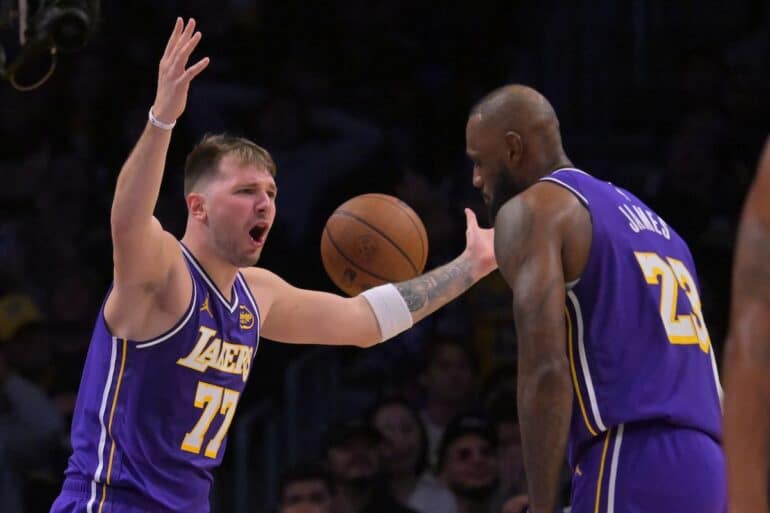
Vincent does indeed scram out toward Dick but James forgets to take Barnes in return. As a result, Barnes is left alone on the dunk, with James looking exasperated (on a breakdown that technically was his fault).
While the problem of switching into a disadvantageous matchup and switching out of one is but one piece of the entire defensive problem, it has become a worrying pattern for the defensively compromised Lakers squad, which ranks 25th in defensive rating this season.
To Switch Or Not To Switch?
Not only are the Lakers one of the league’s most switch-heavy teams – they are the most frequent switching team in the league. Around 46 percent of the screens set against them are being switched. This brings into question the choice of whether to switch or not switch, which, at its core, is a matter of personnel.
Historically, teams excelling with a switch-heavy scheme have had the personnel to make it feasible. Each defender is almost always of a similar physical makeup: lengthy wings who are capable of switching up and down the positional spectrum, possessing the requisite foot speed to maintain lateral movement against speedy guards and the length to fight capably against bigger and taller front-court players. Moreover, even with such a makeup on the roster, switching requires a non-insignificant amount of intelligence and knowhow.
That is not to say the Lakers are bereft of intelligence and knowhow, nor are they necessarily a small team across the board. However, their weak points have been glaringly picked on throughout this season – as early as the first game of the year. As opposed to switching being a tool to take command of a possession, it has become a band-aid solution to hide weaknesses (and, in the process, expose them):

Granted, a screen by Stephen Curry would be enough to coax an emergency switch, given the the need to maintain contact with the greatest shooter of all time at all times. But the consequences can be dire, with Vincent having to take Jonathan Kuminga on the drive, forcing multiple bodies to help from the weak-side. This leaves Al Horford open on the dump, with no one to contest him due to the help.
Even worse than a disadvantageous switch is where no switch occurs at all – similar to how James and Vincent botched the scram switch in the aforementioned possession against Toronto:

Curry again sets the screen, this time for Jimmy Butler. Vincent and Luka Dončić commit the cardinal sin of sticking to Curry on the screen, allowing Butler to drive to the hoop and draw a foul.
Not every mistake has looked as drastic as the one above but it does represent the conundrum the Lakers have had at the point of the switch, while speaking to a larger problem concerning their defense. That end of the floor has always been a matter of control – i.e., a tug of war between a defense being able to dictate the tenor of a half-court possession vs. an offense’s ability to pull the strings and move a defense around until it completely shatters.
Top defenses wrest control from opposing offenses while mediocre ones all too easily allow themselves to be controlled. The Lakers have been too mired in the latter category, letting opponents dictate matchups courtesy of switches and allowing them to create advantages as easily as breathing:

Kevin Durant calls for a screen to get Dončić switched onto him, immediately ringing alarm bells throughout the rest of the Lakers’ defense. Instead of sticking to Jabari Smith Jr., Rui Hachimura opts to cut off a potential Durant blow-by and shows help at the gap – one pass away from Smith. Durant simply finds Smith on the wing for a three, a downstream consequence of the initial switch.
Which begs the question: exactly why do the Lakers switch so much, to the point they are providing opposing teams matchups they are seeking?
To Move Or Not To Move?
Ideally, a team that switches keeps an offensive possession flat, preventing dribble penetration as much as possible and encouraging inefficient shots out of opponents. An inefficient shot can take several forms, depending on player and schematic context – but in this day and age, an inefficient shot has generally come to be defined as a long midrange jumper.
Teams which give up more midrange shots aren’t necessarily the best defenses in the league. The Sacramento Kings – 27th in points allowed per 100 possessions – cough up the highest rate of opponent midrange shots at 35.5 percent. Meanwhile, the Lakers have an opponent midrange frequency of 30.1 percent, placing them in the middle of the pack when it comes to letting opponents step inside the arc and attempt jumpers or floaters.
But when it comes to letting them step inside the arc and drive all the way to the rim, an uglier picture immediately comes to mind. While they have also been middle of the pack in opponent rim attempt rate (31 percent, 14th), opponents shoot a whopping 72.2 percent at the rim – with only the Kings having a worse opponent rim field goal percentage in the league (72.7 percent).
This particular problem stems from a glaring lack of fight and urgency at the point of attack, some of which have come on standard straight-line drives and blow-bys without a preceding switch, and some that occurred despite a switch happening. An example of the latter – while revealing Lakers switches haven’t necessarily tempered the problem of point-of-attack defense – reveals yet another concern:

With Reed Sheppard getting Deandre Ayton to step up against him, Sheppard drives by easily. That in and of itself is a concern but the lack of help and backline resistance is arguably more worrying. Austin Reaves shows little desire to help at the gap, despite guarding a non-shooting threat in Josh Okogie. Marcus Smart doesn’t step up to show help on the drive, due to James never even attempting to bump Smart off of Steven Adams while James sinks in to “help the helper”; one can’t help on help that never occurs in the first place.
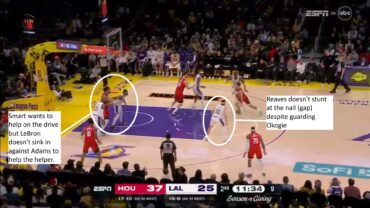
The possession above can be considered a microcosm of another team-wide defensive problem: the Lakers, simply put, barely move at all on defense.
Distance traveled on defense per 36, vs Def Playmaking.
Lakers are 1 of the most inactive teams on defense I’ve seen. Granted they play zone a lot now, watching last nights game was still a bit shocking seeing how many players just don’t move.
A lot of reliance on vando and… pic.twitter.com/b2leyCfddP
— Hoopology (@hoopologyxx) January 13, 2026
The lack of rotation and movement from their defense can be a schematic consequence of playing conservative coverages such as switching and drop, both of which aim to keep their entire defensive infrastructure from having to scramble around and defend on a string. Indeed, the Lakers are among the teams which employ the most conservative coverages, as their heavy switching has proven.
But that hasn’t stopped teams from burning them from another valuable spot of the floor: beyond the 3-point line.
The Lakers are in the bottom half of the league in opponent 3-point attempt rate (37.1 percent, 19th) and are near rock bottom in opponent 3-point percentage (34.5 percent, 26th). Interestingly, the breakdowns mostly come in the form of subpar switch execution against deadly pull-up shooters:

Passes to shooters whose defenders are showing help (due to an initial switch onto a potential mismatch):

And threes taken in transition (the Lakers are currently 21st in transition defensive rating):

In their attempt to minimize defensive movement through switching, the inconsistency in proper execution of switching ends up in them having to scramble and move anyway — fodder for opponents which willingly spray passes out toward the perimeter and patiently swing the ball until it finds an open shooter:

At 25-16 – sixth in the Western Conference – the Lakers are constantly teetering on the brink of outright playoff contention and Play-In mediocrity. The record may seem dandy, with a top-10 offense in terms of points scored per 100 possessions. But their defense continues to give up slightly more than the rate at which they’ve been scoring, resulting in a slightly negative net rating (minus-0.5, 17th) — but negative, nonetheless.
At 118.5 points allowed per 100 possessions, the Lakers are 25th in the league in non-garbage-time defensive efficiency. It’s unbecoming of a squad with the top-end talent to compete for a title but has simply been far from what is required of a championship-level defense.
Perhaps, they are one roster move away from finding a solution. But until they solve the literal problem of when and when not to move, no acquisition can mask the inherent warts that have been exposed for everyone to see.