
In the modern sports broadcasting landscape, “live” has become nothing more than a marketing term and the latest streaming data proves it.
According to the 2026 Super Bowl Latency Report by Stats Perform, some fans watching the Super Bowl on streaming platforms saw plays unfold more than a full minute after they happened on the field. In a viewing environment dominated by instant score alerts, social media, and second-screen engagement, that delay isn’t just noticeable — it fundamentally changes the experience for fans.
Measuring the Spoiler Gap
To quantify just how far behind “live” broadcasts really are, researchers used a globally synchronized clock accurate to within half a second, combined with in-stadium observers logging key moments such as kickoffs and quarter starts.
Those timestamps were then compared with when the same events appeared on consumer feeds across platforms and devices.
The results revealed a clear hierarchy and a surprisingly wide performance gap.
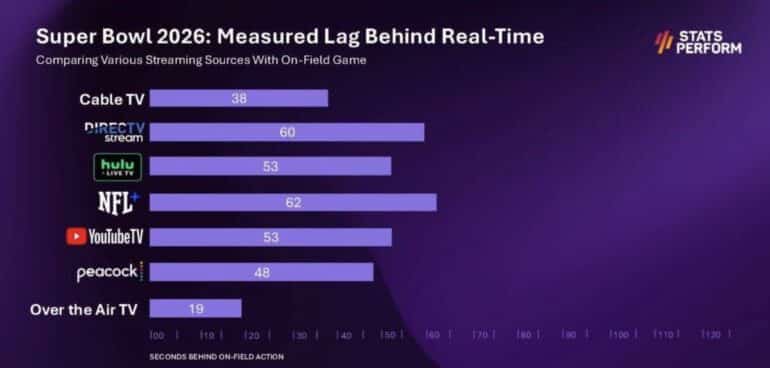
Measured delay behind on-field action:
- Over-the-air TV (antenna): 19 seconds
- Cable TV: 38 seconds
- Peacock: 48 seconds
- Hulu + Live TV: 53 seconds
- YouTube TV: 53 seconds
- DirecTV Stream: 60 seconds
- NFL+: 62 seconds
Even within the same service, viewers often experienced different delays, a phenomenon known as drift.
Two fans watching the same game on the same platform could be tens of seconds apart — a quiet but consequential fracture in what has traditionally been a shared, real-time event.
Why Seconds Matter More Than Ever
Latency has always existed in broadcasting. What’s changed is how people consume games and the cost that fans pay to stream the action.
Score apps update instantly, betting markets move in real time, and social media reacts to touchdowns before replays finish airing.
When video lags behind that ecosystem, that suspense evaporates.
The study found:
- 76% of streaming viewers feel annoyed when they realize their feed is behind
- 26% are frustrated by delays of less than five seconds
That five-second threshold is telling. It suggests fan tolerance for delay is shrinking, not growing. In the age of sports betting and prediction markets, live sports are now tightly into digital life.
For many viewers, the most jarring moment isn’t the delay itself, but the spoiler: a phone buzz announcing a touchdown that hasn’t appeared on screen yet.
Latency Is Now A Major Problem
What once felt like a technical inconvenience has become a strategic risk for streaming platforms.
In a survey of 1,000 NFL fans:
- 83% said they’re likely to switch platforms if their stream is delayed
- 63% said they would pay extra for a reduced-delay or no-delay option
As leagues and broadcasters push deeper into interactive features — live polls, alternate camera angles, synchronized watch parties, in-play betting integrations — real-time delivery isn’t optional. Those experiences only work if everyone sees the same moment at the same time.
Latency, in other words, directly affects retention, engagement, and revenue.
The Future: Closing the Gap
The industry’s response is a growing push toward sub-second, glass-to-glass streaming, a technology designed to eliminate the spoiler gap entirely. The goal is simple: bring digital broadcasts as close to the speed of the stadium as possible, while also narrowing the window that piracy exploits.
Until that becomes standard, the fastest option remains the least glamorous one.
If you want the closest thing to real time in 2026, the data is unambiguous: an over-the-air antenna still beats every major streaming service.
For an industry racing toward innovation, it’s a reminder that in live sports, speed — not just resolution or presentation — defines the experience. And increasingly, fans are watching the clock as closely as the score.