

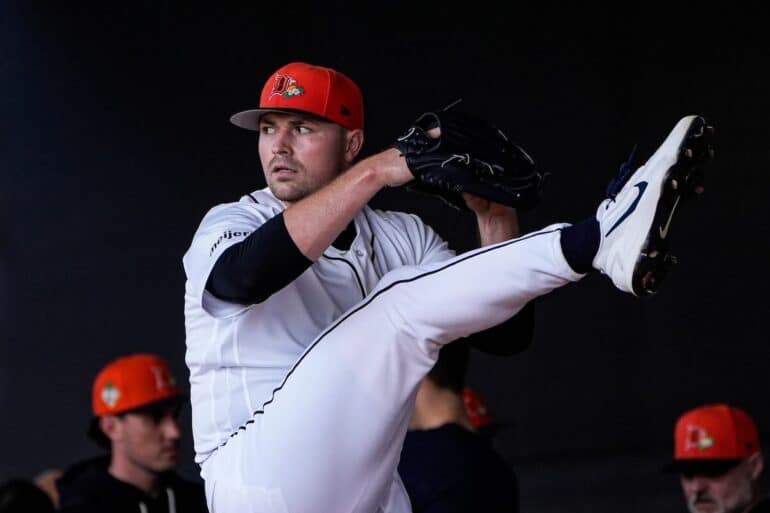
In a quiet hearing room on February 4, 2026, the bedrock of Major League Baseball’s salary structure didn’t just shift—it shattered.
Tarik Skubal, the two-time reigning American League Cy Young winner, won his arbitration case against the Detroit Tigers. The ruling grants him a $32 million salary for the 2026 season, a figure that obliterates every existing record in the history of the arbitration system. For a player still under team control, this isn’t just a pay raise; it’s a revolutionary act.
Breaking the $20 Million Barrier
To understand why $32 million is so jarring, you have to look at the ceiling Skubal just crashed through.
Before this ruling, the record for a pitcher in arbitration was $19.75 million, set by David Price—coincidentally with the Tigers—all the way back in 2015.
For over a decade, that $20M mark acted as an invisible tether for even the most elite arms.
Skubal didn’t just nudge that tether; he snapped it, nearly doubling the previous pitching record and even surpassing Juan Soto’s $31 million overall arbitration record from 2024.
|
Category |
Previous Record | Tarik Skubal (2026) |
| Pitcher Arb Salary | $19.75M (Price, 2015) |
$32.0M |
|
Any Player Arb Salary |
$31.0M (Soto, 2024) | $32.0M |
| Arb Panel Award | $19.9M (Guerrero Jr., 2024) |
$32.0M |
How Agent Scott Boras Pulled It Off
How did agent Scott Boras pull this off?
By leveraging a rarely-used clause in the Collective Bargaining Agreement (CBA) that allows “Special Accomplishments” to bypass traditional comps.
Skubal’s argument was easy to understand.
As the first American League pitcher since Pedro Martinez to win back-to-back Cy Young awards, Skubal’s camp argued he should be compared to the open market—where aces like Zack Wheeler and Gerrit Cole pull $36M–$42M annually—rather than the suppressed wages of the arbitration pool.
The Tigers filed at $19 million, a number that was “logical” based on old-school precedent but felt increasingly insulting as Skubal spent the last two years leading MLB in ERA (2.30), WHIP (0.91), and strikeouts (469).
The Fallout: A $70M Rotation and a New Market
The Tigers didn’t wait for the panel’s decision before moving forward with their “Win Now” mandate. Just hours after the hearing, they signed free-agent lefty Framber Valdez to a three-year, $115 million deal.
With Skubal at $32M and Valdez at $38.3M, Detroit now has over $70 million committed to just two starting pitchers in 2026.
It is the highest competitive-balance tax payroll in franchise history, signaling that the “rebuild” is not just over—it’s being funded with a blank check.
Why This Matters for 2027
Skubal is set to hit unrestricted free agency next winter. By winning this $32M award, he has set the absolute floor for his next contract. If he can command $32M while the team still “owns” his rights, the bidding war for his services in 2027 will likely start north of $400 million.
For the rest of the league, the message is clear: the days of getting “cheap” elite production from arbitration-eligible stars are dead.
Tarik Skubal just proved that if you play like the best in the world, the system can no longer force you to be paid like a bargain.