
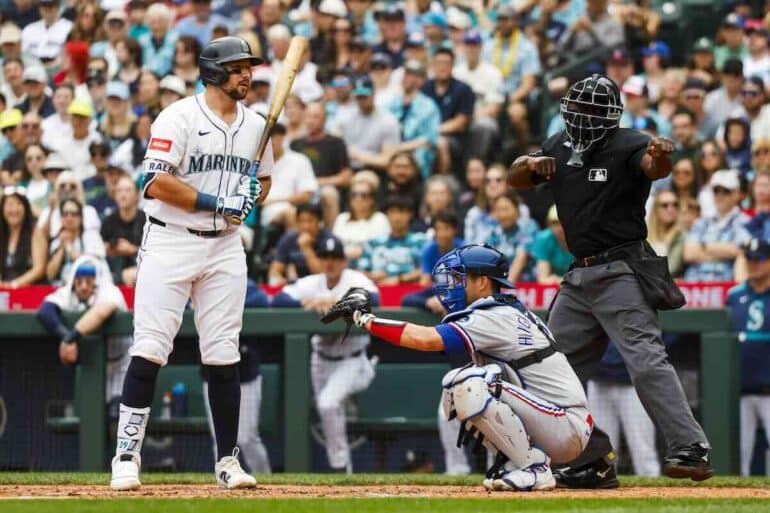
For over a century, baseball debates have boiled down to one simple question: was it a ball or a strike? Until now, players had no recourse when human error decided the outcome.
Starting with the 2026 MLB season, that changes — and it could redefine the game’s most critical moments.
The new Automated Ball-Strike (ABS) Challenge System doesn’t replace umpires. It gives batters, pitchers, and catchers the power to challenge calls in high-leverage situations, using the same Hawk-Eye technology behind Statcast. What was once a guaranteed argument now has a definitive answer, almost instantly — and the numbers show players are already using it to their advantage.
What Is the ABS Challenge System?
The ABS Challenge System is not “robot umpires.”
Human umpires still call every ball and strike in real time.
Think of it like instant replay for balls and strikes: the technology runs silently on every pitch and only comes into play when someone asks for a second look.
The goal, as MLB states plainly, is to “provide players with an opportunity to correct missed calls in high-leverage moments.”
How Does The ABS Technology Work?
Each pitch is tracked by 12 Hawk-Eye cameras installed around every MLB ballpark — the same system that powers Statcast.
When a challenge is requested, the result is transmitted over a 5G private network and displayed to fans in the stadium and at home almost instantaneously.
The whole process takes roughly 15 seconds and adds less than one minute to the total gametime.
Who Can Challenge?
Only the batter, pitcher, or catcher may challenge a call, by tapping their cap or helmet within about two seconds of the umpire’s ruling. Managers and coaches cannot challenge.
Umpires can deny a challenge if they believe it was influenced by someone in the dugout.
Each team gets two challenges per game and keeps one if the challenge succeeds.
In extra innings, a team that has exhausted its challenges receives one to start each half-inning — a small but meaningful lifeline in the game’s highest-pressure moments.
How Often Are Challenges Winning?
Through the first weeks of 2026 spring training, the results are striking.
According to Baseball Savant, players have challenged 457 calls, overturning 242 of them, a 53% success rate overall. Fielders (pitchers and catchers combined) have been the sharper challengers, overturning 142 of 254 attempts (56%), while batters have gone 100-for-203 (49%).
That gap isn’t a coincidence.
Catchers spend every pitch crouched inches behind the plate, developing an instinct for borderline calls that no other player on the field can match. T
he data backs it up, and smart teams will notice: designating the catcher as the primary challenge decision-maker isn’t just reasonable — it may become standard.
The Strike Zone: Personalized for Every Hitter
This is where the system gets genuinely sophisticated.
The ABS zone is a rectangle 17 inches wide — the width of home plate — with the top set at 53.5% of each batter’s height and the bottom at 27%. Location is judged as the ball passes through the middle of the plate, not the front edge.
But the zone isn’t built on a static measurement.
According to Sportvision, the company behind the original tracking technology, the center-field camera calibrates each hitter’s zone individually using guidelines from the MLB umpiring department.
There is a database for every hitter in MLB, and a rolling average of his strike zone is preloaded into the system each time he comes to bat.
That detail matters more than it might seem. Hitters naturally shift up and down in their stances — sometimes mid-at-bat — and a single height number couldn’t account for that.
The rolling average ensures the zone reflects how a hitter actually sets up in real game conditions. Spring training measurements, taken without cleats and confirmed through biomechanical analysis, serve as the baseline the system continuously builds on.
The result is a zone that is both rigorously standardized and genuinely personal.
How Does It Compare to What Umpires Call?
The ABS strike zone is slightly smaller.
Human umpires have historically called a zone topping out around 55.6% of a batter’s height and bottoming out near 24.2%.
The ABS zone is tighter. MLB research found it measured roughly 443 square inches in 2-2 counts, compared to 449 for the umpire-called zone.
The practical effect: marginally fewer strikeouts, marginally more walks, and pitchers who have lived on the edges of the zone will need to adjust.
Why Not Just Full Automation?
Because baseball resisted it — and for good reason.
Minor league testing with fully automated ball-strike calls led to more walks, slower games, and a near-total erosion of pitch framing: the ability of a catcher to subtly present a borderline pitch in a way that coaxes a strike call. It’s a craft some catchers have spent entire careers perfecting, worth millions in contract value and run prevention. Players didn’t want to lose it, and the league listened.
The challenge system preserves the human element while still giving players recourse when it matters most. As Commissioner Rob Manfred put it, the goal isn’t perfection — it’s having “a system in place that allows the players an opportunity to correct the high-leverage miss.”
The ABS Challenge System won’t eliminate every bad call, and it was never meant to. But when the count is full in the ninth and everything is on the line, players now have something they never had before: a way to fight back.
Whether they use it wisely is a strategy unto itself.