

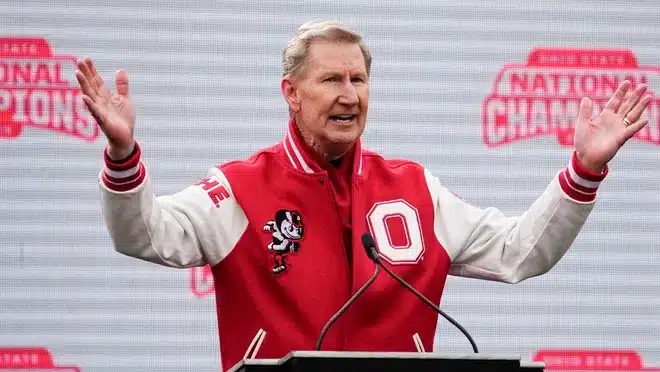
Ohio State thought it had stability when Walter “Ted” Carter Jr. arrived in Columbus. The former Navy vice admiral and University of Nebraska system president brought a resume built on leadership, discipline, and institutional management. Two years later, that tenure has ended abruptly after Carter disclosed an inappropriate relationship tied to someone seeking public resources from the university.
The resignation was accepted by the Ohio State Board of Trustees after Carter told them about the relationship and acknowledged that he allowed inappropriate access to university leadership. What makes the situation different from a standard campus scandal is not the relationship itself. It is the suggestion that the president’s office may have been used to help advance a private business.
While comparisons are being made to Buckeyes’ rival school Michigan, and their football coach, Sherrone Moore, this story is a little different.
Ted Carter Ohio State Resignation Raises Questions About Access To Leadership
BREAKING: In a statement, Carter said, “For personal reasons, I have made the difficult decision to resign from my role as president of The Ohio State University.”https://t.co/bZw8BRFSnU
— WSYX ABC 6 (@wsyx6) March 9, 2026
Ohio State confirmed that Carter disclosed an inappropriate relationship with a person who was seeking public resources to support her personal business. Carter also admitted that he made a mistake in allowing inappropriate access to Ohio State leadership.
Those phrases leave a wide range of possibilities open. Public resources at a major university can include staff time, institutional partnerships, research collaboration, donor introductions, or access to university branding and influence. The president’s office sits at the center of that network.
That is where the story shifts from a personal relationship into something larger. If a private venture was attempting to secure university resources, the central question becomes how that access was granted and whether it bypassed normal institutional processes.
Universities operate through layers of approval. Funding decisions, partnerships, and research agreements normally move through compliance offices and administrative review. Direct access to a president can shorten those pathways dramatically.
When Carter acknowledged inappropriate access to leadership, he effectively acknowledged that the situation crossed a line between professional networking and institutional favoritism.
Ohio State Board Of Trustees Moved Quickly After Disclosure
Carter’s exit moved at unusual speed. The president informed the board of the relationship and offered his resignation, which trustees accepted shortly afterward. The university announced the leadership transition publicly on March 9.
Ohio State has not identified the individual involved or detailed what resources were being pursued. The university also has not explained whether any funding, partnerships, or internal support were ultimately granted.
That silence is likely deliberate. Still, the lack of detail leaves several questions open. Was the private business seeking research collaboration, institutional sponsorship, or donor access through the president’s office. Did university staff participate in discussions connected to the venture. And at what point did trustees become aware of the situation.
Ohio State Leadership Instability After Second Presidential Exit
The Carter resignation also lands in the middle of a pattern that Ohio State would rather avoid. The university has now seen two presidents depart unexpectedly in roughly three years.
Carter began his tenure in January 2024 after previously leading the University of Nebraska system. Before moving into higher education leadership, he spent nearly four decades in the United States Navy and eventually rose to the rank of vice admiral.
His hiring was seen as an attempt to bring steady leadership to the university after the earlier departure of Kristina Johnson. Instead, Ohio State now faces another sudden transition while it continues to pursue long term strategic plans tied to research expansion and national rankings.
For trustees, the next presidential search will carry more scrutiny than the previous one. Stability at the top of a flagship public university is not simply a matter of internal management. It affects fundraising, athletics, research funding, and relationships with state government.
What The Ted Carter Affair Actually Reveals About Power At Major Universities
The most revealing part of the Ohio State announcement is not the admission of an inappropriate relationship. Universities have weathered those before.
The revealing part is the phrase about someone seeking public resources to support a personal business.
Public universities sit at the intersection of money, influence, and access. They control research partnerships, large donor networks, athletic branding, and government funding streams. The president’s office often acts as the gateway to those connections.
When that access becomes personal rather than institutional, the line between opportunity and favoritism can blur quickly.
Ohio State has not said whether any public resources were actually used in connection with the situation. For now, the university has framed the episode as a lapse in judgment that required a leadership change.
The unanswered questions surrounding access, influence, and institutional gatekeeping will likely continue long after Carter’s departure from Columbus.