
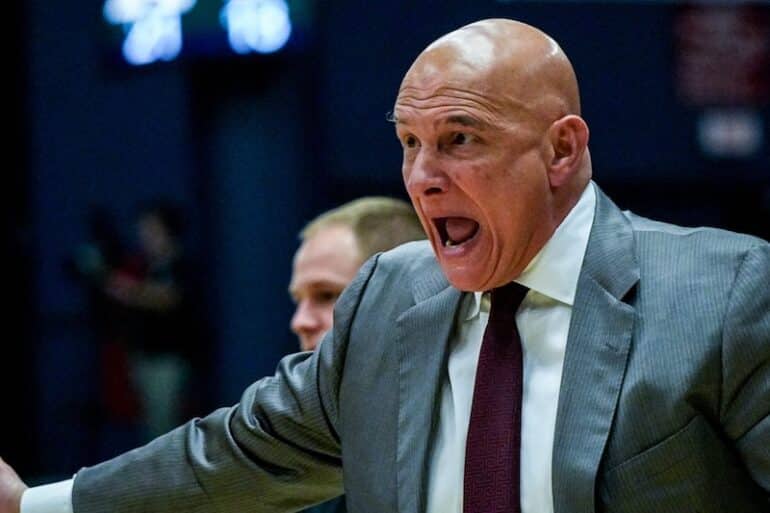
Frank Martin just knocked off the last undefeated team in the country. Then, he turned around and demanded they get into the NCAA Tournament anyway. That apparent contradiction tells you everything about the UMass head coach and about the broken logic embedded in a selection process he has spent years trying to expose.
On Thursday in Cleveland, Martin’s Minutemen handed the 31-0 Miami (Ohio) RedHawks their first loss of the season, 87-83, in the MAC Tournament quarterfinals. And then, almost before the handshakes were done, he said what a lot of college basketball people have been thinking for years.
“It’d be an embarrassment. A complete embarrassment if this league doesn’t get two teams in.”
But the most explosive thing Martin said this week didn’t come from a postgame podium. It came from a recent appearance on Fearless with Jason Whitlock and went straight to the origin of the problem.
“They rigged the whole system to protect the big conferences. It’s what they did. I don’t care if they get mad. I was in the meetings, I know what happened.”
"(The NET formula) rigged the whole system to protect the big conferences. I was in the meetings, I know what happened." – Former South Carolina/Kansas State and current UMass head coach, Frank Martin. pic.twitter.com/96tRAhuB3k
— Jason Whitlock (@WhitlockJason) March 13, 2026
The System, Explained
To understand what Martin means, you need to know how teams get evaluated on Selection Sunday. The NCAA uses the NET rankings, a formula introduced in 2019 to replace the widely criticized RPI, which grades every team and slots them into tiers called quadrants. Quad 1 represents the highest-quality wins: road games against top-30 teams, home games against top-75. The more Quad 1 wins you accumulate, the stronger your tournament case.
Here’s the problem. Power conference teams (Big Ten, SEC, ACC) play each other nearly every night. That means almost every game they play counts as Quad 1, regardless of outcome. Wins help, and even losses don’t hurt much. Mid-major programs in leagues like the MAC play most of their games against opponents ranked outside the top 200. Their schedule generates almost no Quad 1 opportunities.
It’s a structural head start baked into the calendar, and Martin says it was no accident.
“You know what we met about in the SEC?” he told Whitlock. “We got to change the RPI — because the RPI has been tricked by the smaller schools to take our bids away at the big schools.”
He then identified the core absurdity of what replaced it. “They use all these metrics to give us our numbers. I got 11 new players — how does anyone know what our ‘number’ is before the season starts?”
They don’t. The preseason NET values assigned to each conference are projections, not verdicts. But they shape the entire scheduling ecosystem. Power schools have no incentive to book a road game against a mid-major that could cost them a quality loss for minimal reward. The games never get scheduled. Mid-major NET values stay suppressed, and the cycle renews itself every November.
Miami (Ohio) as Proof
The RedHawks went 31-0 through the regular season, the last unbeaten team in Division I basketball. And yet entering this week’s MAC Tournament, their NET ranking sat at No. 54, their strength of schedule ranked 339th nationally, and they had zero Quad 1 games on their résumé. Now, suddenly they are on the bubble. Not by choice. By design.
Meanwhile, several power-conference teams are projected to make the field today with losing records against their own best competition. They are kept alive almost entirely because their conference schedule auto-generates Quad 1 credentials before Thanksgiving.
The last time the MAC earned two NCAA Tournament bids was 1999. The architecture has only grown more resistant since.
Final Thoughts
The committee convenes this afternoon in Indianapolis. By tonight we’ll know whether 31 wins and a perfect regular season can override a framework that, by Martin’s own testimony from inside the room, was engineered to make sure it couldn’t.
“We’ve created a bad system,” he said on Thursday night in Cleveland, quieter this time, almost resigned to it.
He already told us who built it and why. Now we find out if it still works.