

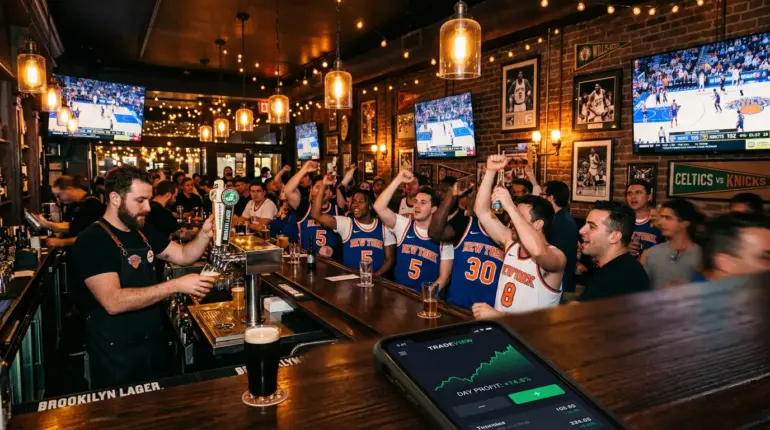
The Jeffrey, an Upper East Side bar in New York City, ran a promotion for NBA Finals Game 1: if the Knicks win, every customer’s tab is on the house. To make sure that generosity didn’t crater the night’s revenue, owner Andy Freedman placed a $5,000 hedge on Kalshi, the world’s largest regulated prediction market. The payout structure is simple – if the Knicks win and the bar eats every tab, the Kalshi contract pays out and offsets the loss.
That is the Mattress Mack playbook, scaled down to a single bar on the Upper East Side. The strategy is replicable, the platform is regulated, and the math works the same way at $5,000 as it does at $75 million.
The Business Problem: What the Promo Actually Created
A free-tab promotion sounds like great marketing until you run the numbers. If The Jeffrey does a full night of business on NBA Finals Game 1 and the Knicks win, Freedman absorbs the entire night’s revenue as a cost – food, drinks, staff, inventory, all of it gone with no offsetting income. That is not a rounding error for a small business; it is an existential liability tied to a coin-flip sports outcome.
The structural danger of sports-outcome promotions is that they create asymmetric exposure. The bar pays full marketing costs every night regardless, but the payout – a completely free tab for the house – only triggers on a win. Without a hedge, the bar is running a one-sided bet it never agreed to take. As Freedman put it: “We want our customers to feel the magic of this moment. But we’re a small business; we can’t just eat a full night’s revenue on a whim.”
The Knicks’ path to the NBA Finals was built on a roster constructed for exactly this kind of deep playoff run – which made the promotion’s liability very real, not hypothetical.
The Kalshi Hedge: How It Worked
Kalshi is a Commodity Futures Trading Commission (CFTC)-regulated Designated Contract Market where users buy and sell event contracts – binary positions that pay $1 if a stated outcome occurs and $0 if it doesn’t. It is not a sportsbook. There is no house taking juice on every position; the price reflects the market’s implied probability of the outcome, and both sides of the contract are held by participants.
The mechanics of The Jeffrey’s hedge are direct. Freedman purchased a Kalshi contract that pays out if the Knicks win Game 1. If the Knicks win: the free-tab promotion triggers, the bar loses its night’s revenue, and the Kalshi contract pays – partially or fully offsetting that loss depending on the contract’s payout relative to the $5,000 position. If the Knicks lose: the promotion never triggers, the bar collects full revenue, and the $5,000 Kalshi position expires worthless – functioning as a straightforward marketing expense in exchange for a night of elevated customer engagement and goodwill.
Nicolas Hull, who works on business development at Kalshi, framed the broader implication plainly: “Traditional insurance is expensive, slow and not built for this kind of operational exposure. Kalshi changes the equation: liquid, transparent markets that let any business take an offsetting position on the risks that affect their bottom line.”
Who Is Mattress Mack – and Why the Comparison Fits
Jim “Mattress Mack” McIngvale is a Houston furniture retailer who turned sports-outcome hedging into a national story. His core playbook: run a promotion that refunds customers’ furniture purchases if a specific team wins a major championship, then place a large bet on that team at sportsbooks to offset the refund liability. The promotion drives massive sales volume. The bet caps the downside.
In 2022, McIngvale reportedly placed over $10 million in bets on the Houston Astros – at average odds around +750 – creating a potential return of roughly $75 million that closely matched his promotional liability from furniture refund offers worth up to $10,000 per customer. The same logic applies to his Super Bowl bet strategy: he has run promotions tied to Super Bowl outcomes and taken opposing positions through sportsbooks in multiple jurisdictions to convert the sports risk into a manageable, deterministic cost. The bet is not gambling in the traditional sense – it is a financial instrument that transforms a variable liability into a fixed one.
The difference between Mack and Freedman is scale, not structure. Mack needed relationships with major sportsbooks across multiple states to place eight-figure positions. Freedman needed a Kalshi account and $5,000. As sports-betting analyst Dustin Gouker observed: “Mattress Mack walked so Kalshi could run.”
Why This Works for Small Business Owners
The Jeffrey’s hedge is a proof of concept for any business that runs promotions tied to uncertain real-world outcomes. A restaurant offering free meals if the local team wins a playoff game faces the same structural liability. A retailer discounting championship merchandise if the home team takes a title has the same exposure. The promotion creates customer engagement on the upside; the hedge caps the cost if that engagement triggers.
Kalshi’s event contract format is structurally better suited for this use case than a traditional sportsbook. There is no juice baked into a small position, no minimum handle requirement, and the CFTC-regulated exchange format means both the contract terms and the payout mechanics are transparent and enforceable. Hull’s broader point – that hotels can hedge on playoff-series-length contracts, and weather-sensitive retailers can hedge on Kalshi weather contracts – identifies a genuine market gap that traditional insurance products do not fill efficiently.
The Bettor’s Version: Using the Same Logic to Hedge a Futures Ticket
The retail-bettor mirror image of the bar hedge is straightforward. You hold a Knicks championship futures ticket bought at long odds in October – say, +800. The Knicks make the NBA Finals, the line shortens to +180, and your ticket is now sitting on significant paper profit with one series still to play. The risk is giving back the entire ticket if they lose the Finals.
Taking an opposing position on Kalshi – buying a contract that pays if the Knicks lose the Finals – locks in a return regardless of outcome. If they win, your futures ticket hits and the Kalshi position expires worthless, a cost you pre-priced when you took the hedge. If they lose, the Kalshi payout partially or fully offsets your futures miss. This is sports betting hedging at the retail level, using the same opposing-position logic Freedman used for The Jeffrey – converting a binary outcome into a range-bound return. The platform’s CFTC regulation and transparent contract pricing make it easier to size the hedge accurately than trying to find the right live line at a sportsbook mid-series.
The same risk management thinking applies across betting markets, as regulated hedging frameworks in other sports have demonstrated – the mechanism is consistent even when the asset changes.
Bottom Line
The Jeffrey’s $5,000 Kalshi position is not a quirky local story – it is a documented, replicable hedge structure that any business running a sports-outcome promotion can copy today. The Mattress Mack parallel is not flattery; it is a precise structural comparison, and the only meaningful difference is the dollar amount. The edge for small businesses is in converting a variable promotional liability into a fixed marketing cost – Kalshi’s event contracts make that conversion accessible at any scale. Individual bettors holding large futures tickets have the same tool available. The strategy scales down. Use it.