
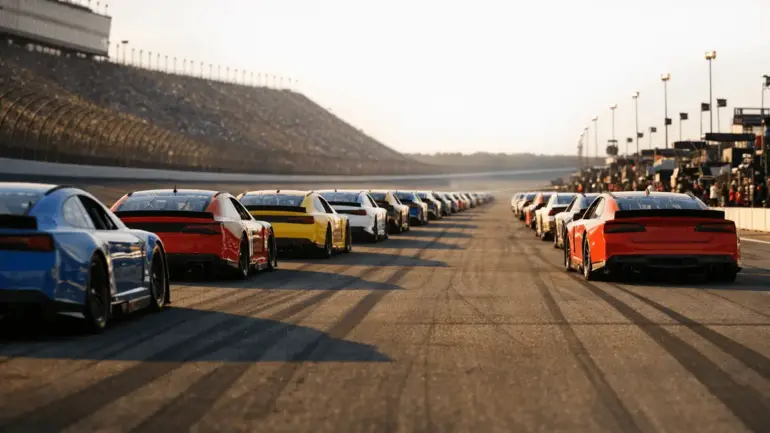
Six Cup Series drivers – including pole-sitter Denny Hamlin and William Byron – were ordered to start at the rear of the FireKeepers Casino 400 field for unapproved post-qualifying adjustments, and that fact alone flips the outright market and several top-10 propositions before a single lap is run at Michigan International Speedway. The betting board has not fully priced the ripple effects: Carson Hocevar and Tyler Reddick inherit the front row, Kyle Larson and Chase Elliott gain clean air they did not qualify for, and two additional teams in Chris Buescher and J.J. Yeley lose pit-stall selection with their car chiefs ejected. Michigan is a two-mile intermediate where track position and pit strategy are not decorative advantages – they are the race.
Why These Penalties Carry More Betting Weight Than a Standard Grid Change
The structural consequence here is layered. Hamlin earned his 51st career pole with a 195.117 mph lap, and NASCAR confirmed the unapproved adjustment stemmed from underbody and diffuser repairs made after a tire issue damaged his No. 11 Joe Gibbs Racing Toyota during practice. Byron’s No. 24 Hendrick Motorsports Chevrolet required a charging-system fix after qualifying ninth. Both repairs were legitimate in purpose – NASCAR’s objection is procedural, not competitive – but the penalty is identical regardless: rear of field, full stop.
At Michigan specifically, starting position matters in a specific way. The track’s wide lanes and long straightaways do allow for passing, which the conventional read uses to dismiss rear-start penalties. But that same conventional read ignores what a rear start costs in the first stage – points, stage wins, and the pit-strategy positioning that compounds over a 400-mile race. A driver starting 35th at Michigan is not just 35th; he is behind slow cars, lapped traffic candidates, and the chaos of a mid-pack restart. The team burns tires earlier, the pit strategy narrows, and the margin for error on green-flag cycles shrinks to near zero.
For Buescher, the damage is different but real. RFK Racing entered the weekend eighth in the championship standings – a playoff-caliber operation that depends on stage points and clean pit execution. Losing pit-stall selection at a two-mile oval, where green-flag stop sequence is among the most consequential strategic variables, is a genuine handicap. Buescher is not starting at the back, but his crew chief is working without his car chief for the full race weekend, and his pit stall will be assigned last among the field.
Hamlin, Byron, and the Drivers Who Gain – Mapping Every Affected Betting Angle
Denny Hamlin is the defending Michigan winner and the driver most bettors will instinctively want to back on the rebound narrative. That instinct is understandable and probably wrong as an outright play. Hamlin acknowledged the car was fast, which is credible – Joe Gibbs Racing qualified on pole and the underlying speed is real. But Hamlin starting from the rear at Michigan means navigating traffic for 30-40 laps before reaching clean air, and at a track where the leaders set pace in the 190s, that gap compounds. His outright price – in the range of 8-1 (+800) at most books – does not adequately discount the rear start. His top-10 number is safer and still compresses value. Fade Hamlin to win outright; his top-10 price is acceptable only if it drifts toward +120 or better.
William Byron enters with eight career top-10 finishes at Michigan – one of the stronger track records among the penalty group – and at 26 years old is arguably at the peak of his Michigan learning curve. The charging-system issue that triggered the penalty was resolved before the race, so there is no reliability concern baked in. Still, Byron starting from the rear compounds the same problem Hamlin faces: traffic management, early tire burn, and a compressed strategic window. His outright odds at roughly 12-1 (+1200) are not interesting from the back. His top-10 is a borderline play only – eight previous top-10s here matters, but none of them came from a rear start.
Kyle Larson is the clearest beneficiary on this board. Front-row chaos and penalty starts tend to cluster value toward the driver who qualifies cleanly in the top five and inherits even cleaner air than he bargained for. Larson’s Michigan record is strong, Hendrick Motorsports builds cars that run well at two-mile ovals, and a starting position in the top five now looks even more premium with Hamlin, Byron, and four others surrendering their grid slots. At 5-1 (+500) or thereabouts, Larson is the best outright play on the adjusted board. Back Larson to win at 5-1 (+500).
Chase Elliott is the secondary value. Elliott positioned near the front with a clean starting spot and the benefit of Hamlin and Byron – two drivers who would have applied early pressure – now buried in traffic. Elliott’s top-5 number, if available around -115 to +100, is worth a small play. His outright at 8-1 (+800) or longer is the secondary directional bet. Elliott top-5 at even money or better is a live secondary play.
Carson Hocevar and Tyler Reddick inherit the front row. Reddick specifically – a driver with legitimate intermediate-track speed and a 23XI Racing operation that has shown race-winning capability – is worth monitoring. His outright odds likely firm with the news, but if he is still available north of 10-1 (+1000) at green flag, that represents real value for a driver starting P2 with no one fast in front of him for the opening laps. Regarding how to frame penalty-driven grid changes for betting purposes, the same logic that applied at Talladega applies here: the driver inheriting clean air near the front is the first market adjustment to make.
The Honest Pushback – Why the Penalties Might Not Move the Needle
The honest pushback is that Michigan is genuinely one of the easier tracks on the schedule for rear-starters to recover. The two-mile layout, wide racing surface, and consistent tire degradation profile allow skilled drivers to move through the field faster than at short tracks or road courses. Hamlin won here as the defending champion and knows every inch of this track. Byron has eight top-10s here for a reason – the circuit suits his driving style, and Hendrick cars tend to find speed regardless of starting position.
There is also a realistic scenario where both penalty cars are running top-10 by lap 75, negating much of the strategic disadvantage. If that happens, the outright odds compress fast, and anyone who faded Hamlin at 8-1 will be watching him contend in the final 50 laps. The penalty matters – but Michigan’s passing opportunities are the most legitimate counter-argument on the board.
What to Watch Before Green Flag – Information Triggers That Actually Matter
Watch Larson’s price in the 60 minutes before green flag. If he firms below 4-1 (+400), the market has already priced the penalty news and the outright value collapses – wait for the live betting window. If he is still 5-1 or longer at green flag, that is the signal to act.
Monitor Hamlin’s top-10 number specifically. If books are still offering it at -130 or shorter, pass – the rear-start risk is not reflected. If it drifts to +110 or longer, that is where the rebound narrative starts carrying actual edge. Reddick’s outright is the secondary trigger: if he is still 12-1 (+1200) or longer at green flag with a P2 start, that is a small-bet opportunity worth taking. Any additional penalty announcements from NASCAR’s pre-race inspection window – typically finalized 90 minutes before green flag – could further reshape the front of the field and should be treated as a live information event.
- 🗓️ Race: FireKeepers Casino 400 at Michigan International Speedway
- ⏰ Green Flag: Sunday afternoon
- 📍 Track: Michigan International Speedway (2-mile oval)
- 📺 Broadcast: USA Network / MRN
Bottom Line
The Bet: Back Kyle Larson to win outright at 5-1 (+500) – clean starting position, proven Michigan speed, and six drivers ahead of him on the grid either starting from the rear or compromised by inspection penalties. The secondary play is Chase Elliott top-5 at even money (+100) or better – a situational boost from an adjusted grid that puts him in clean air earlier than his qualifying position suggested.
Fade Hamlin to win outright at his current number – the rebound narrative is real but the price does not account for the rear-start tax at a track where stage points compound. Fade Byron to win entirely. Both are top-10 considerations only if their prices drift significantly from current market levels before green flag. The penalty group handed the front of this field to Larson and Elliott. Back them accordingly.