
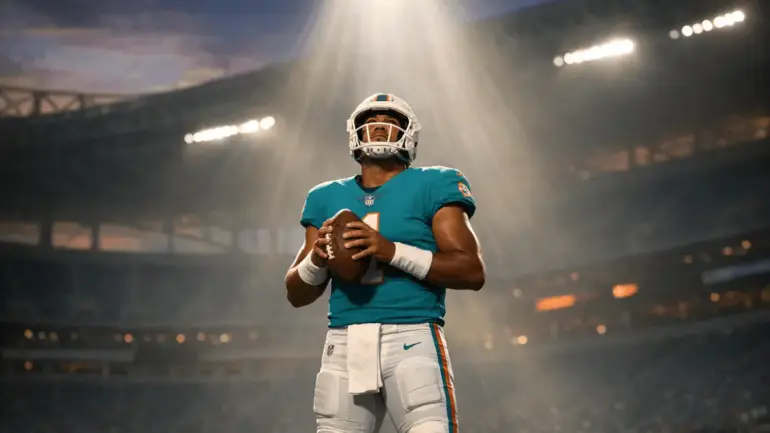
Malik Willis signed a three-year, $67.5 million deal to start for the Miami Dolphins in 2026 – and analysts are already flagging him as a benching candidate before he takes a regular-season snap.
Bleacher Report has ranked Miami as the second-worst team in the NFL, the Dolphins traded away both of their star receivers, and Willis carries exactly six career starts into what amounts to the most high-stakes quarterback audition of the offseason.
The downstream effects touch every level of the Dolphins’ offensive outlook – fantasy value, team futures pricing, and what a 17-game starting trial actually looks like for a player who has never completed one.
That is not a minor roster note. That is the defining story of Miami’s 2026 season before it begins.
What the Benching Watch Actually Means for Malik Willis and Miami
Bleacher Report analyst Kristopher Knox identified Willis this week as one of eight quarterbacks most likely to be benched during the 2026 season. Knox specifically named Willis’ lack of experience and the Dolphins‘ stripped-down supporting cast as the twin pressure sources.
That combination – a first-time full-time starter with a thin roster underneath him – is what makes this signal real rather than speculative.
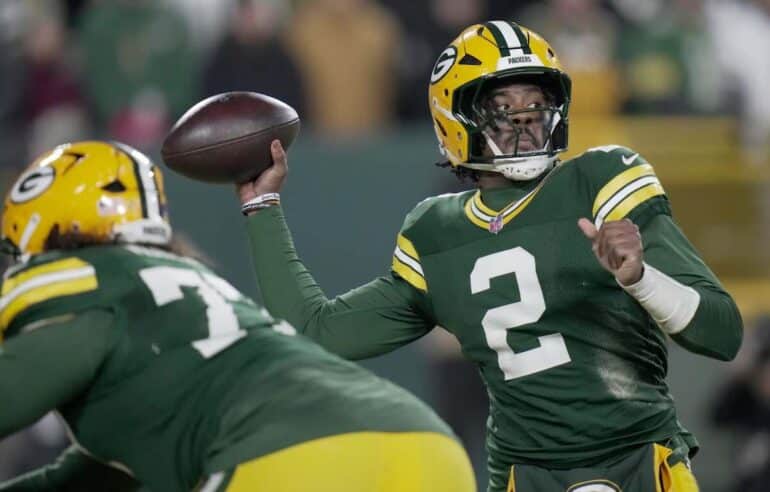
Knox did not bury the lead: “Willis showed a ton of potential during his time with the Packers. While he only made three starts in two seasons, he posted a 134.6 passer rating while flashing elite dual-threat ability.” Then came the honest qualifier: “After purging the roster of talent in the offseason, Miami is probably closer to those Tennessee teams than what Willis had over the past two years with the Packers.”
That is not a vote of confidence dressed up as a compliment. That is a structural warning about the environment Willis is walking into.
The Tennessee reference carries real weight. Willis posted a 49.4 QB rating across two years with a bad Tennessee Titans team. The context matters – that was a weak supporting cast around a developmental quarterback – but it is also the most extended sample of Willis under pressure, and the number is not good.
Knox is essentially arguing that Miami 2026 rhymes with Tennessee 2022, not Green Bay 2024. That is the honest read underneath the optimistic contract framing.
Why Malik Willis Matters – The Football, Fantasy, and Futures Logic
Start with the football layer. Willis brings legitimate dual-threat ability – 405 rushing yards and four rushing touchdowns across just six career starts – and his 134.6 passer rating with the Green Bay Packers is a real data point, not a fluke.
His college tape at Liberty (5,117 passing yards, 47 touchdowns, 1,822 rushing yards, 27 rushing touchdowns across 23 starts) established the athletic profile. ESPN ranked him as its top free-agent quarterback in the 2026 class, ahead of Kyler Murray, which signals the league viewed this as a legitimate market, not a reclamation project.
But the fantasy and futures implications cut harder. Tyreek Hill and Jaylen Waddle are gone. The only remaining offensive weapon of consequence is running back De’Von Achane, whose fantasy value now hinges almost entirely on whether Willis can keep defenses honest enough to prevent eight-man boxes.
A Willis who struggles – turnovers, inaccuracy, inability to extend plays – compresses Achane’s ceiling dramatically. Achane’s ADP should be treated as a barometer for how the market prices Willis’ starting probability as training camp progresses.
On the futures side, the Dolphins’ win total is going to open low – likely in the four-to-five range – and the second-worst-team ranking from Bleacher Report reflects the same math. NFL offseason moves have reshaped the futures board across the league, and Miami’s rebuild is one of the more dramatic resets.
The question for bettors is whether the under on Miami’s win total is already priced in, or whether the market is still underweighting the roster depletion. With Quinn Ewers as the backup, there is no credible Plan B – which actually may keep Willis’s starting probability high even if the performances are rough, but it does nothing for the team’s competitive ceiling.
The probability framing here is roughly 65/35 that Willis finishes the season as the starter – not because he is likely to thrive, but because the Dolphins have no viable alternative and are explicitly in rebuild mode. The more interesting bet is whether Miami wins more than four games, which feels closer to 50/50 given how much offensive talent was purged.
The Complication – Why Willis Could Start For Miami Dolphins
Here’s the honest pushback: the structural case for Willis surviving the full 17 games is actually stronger than the benching narrative suggests.
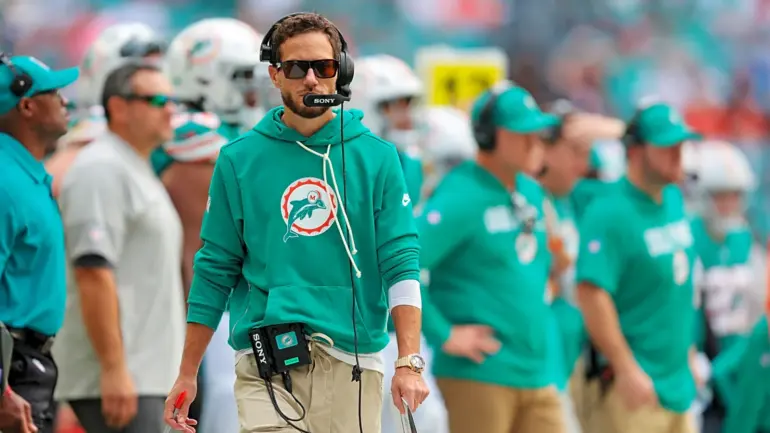
Jeff Hafley and GM Jon-Eric Sullivan came directly from Green Bay, where they watched Willis develop up close. That is not incidental organizational alignment – that is a coaching staff that specifically chose Willis, understands his development arc, and has institutional reasons to extend patience beyond what an outside analyst’s benching watch implies. Hafley is not going to pull the quarterback he lobbied to sign after four bad games in October.
The $45 million fully guaranteed in Willis’ contract is also a structural anchor. Teams do not bench $45 million guarantees after partial seasons without a franchise-altering injury or a catastrophic collapse.
The Dolphins are rebuilding – they said so publicly – and benching Willis in favor of a seventh-round pick in Ewers would signal organizational chaos, not organizational process. That is a real deterrent.
The counter-argument’s limit is this: it explains why Willis probably finishes the season, not why he plays well. The benching concern and the performance concern are separate questions.
Willis may start all 17 games and still validate every worry Knox raised about the roster situation. The honest read is that Willis’ job security is more stable than the narrative suggests, but his performance ceiling in 2026 is genuinely constrained by the weapons around him. Veteran quarterbacks facing high-pressure auditions in new systems follow a pattern that should make Dolphins fans cautious even while they root for Willis to prove the doubters wrong.
What Happens Next For Malik Willis And Miami Dolphins
The real resolution window opens in training camp. Watch for any reporting from beat writers covering Miami’s camp – specifically whether Willis is operating the first-team offense with consistent command, or whether the coaching staff is managing his reps in ways that suggest uncertainty about the depth chart.
Watch for: Any Adam Schefter or Ian Rapoport update flagging that Miami is adding a veteran quarterback via trade or free agency. That would be the definitive signal that the Hafley-Sullivan staff is no longer comfortable with Ewers as the only fallback option – and it would immediately compress Willis’ job security from 65/35 to something closer to a coin flip depending on who arrives.
For fantasy managers, the key data point is Achane’s target share and usage in the first preseason game. If Willis is running a quick-game, play-action-heavy scheme that gets Achane involved in the passing game, that is a bullish signal for both of them. If the offense looks disorganized early, fade Achane’s ADP accordingly.
For bettors, the Dolphins’ season win total is the position to evaluate now, before the market fully absorbs the offensive talent loss.
Bottom Line
Malik Willis is entering the most consequential stretch of his career with the least favorable supporting cast he has had since Tennessee – and the structural parallels to that 49.4-QB-rating era are exactly what Knox is flagging.
The coaching staff’s loyalty and the guaranteed money in his contract give Willis a genuine runway, and the 65/35 probability that he finishes the season as Miami’s starter is real. But finishing the season and playing well enough to validate a $67.5 million investment are two different outcomes.
The single most important variable is whether Hafley can design an offense that maximizes Willis’ mobility and quick-game accuracy before the roster limitations become overwhelming. If that scheme clicks early, the entire Dolphins offensive outlook shifts. If it does not, Miami is looking at a long 17 games with no upgrade option waiting in the wings.
For the latest on Malik Willis, the Miami Dolphins, and everything in the NFL conversation, keep it locked to Sportscasting.com.