
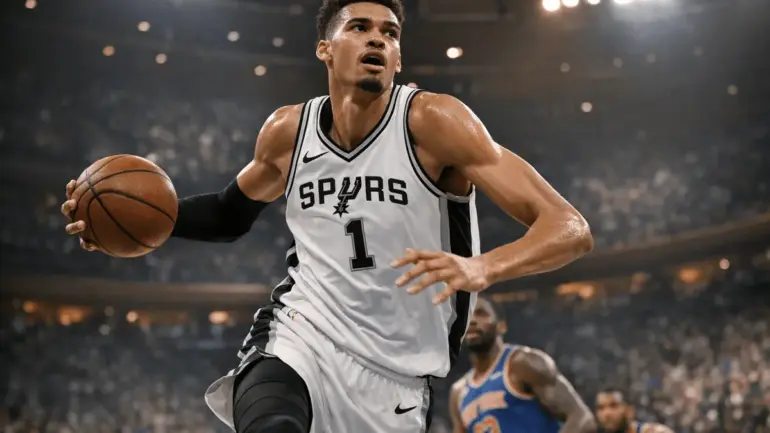
Victor Wembanyama posted 39 points, 15 rebounds, and five blocks in Game 3 of the NBA Finals – a career high in playoff scoring – and the San Antonio Spurs are back in this series. The Spurs took the road win at Madison Square Garden to pull within 2-1, and what looked like a swift Knicks coronation now has real structural doubt baked in.
That single performance reshapes every market attached to this series. The championship futures that opened heavily favoring New York are repricing in real time, and Game 4 is now the most consequential game of the season for both franchises. Here is what happened, why it carries weight beyond the box score, and where the actionable edges sit heading into Game 4.
What Actually Happened – The Full Sequence
Wembanyama was not just good in Game 3. He was dominant in a way that changed the tactical texture of the game from the opening quarter. The Knicks had leaned on their physicality in Games 1 and 2 to disrupt his rhythm, but at Madison Square Garden, he imposed himself in the paint, at the rim, and in transition before New York could set its defense.
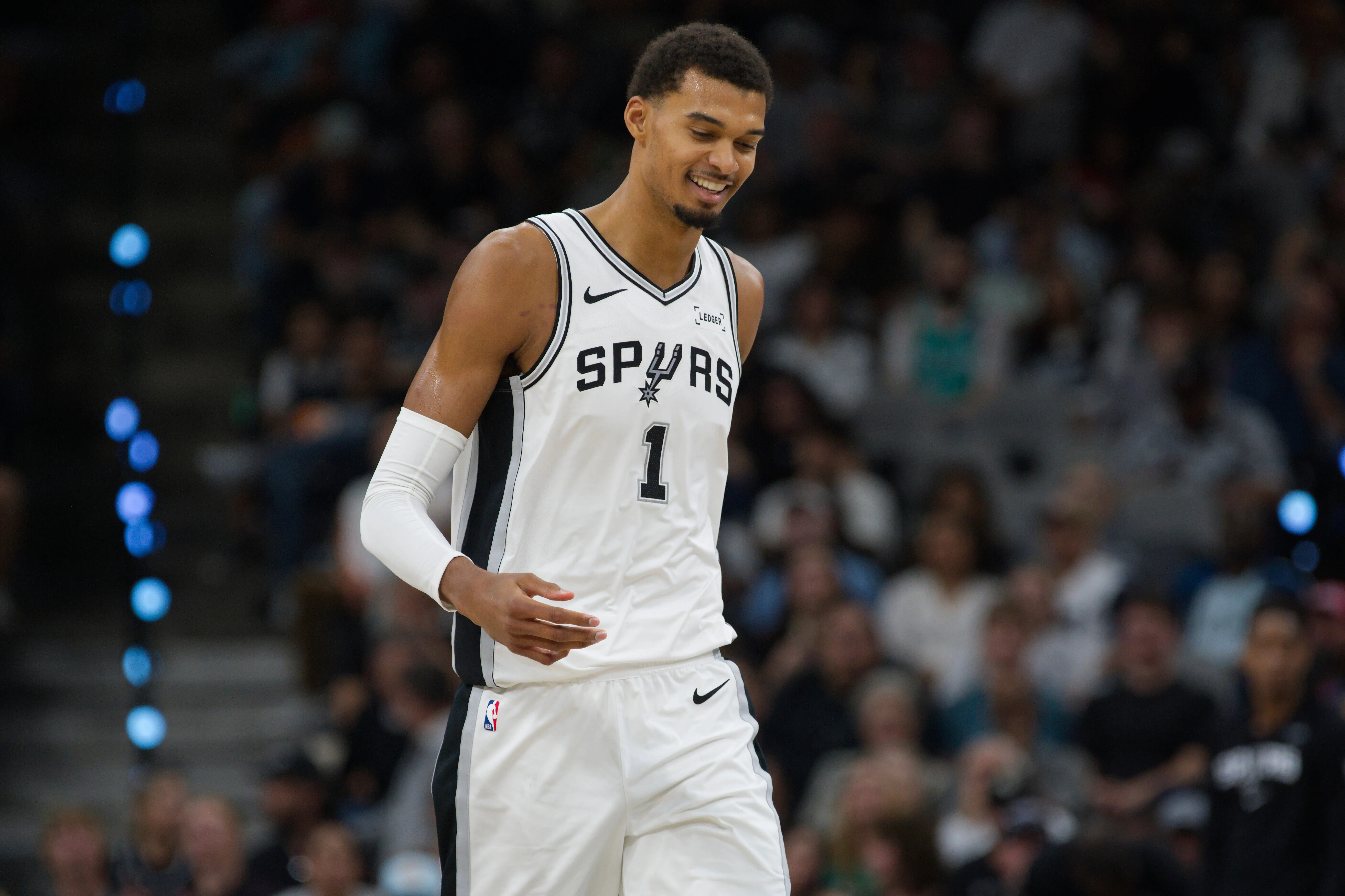
The 15 rebounds were as important as the 39 points. San Antonio controlled the glass in a way that denied New York second-chance opportunities – the exact resource the Knicks exploited in their two wins at home in San Antonio. His five blocks provided the defensive spine the Spurs needed to make stops in late-game situations, turning possessions that might have buried them into run-outs in transition.
Stephon Castle and Dylan Harper both contributed meaningfully, with NBA.com noting that Harper became the youngest player in NBA playoff history to score 25-plus points off the bench, at 20 years and 53 days old. Harper and Castle also became just the second pair of teammates age 21 or younger to each score 25-plus in a playoff game. That supporting cast output matters tactically – it prevented the Knicks from collapsing entirely onto Wembanyama without consequences, which is the defensive blueprint that had limited him in the first two games.
The final result: Spurs win, series now 2-1 in favor of New York. A series that felt over two days ago is alive.
Why Wembanyama’s Game 3 Carries More Weight Than a Standard Stat Line
The context matters. After Wembanyama called himself bad following a difficult Game 1 where turnovers and decision-making lapses defined his night, the pressure on him entering Game 3 was legitimate. Players who diagnose their own failures that specifically either fix them or spiral. Wembanyama fixed them.
What changed tactically was shot selection and downhill aggression. In Games 1 and 2, he was operating too often from the mid-range and on the perimeter against a Knicks defense designed to keep him out of the paint. In Game 3, he attacked the rim consistently in the first half, drawing fouls and generating early rhythm that carried into the fourth quarter. That is not coincidental. That is a conscious adjustment executed in the highest-pressure environment this sport offers.
The five-block total also signals something beyond individual production. Wembanyama’s rim protection defines San Antonio’s entire defensive identity – when he is disrupting shots and altering approaches at the basket, the Spurs play a different brand of basketball. Games 1 and 2 saw New York get clean looks at the rim. Game 3 did not. The Spurs’ ability to sustain that defensive shift is the analytical question that determines whether this is a real series or a borrowed night.
There is also historical framing worth applying. The Spurs have used Game 3 wins to seize series control across multiple eras – including the 2013 Western Conference Finals over Memphis and a 2012 rout of the Lakers. This franchise knows how to convert a momentum break into structural series pressure. That pattern does not guarantee anything, but it informs how the coaching staff will approach Game 4.
How Game 3 Moves the Series and Game 4 Markets
Before Game 3 tipped off, the betting baseline had New York as heavy championship favorites, a position established early in the series and detailed in the full Game 1 odds breakdown. That pricing is now under significant revision. A team down 3-0 in the Finals has never come back to win the championship – that historical anchor was protecting New York’s championship price. It no longer applies. A team down 2-1 has a real series.
Current series odds have shifted toward the Spurs following Game 3, though the Knicks retain a meaningful edge at approximately -210 to win the championship with San Antonio around +175. Game 4 spread pricing has New York as a home favorite in the range of -4.5 to -5.5, reflecting the home-court advantage but acknowledging the Spurs’ demonstrated ability to win at MSG. Odds are subject to movement and are presented here for informational purposes only.
Scenario 1 – Spurs carry the momentum into Game 4: If San Antonio wins Game 4, the series is tied 2-2 with full home-court parity erased. The Spurs’ championship price would likely compress sharply toward even money or better. The spread value in this scenario is on San Antonio’s side – a team that just won on this floor, with this version of Wembanyama, covering a five-point number is not a stretch if he plays at anything near Game 3 efficiency.
Scenario 2 – Knicks re-assert at home: A New York win in Game 4 puts them one win from the championship at 3-1, and historical 3-1 Finals deficits have produced exactly zero comebacks. The Knicks’ championship price would likely return toward -300 or beyond, and San Antonio futures become near-worthless. The Knicks live spread and series price both become strong positions in this scenario.
Prop Market and DFS Implications
Wembanyama’s scoring prop, which likely opened Game 4 somewhere in the 26.5-to-28.5 range before the series, is now tracking higher following Game 3. Expect the market to shade his points total upward – the over on a 28.5 or 29.5 line carries real value if Game 3 represents a genuine tactical reset rather than a single outlier. His blocks prop deserves attention in the opposite direction from the public: five-block games are rare even for him, and regression toward his 2.5-to-3.5 per-game playoff range is the more probable outcome. The over on his rebounds line – set in the 11.5-to-12.5 range – reflects a ceiling he just hit, not a sustainable floor.
For DFS, Wembanyama is the primary salary-absorption play at whatever price the major platforms set him given this performance. The question is whether that price creates slate-breaking value or simply reflects the obvious. Castle and Harper as secondary plays offer leverage – both are likely underpriced relative to their demonstrated output in the supporting role, and pairing either with Wembanyama in a Spurs-heavy build is now a legitimate GPP structure given the youth movement’s proven capacity to shift a game.
The Honest Pushback Bettors Should Weigh
One game does not flip a series. The Knicks still lead 2-1 and still have Jalen Brunson – the most reliable closer in this postseason – available for Game 4. Before Game 3 tipped, Brunson’s own acknowledgment of San Antonio’s capacity to elevate their level was a credible warning, not a concession. He has not stopped being a problem.
The Knicks’ structural advantage – home court, proven closing ability, a 2-1 series lead – did not disappear because Wembanyama had a career-defining night. Teams down 2-1 in the Finals are 22-15 in Game 3 historically. The Spurs are now one of those 22 wins. But teams that went down 2-1 still lost those series at a rate that reflects just how hard it is to win three games from that position.
The accountability of Wembanyama’s Game 3 response is real. The structural challenge it describes has not been resolved by one performance. Game 4 at MSG, with the Knicks needing only to hold serve, is a different kind of pressure test than the one the Spurs just passed.
What’s Confirmed and What Isn’t
What is confirmed: Wembanyama scored 39 points, grabbed 15 rebounds, and recorded five blocks in Game 3 – a career high in playoff scoring and his seventh career playoff game. The Spurs won the game, pulling the series to 2-1 in favor of New York. Harper’s 25-plus point bench performance made him the youngest player in NBA playoff history to achieve that mark at 20 years and 53 days old. Game 3 was played at Madison Square Garden, which last hosted an NBA Finals game on June 25, 1999, when San Antonio clinched its first title there. President Donald Trump was reported in attendance for Game 3.
What is not confirmed: Exact updated series odds and Game 4 spread pricing are still moving and should be verified at current sportsbook lines before any betting decision. Whether Wembanyama’s Game 3 tactical adjustments are sustainable over a full game in Game 4 is inference, not established fact. No injury or availability reports for either roster heading into Game 4 have been confirmed at time of writing. The durability of the momentum shift is analytical inference, not guaranteed outcome.
Bottom Line
Watch Wembanyama’s first four possessions in Game 4 – specifically whether he is attacking the paint immediately or settling for early perimeter attempts. If he is hunting the rim from the opening tip and the Knicks are forced into foul trouble before the first timeout, the Spurs covering a five-point spread is live money and his scoring over is worth the play. If New York’s defense has an answer and he defers to the mid-range in the first quarter, the Knicks covering at home and winning Game 4 to go up 3-1 becomes the overwhelmingly correct series position.
The series is genuinely alive. That alone justifies repricing everything. But alive does not mean flipped. One performance changed the math on a championship that seemed over. Game 4 determines whether this was a pivot or a detour.
For the latest on Victor Wembanyama, the San Antonio Spurs, and the 2026 NBA Finals, keep it locked to Sportscasting.com.