

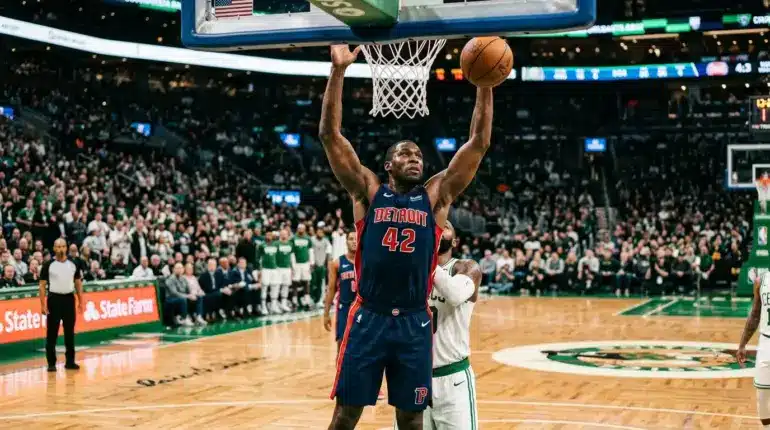
Isaiah Stewart, the 24-year-old center for the Detroit Pistons, has been floated as a trade target for the Boston Celtics – a player entering the final guaranteed year of a four-year, $60 million deal who brings rim protection, defensive versatility, and a serviceable three-point stroke to a Boston frontcourt that will almost certainly look different by opening night.
The proposal originates from Sam LaFrance of Hardwood Houdini, layered on top of independent reporting from Marc Stein confirming that Nikola Vucevic is widely expected to leave Boston in free agency this summer.
For bettors tracking East futures and fantasy managers projecting frontcourt usage, this is the kind of low-cost, high-fit acquisition that quietly reshapes championship probability without moving a headline number.
Why Isaiah Stewart Rumor Carries Weight
LaFrance is a credentialed analyst at Hardwood Houdini, a publication that covers the Celtics with beat-level consistency – not a Woj or Shams-tier insider, but not a speculative fan account either.
His Stewart proposal carries analytical weight because it is explicitly built on two real structural facts: Boston’s $27 million traded player exception created by the Anfernee Simons-for-Vucevic swap in February, and the Pistons’ internal center competition between Stewart and Paul Reed, which could make Stewart available at a price Boston can absorb.
The Stein reporting underneath it adds a second credibility layer. Stein characterized Vucevic’s departure as “increasingly regarded as a certainty,” which means Boston’s center search is not hypothetical – it is active.
A fractured right ring finger in March derailed Vucevic’s brief stint, and at 36 years old in October, re-signing him would represent a backward-looking roster decision for a team with championship ambitions.
The Celtics have known since at least midseason that the frontcourt needed structural work, with earlier reporting linking Brad Stevens to Ivica Zubac as an “ideal target.” Stewart enters this conversation as a more affordable, younger alternative in that same defensive-first archetype.
Why Isaiah Stewart Move Makes Sense – Logic Behind Celtics Deal
The financial mechanics are clean. Stewart’s $15 million salary fits comfortably inside Boston’s $27 million traded player exception, meaning the Celtics could absorb his contract without sending matching salary back to Detroit – a meaningful advantage in any negotiation.
His contract structure adds another layer of appeal: he is on the final guaranteed year of his deal, with the 2027-28 season being a team option, which gives Boston cost certainty and flexibility simultaneously.
The basketball fit holds up under scrutiny. Stewart shot 64.2% from two-point range last season and carries a career three-point rate of 34.3% – not a floor-spacing weapon, but enough of a threat to prevent defenses from completely collapsing on Jayson Tatum and Jaylen Brown.
More critically, he is an enforcer-type big who protects the rim and defends with physicality, which directly addresses Boston’s documented weakness: a center rotation currently limited to drop defenders who cannot switch in playoff matchups. He finished seventh in Sixth Man of the Year voting last season on a Detroit Pistons team that won 60 games – not a star, but a proven contributor in a winning environment.

For fantasy managers, the downstream effects are real. If Stewart lands in Boston, Neemias Queta and Luka Garza – both under contract – get pushed into pure depth roles, compressing their already limited usage floors.
Amari Williams, the 46th pick in the 2025 Draft who averaged 1.4 points and 1.8 rebounds in 22 games last season, likely remains a developmental asset rather than a rotation player. The roster construction discussion around center valuations is something the ongoing debate over big-man roles and contract value has repeatedly surfaced this offseason – and Stewart sits at an interesting price point in that conversation.
How Isaiah Stewart Rumour Moves the Futures Market
The Celtics currently sit among the top-tier Eastern Conference title contenders, with championship odds in the range of +600 to +800 depending on the book – a position they hold on the strength of the Tatum-Brown core rather than any frontcourt certainty.
A confirmed Stewart acquisition would not dramatically compress those odds on its own, but it would remove one of the identifiable weaknesses that sharp bettors have been pricing in: the absence of a switchable, playoff-tested center. The directional move is modest but real – expect a tightening of roughly 30 to 50 basis points on East odds if a deal closes.

Scenario mapping: (1) Move confirmed – Boston’s title odds tighten modestly, Stewart’s individual props become relevant for fantasy and player markets, and the Celtics frontcourt narrative shifts from liability to addressed need; (2) Celtics miss out – the center search story continues, odds remain flat or drift slightly, and attention pivots to whether Stevens pursues a more expensive option like Zubac or a lower-cost alternative like Day’Ron Sharpe.
The signal to watch for sharp money is any compression on Boston’s Eastern Conference futures before a formal announcement – that kind of preemptive movement historically reflects informed positioning rather than public reaction. This kind of contender trade speculation and its effect on championship markets follows a pattern that frontcourt rumors have consistently demonstrated across recent offseasons.
All odds are approximate, for informational purposes only, and subject to change. Please check your preferred sportsbook for current lines. Gambling involves risk – bet responsibly.
The Social Mechanics – Why This Travels Beyond the Core Audience
At least four distinct audience communities are engaging with this story, and their motivations do not overlap. Celtics fans are tracking it as a roster construction signal – the question of whether Stevens can stabilize the center position before training camp is the defining offseason anxiety for a fanbase that expects title contention every year.
Eastern Conference futures bettors are watching it as a probability variable: a switchable, affordable center meaningfully reduces Boston’s playoff exposure against mobile big men, and that risk reduction has a direct odds implication.
Fantasy managers are running the usage math – any new center who slots into a starting or rotation role immediately compresses Queta’s already thin floor, which is a live consideration for dynasty and keeper formats heading into draft season.
The broader NBA discourse community – the national audience that tracks contender construction, offseason trade logic, and the gap between what teams say publicly and what they do financially – engages with this story as a case study in how a team with a traded player exception and a known positional need navigates a market quietly before the loud moves happen. These four communities do not read the same content on a normal Tuesday.
The Honest Pushback – Why Celtics May Miss Out
Here’s the honest pushback: LaFrance is an analyst, not an insider. He does not have sourcing inside the Celtics front office or the Pistons organization – this is a reasoned proposal built on public information, not a reporting scoop.
Every element of the argument could be correct and the deal could still never happen, because neither team has indicated publicly that Stewart is available or that Boston is pursuing him specifically.
The basketball complications are also real. Stewart averaged just 5 rebounds per game last season in 58 games – not an elite rebounder for a team that has historically struggled on the offensive glass. His three-point shooting at 33.3% last season dipped below his career average and represents a floor-spacing limitation rather than a strength.
Detroit, coming off a 60-win season, may not be motivated to move a 24-year-old enforcer who fits their own contention window – especially if Reed is not yet proven as the preferred long-term option.
The Celtics also have competing frontcourt options on the board, and offseason roster construction rarely follows the most logical path when multiple teams are competing for similar assets. None of that eliminates the analytical logic of the proposal – it just means confirmation requires a different sourcing tier.
No Confirmation Of Pistons’ Desire To Sell
What is confirmed: Isaiah Stewart is entering the final guaranteed year of a four-year, $60 million contract at a $15 million salary; the Celtics hold a $27 million traded player exception from the Simons-for-Vucevic trade; Nikola Vucevic is widely expected to leave Boston in free agency per Marc Stein; Neemias Queta and Luka Garza are under contract but represent depth rather than starting-caliber options; Stewart averaged 10 points, 5 rebounds, and shot 64.2% from two on a 60-win Detroit team last season.
What is not confirmed: Any direct interest from the Celtics in Stewart specifically; any indication from the Pistons that Stewart is available; whether Brad Stevens is prioritizing an external center acquisition over internal development; whether Detroit would prefer to move Stewart over retaining him alongside Reed; and whether Boston’s center search has moved beyond exploratory conversations into concrete trade discussions with any team.

What to Watch Next
- Woj or Shams language escalation: The credibility threshold elevates the moment Adrian Wojnarowski or Shams Charania enters this conversation. A single tweet placing Stewart in Boston’s orbit would immediately shift this from analyst proposal to live rumor. Monitor their feeds in the weeks following the NBA Draft and early free agency.
- Detroit’s Reed deployment signals: If the Pistons publicly commit to Reed as their starting center or extend him before free agency opens, that is the clearest signal that Stewart’s role in Detroit is diminishing – and his availability becomes a legitimate front-office conversation rather than speculation.
- Celtics TPE activity: Boston’s $27 million traded player exception has a shelf life. Any reporting that the Celtics are deploying that exception – toward Stewart or any other center – would confirm the frontcourt upgrade is imminent and active rather than theoretical.
- East futures compression: A tightening of Boston’s Eastern Conference odds without a corresponding public announcement is the sharpest signal that informed money has received non-public confirmation of a move. Watch for that compression in the 48-hour window after the NBA Draft lottery and again at free agency open.
The probability estimate on a Stewart-to-Boston deal materializing: 35/65 against, given the sourcing tier and the absence of any confirmation from either organization. That number moves to 50/50 the moment a credentialed insider places Stewart in active trade discussions. The analytical case is sound – the evidentiary layer is not there yet.
For the latest on Isaiah Stewart, the Boston Celtics, and the full NBA offseason trade market, keep it locked to Sportscasting.com.