
The Jacksonville Jaguars have secured a 30-year lease and a binding Non-Relocation Agreement tied to a $1.4 billion stadium renovation – and that combination does something no amount of fan optimism could do alone.
It removes the franchise from the relocation conversation, structurally and contractually. NFL owners voted 32-0 to approve the deal.
Jacksonville’s Relocation Threat Was Real – This Deal Kills It
The Jaguars have operated under a relocation cloud since their 1995 debut. Jacksonville is one of the NFL’s smallest markets, and whenever stadium talks stalled, London speculation followed immediately. The league tested Jacksonville’s commitment repeatedly. The city blinked first on every prior negotiation.
The 2021–22 “Stadium of the Future” visioning process produced a $120 million Miller Electric Center renovation – useful, but not a commitment. A formal $1.4 billion renovation concept emerged in mid-2023, setting up the approval sequence that just concluded. The difference between then and now is a signed lease and a unanimous owner vote.
Jacksonville at $1.4 Billion: A Market Priced Like the Uncertainty Isn’t Over
The structural argument for this deal’s significance is straightforward. Jacksonville commits the franchise through the late 2050s. The non-relocation clause has teeth – breaking it mid-lease would trigger penalties no ownership group absorbs lightly. Relocation risk, the single largest overhang on this franchise’s long-term value, is gone.
The financing is smarter than most public stadium deals. The city and team split the main project evenly at $625 million each.
Jacksonville covers $150 million in pre-construction upgrades but avoids new taxes by reallocating $600 million from its existing capital improvement plan and tapping an existing half-penny sales tax. City officials project that structure saves $1.5 billion in debt-service costs over the lease term.
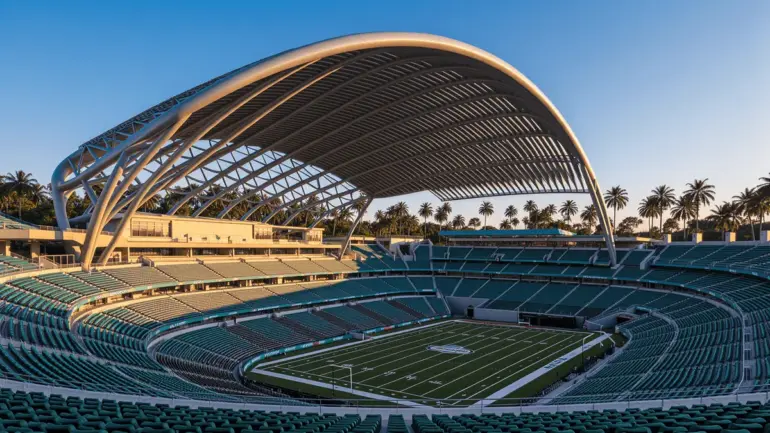
The HOK-designed renovation adds a continuous shade canopy projected to drop perceived temperatures by 10–15°F – a genuine quality-of-life upgrade for a Florida NFL stadium in September. Flexible capacity runs from the mid-60,000s for standard NFL dates up to 70,000-plus for the Florida-Georgia game or Super Bowl bids.
Honest caveat: Team-commissioned economic projections – $26 billion in total impact over 30 years, including $2.4 billion during construction – are advocacy numbers. Independent economists routinely cut franchise-commissioned impact estimates by 30 to 50 percent.
Directional call: Watch Jacksonville’s franchise valuation trajectory over the next 24 months. Stadium certainty is a direct input into Forbes franchise rankings, and the Jaguars have room to climb significantly once the relocation discount disappears from analyst models.
The Stadium Deal: What Was Approved and What Comes Next
The core terms of the approval are worth keeping in one place:
- Main renovation cost: $1.4 billion, split $625 million city / $625 million team
- Pre-construction upgrades: $150 million, city-funded
- City financing strategy: $600 million reallocated from capital improvement plan; existing half-penny sales tax; no new taxes
- Lease length: 30 years with binding Non-Relocation Agreement
- NFL owner vote: 32-0 unanimous approval
- Shade canopy: Continuous design, projected 10–15°F temperature reduction
- Capacity range: Mid-60,000s standard; 70,000-plus for marquee events
The approved timeline calls for reduced-capacity play at EverBank Stadium in 2026, a partial or full relocation to Gainesville or Orlando in 2027, and a completed venue reopening in 2028. That is a disruptive three-season window – logistically and competitively.
This is also described as both the largest public infrastructure investment and the largest private investment in Jacksonville’s history.
What This Signals for the Rest of the NFL
The Jaguars deal fits a clear league-wide pattern. NFL ownership is pushing modernized, publicly backed venues as the baseline standard – not a luxury tier. NFL.com’s Judy Battista noted the deal aligns with a broader league trend toward heavily renovated venues in smaller markets, citing Jacksonville’s commitment as evidence the league is willing to invest in non-top-10 media markets when the infrastructure case is strong.
The comparable franchise situation is Buffalo, where a new publicly financed stadium secured the Bills’ long-term future in a similarly small market. Jacksonville’s deal is larger in scope but identical in structural logic: city commits capital, team commits to a lease, relocation risk evaporates.
The 32-0 owner vote signals something specific. No franchise voted against locking Jacksonville in. That unanimity reflects league confidence in the market’s viability – and removes any internal NFL leverage that relocation advocates might have used in future negotiations.
The 2027 temporary relocation window is the next live variable. Game assignments to Gainesville or Orlando will affect attendance, revenue, and fan retention data that ownership will watch closely. Monitor those announcements. The stadium is approved. The harder work – keeping a fanbase engaged through two displaced seasons – starts now.