
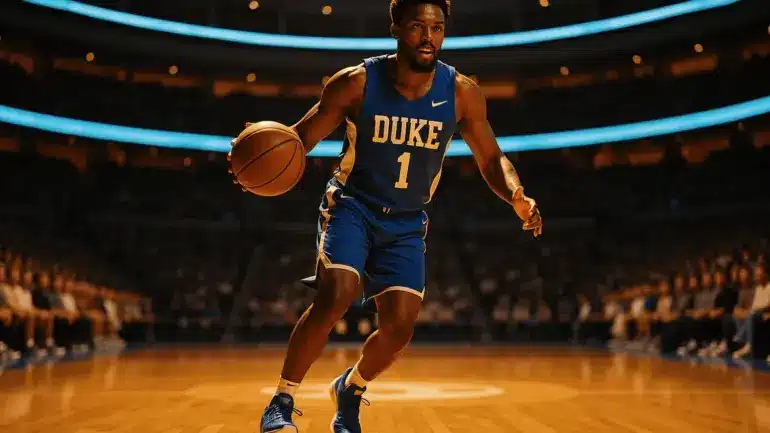
Cameron Boozer is the No. 1 prospect in the 2026 NBA Draft according to Bleacher Report analyst Jonathan Wasserman – a verdict backed by the second-highest box plus-minus on record at 18 years old, trailing only Zion Williamson.
That number places Boozer ahead of Anthony Davis at the same age, which is not a trivial comparison. The full top 75 board is now locked after the withdrawal deadline passed, and the class is thinner than expected thanks to NIL money keeping players in college.
Cameron Boozer Takes Number One Spot In NBA Draft Rankings
Wasserman at Bleacher Report wrote: “At over 6’8″ barefoot with more functional ball-handling and driving efficiency than Caleb Wilson, better three-point and assist numbers than Dybantsa, and the second-highest box plus-minus on record at 18 years old, Boozer is my No. 1 prospect.”
That is not a sentimental pick – it is a production-first verdict built across every competitive setting from age 15 through his Duke freshman year.
The occasional shot-block highlight reel on social media has created noise around his athleticism ceiling, but Wasserman framed that as a distraction from an otherwise elite profile.
This is not a consensus call. CBS Sports has AJ Dybantsa at No. 1 with Darryn Peterson second and Boozer third – the clearest direct contradiction to Bleacher Report‘s order.
ESPN‘s board described all three as the class-defining names and noted genuine debate inside front offices.
The top of this draft is legitimately unsettled, which creates real draft-night line movement opportunity for bettors tracking first-pick odds.
Standout Players In Wasserman’s NBA Rankings
| Rank | Prospect | School | Position | Age |
| 1 | Cameron Boozer | Duke | PF | 18 |
| 2 | Darryn Peterson | Kansas | SG | 19 |
| 3 | AJ Dybantsa | BYU | SF | 19 |
| 4 | Caleb Wilson | North Carolina | PF | 19 |
| 5 | Kingston Flemings | Houston | PG | 19 |
| 8 | Ebuka Okorie | Stanford | PG | 19 |
| 14 | Yaxel Lendeborg | Michigan | PF | 23 |
| 22 | Jayden Quaintance | Kentucky | C | 18 |
| 32 | Tarris Reed | Connecticut | C | 22 |
Ebuka Okorie Is the Biggest Riser
Okorie jumped the most ground of any prospect after Wasserman went back through film in April and May, landing at No. 8.
His 23.2 points per game at Stanford felt easy to dismiss given his 6’2″ frame and the program’s record – but the film told a different story.
Okorie logged 250 rim attempts compared to just 95 for projected top-20 pick Christian Anderson, shot 35.4 percent from three on 178 attempts, and converted 51.6 percent of his floaters.
That finishing range at his size is a legitimate NBA weapon, not a college quirk.
Fantasy managers and bettors tracking first-round prop markets should note that Okorie‘s No. 8 ranking puts him inside lottery range on at least one major board.
The Lakers have already been active in pre-draft workouts with class members, and guards with his creation profile draw interest from multiple rebuild-mode franchises.
NBA Draft Lottery Sleepers, Wildcards, and Second-Round Value
Yaxel Lendeborg at No. 14 carries genuine lottery upside despite being 23 years old.
Wasserman wrote that “history just continues reminding teams not to reach too high on 23-year-olds,” but also confirmed the safe-pick label is valid after Lendeborg added real shooting and defensive improvement this season.
The age knock is real – but so is the production floor.
Jayden Quaintance at No. 22 is the board’s most volatile name. Still 18 years old with elite defensive tools, he has played just 25 games across two seasons due to knee injury history.
Wasserman acknowledged the medical uncertainty directly, calling him the draft’s biggest wildcard. That is a 60/40 health bet before any basketball evaluation even begins.
Tarris Reed at No. 32 carries a historic statistical footnote worth knowing.
He is the only player on record with a single season combining a 9.0 block percentage, 13.0 offensive rebounding percentage, and 15.0 assist percentage.
At 6’10” barefoot with a 7’4″ wingspan, that combination of rim protection, offensive glass work, and passing feel at his size has no comparable precedent.
Second-round value does not get more compelling than that.
Zuby Ejiofor lands at No. 27 but Wasserman said he would assign a first-round grade for certain teams.
The 245-pound frame with a 7’2″ wingspan and legitimate passing IQ fits the modern energizer archetype that contenders overpay for once the playoff bracket tightens.
Henri Veesaar is another international name drawing attention – the Celtics have already been linked to draft positioning tied to this class.
Late-Round Names Worth Tracking Before Draft Night
Bruce Thornton at No. 52 graded in the 90th percentile or better across five offensive categories per Synergy Sports – pick-and-roll ball-handling, transition, spot-ups, off-screen offense, and isolation possessions. That is a two-way contract waiting to happen.
Maliq Brown at No. 60 led the entire nation in defensive box plus-minus, which is the kind of single-skill elite marker that keeps players in NBA rotations for a decade.
Tobi Lawal registered historic vertical numbers at the NBA combine, and Richie Saunders – despite a torn ACL – projects as one of the more efficient catch-and-shoot operators in the class at No. 36.
The NIL era has thinned the mid-to-late second round, but these names represent real value for teams willing to look past the star-chasing at the top of the board.