
The 2025-26 NBA regular season is nearly here, with less than a week until games start to impact the playoff race. In preparation for the year ahead, the Sportscasting crew teamed up to highlight one key stat for every team that could have significant implications for their success or lack thereof this year. Up next is the Southwest Division.
Let’s get to it.
Read our one key stat for teams in other Divisions: Central / Atlantic / Southeast / Northwest / Pacific
Dallas Mavericks: 39
According to Cleaning the Glass, Anthony Davis spent just 14 minutes playing power forward for the Los Angeles Lakers during his final three seasons there. That’s going to change in Dallas, where Davis will share the floor with Daniel Gafford and Dereck Lively frequently.
In the 266 minutes he played last season with the Mavericks, Davis spent 39 percent of his time at power forward– the most he’s spent at the position since his final season with the New Orleans Pelicans in 2018-2019.
I think it’s been overstated how tight the Mavericks’ spacing will be with their double-big lineups and the discussion has often focused on the negatives rather than the positives. Any lineup including a combination of the Mavs’ three bigs and Cooper Flagg or P.J. Washington will be both massive and dominant defensively. They will instantly be one of the best rebounding teams in the league.
Still, offensively, it’ll force Davis to be more diverse in his approach. He’ll have to stretch the floor more than he’s used to. He’ll have to initiate offense above the break more frequently. Maybe, that’s what he wants! But there will be growing pains as Dallas figures out its offensive identity around the superstar big man. -Es Baraheni
Houston Rockets: 48.8
Last season, head coach Ime Udoka seemed to embrace Amen Thompson in his circle of trust. Compared to Thompson’s rookie year, he logged 10 more minutes per game and was relied upon to generate his own shot more often. Not only did he dial his own number more, he did so with greater impact.
As a rookie, 43 percent of his field goal attempts were deemed self-created* and he generated an effective field goal percentage of 45.6 percent on them, per PBP Stats. In 2024-25, 49.8 percent of those attempts were “self-created” to the tune of a 48.8 effective field goal percentage.
*Any touch lasting two or more seconds before a shot.
With Fred VanVleet sidelined for what’s likely to be the entire season, Houston is beset by a massive ball-handling void. Thompson is the most natural and ready replacement, given his playmaking and slashing prowess. What he lacks in a jumper and feathery handle, he compensates — at least partially — with intrepid athleticism.
Partially is the critical word here. Despite his self-creation improvements last year, his 48.8 percent clip still sat 0.4 points below league average (49.2 percent). Overall, Thompson was an efficient scorer, averaging 15.7 points on 60.2 percent true shooting. But that was buoyed by dominant play-finishing. On assisted field goal attempts, he posted an effective field goal percentage of 66.1 — 9.3 points above the NBA average.
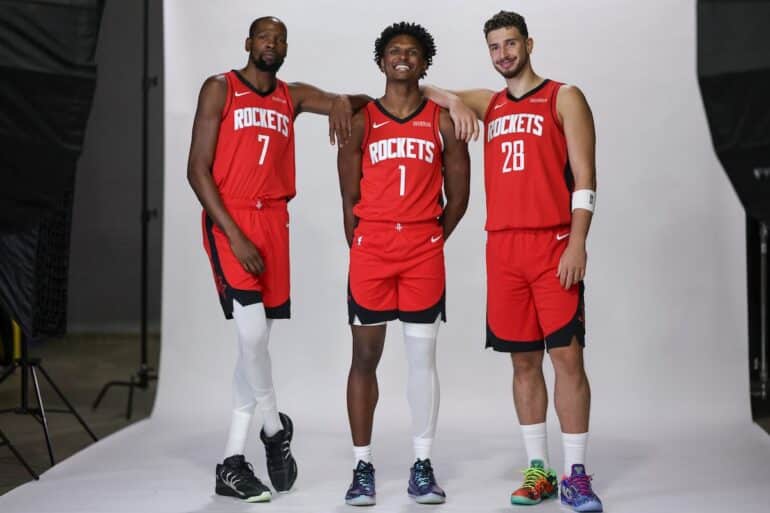
Alongside Alperen Sengun and Kevin Durant, Thompson will surely still see opportunities to continue flourishing as a cutter, roller, offensive rebounder and transition dynamo. But the Rockets are expecting even more of him on the ball. Among the keys to his growth last season were newfound comfort and efficacy as an intermediate scorer. In year one, he shot 37 percent from 4-14 feet on 16 percent frequency, according to Cleaning the Glass. In year two, those numbers spiked to 45 and 26.
If he can maintain similar growth and still live at the rim (72 percent shooting in 2024-25, 91st percentile), he’ll be a rather useful scorer/creator to help carry the load with Sengun and Durant, much to the benefit of Houston’s collective offense. If not, a ferocious defense could again be hamstrung by disheveled offense and spur another early playoff exit. -Jackson Frank
Memphis Grizzlies: 98.5
In 2024-25, the Memphis Grizzlies debuted a new, unorthodox offense that replaces screens and handoffs with calculated off-ball movement. From an uninformed perspective, it would appear they succeeded, placing sixth in offensive rating. We know how the Grizzlies’ season ended, though. They collapsed toward the finish line and fired multiple coaches, including head coach Taylor Jenkins.
Beyond a litany of injuries, defensive problems and rotten vibes, Memphis’s offensive production relied on potent transition and early offense. Its half-court offensive rating ranked 15th (98.5 points per 100 possessions), less than a point above league average, compared to their first-ranked transition offense. Ja Morant’s nuclear explosiveness and Jaren Jackson Jr.’s power driving are nightmarish in the open floor but set defenses were far better equipped to handle those stars.
Without support from traditional ball-screens or off-ball actions, Memphis relied on individual advantage creation, banking on its unique off-ball shifting to create similar windows. As a result, the Grizzlies led the league in drives per game (59) but those drives didn’t create shots at the rim or bend defenses. They took a league-high 34 percent of their half-court shots from 4-14 feet, nearly four percent higher than the second-place Los Angeles Clippers (30.3 percent).
During his nine regular-season games as head coach, then-interim Toumas Iisalo dropped Memphis’s drive frequency (53.8 per game), sprinkling in more traditional high ball-screen and handoff action. Desmond Bane’s departure removes another secondary creation threat as well, likely demanding even more ball-screens and handoffs.
The offseason additions of Ty Jerome and Kentavious Caldwell-Pope should bring more credible floor-spacing threats and increase the Grizzlies’ 3-point volume. If healthy, they’re talented enough to field a playoff-worthy half-court offense. Morant, Jackson and a healthy collection of role players might lead Memphis to its first top-10 half-court offense in the Cleaning the Glass era (since 2003-04). -Ben Pfeifer
New Orleans Pelicans: 365
The website Spotrac is quickly rising up my personal rankings for best basketball resources. A big reason why is its feature that allows you to track how many games a team has lost due to injury in a given season.
Unfortunately, this metric has not been kind to the New Orleans Pelicans recently. Last season, Pelicans players combined to miss 365 games, which was the fourth-highest mark in the league. And it wasn’t just end-of-rotation players missing time. It was mainly their heavy hitters, evidenced by them being second in cash lost due to injuries.
When healthy, the Pelicans may be imperfect (particularly on defense) but they definitely have some guys who could make them dangerous. Jordan Poole, Trey Murphy III, Herbert Jones, Zion Williamson and Yves Missi makes for a pretty intriguing starting lineup. Plus, they still have Dejounte Murray (when he returns), Jordan Hawkins, Jose Alvarado, Saddiq Bey, Kevon Looney and rookies Derik Queen and Jeremiah Fears to round out their roster.
Given they traded away their 2026 first-round pick, there’s no reason the Pelicans shouldn’t try to win as many games as possible. So, we will get to see this collection of players go for it every single night. The question now becomes: Can they stay healthy enough for us to witness their true ceiling? -Mat Issa
San Antonio Spurs: 6.7
In 2024-25, the San Antonio Spurs were a respectable team when their prodigious sophomore big man was on the floor, posting a plus-3 net rating per 100 possessions during Victor Wembanyama’s 1,527 minutes (per PBP Stats). Where things got bad, and why the Spurs ultimately ended the season 34-48, was when they had to play basketball without him. In 2,419 minutes without Wembanyama, the Spurs had a minus-6.7 net rating, which is nearly identical to the 24-58 Philadelphia 76ers’ season-long net rating (minus-6.3).
Now, it isn’t atypical for teams to struggle when their best player is off the floor. But if the Spurs want to make their first postseason appearance of the Wembanyama era, they must do a better job of mitigating the damage when their best player is on the bench.
San Antonio knows this, which is why its most significant non-Draft-related moves included adding Luke Kornet and Kelly Olynyk – two guys who can not only play alongside Wembanyama in double-big lineups but also help be a lifeline when Wembanyama is catching his breath.
Of course, neither of those players are perfect. Kornet is more of a defense-first player while Olynyk strives on offense. The Spurs will always be losing something when Wembanyama comes off the floor. But if what they lose is less than the value they bled last season, a playoff berth could be in their near future. -Mat Issa