

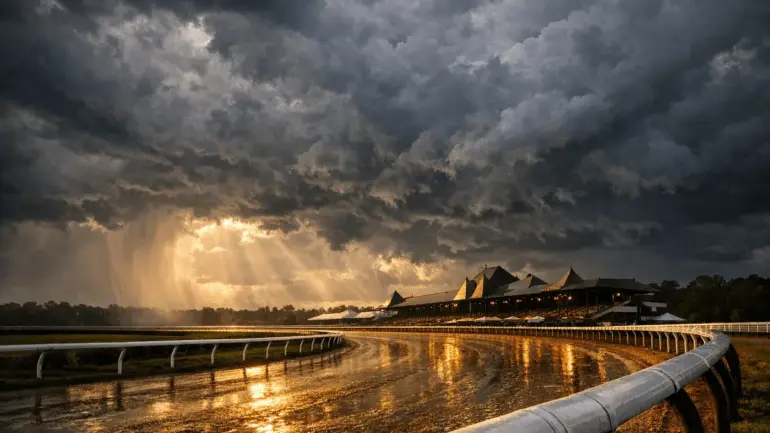
The National Weather Service is currently projecting an 80% chance of showers Saturday night – directly overlapping the 7:04 p.m. ET post time for the 158th Belmont Stakes at Saratoga Race Course – and that single probability figure is now the most consequential number on the entire betting board.
Not the morning-line odds. Not the pace projections. The rain probability. A wet main track at Saratoga does not merely set a backdrop; it restructures which horses can win this race and which cannot, and the books know it. Expect live line movement in the final two hours before post if any storm cell parks over the Spa.
Why This Forecast Carries More Betting Weight Than a Standard Rain Chance
This is not ambient weather noise. This is a material handicapping variable – and the distinction matters. A 20% chance of a passing shower is noise. An 80% chance of showers overlapping the exact post-time window, at a venue that absorbed nearly 1.5 inches of rain on last year’s race morning and still sent the field out onto a heavily muddied surface, is a structurally different problem.
The Belmont at Saratoga setup amplifies every weather variable in ways the traditional Belmont Park configuration did not. The race is contested at 1¼ miles on Saratoga’s tighter, more turn-dependent oval – a clubhouse-turn start that compresses pace dynamics even on a fast surface. On a wet or sloppy track, that compression intensifies. Early position matters more. Wide draws get punished more severely. Horses that can rate and accelerate through slop rather than powering through it gain a measurable tactical edge.
Saratoga’s dirt surface is also known to seal quickly when it gets wet – meaning a track that reads sloppy at 5 p.m. can still be officially listed as sloppy at 7 p.m. even if the rain stops an hour before post. Last year’s race is the direct precedent: the rain cleared, the skies improved, and Sovereignty still ran on a heavily muddied surface. The surface lag is real, and bettors who discount it will be wrong in the same direction they were wrong twelve months ago.
How Track Conditions Move the Odds Board – Field-by-Field Read on the Top Contenders
The full Belmont Stakes odds and post-draw breakdown establishes the baseline. Here is how the weather forecast stress-tests each major contender:
- Renegade (2-1 morning line, +200): Derby runner-up and current chalk. The question a wet track forces on Renegade is whether his fast-track tactical speed translates to off-going. Horses at this price point in classic races have a way of firming up regardless of forecast – the public bets the name, not the surface. If Renegade has no documented off-track form, that 2-1 price becomes a liability the moment the track designation drops below fast.
- Golden Tempo (Derby winner): Morning-line odds place Golden Tempo as a clear participant in the chalk conversation, but Derby winners with speed-dependent profiles are historically the most exposed horses when Saratoga’s surface goes sloppy. Front-runners who set fractions on a fast track often find the early going more laborious in wet conditions – and laborious early fractions at 1¼ miles on a tight oval tend to end badly for the horse that burned the most energy getting to the turn.
- Commandment (+600, 6-1): This is the weather-scenario horse to watch. At 6-1, Commandment already represents the best odds value in a field where the top two are priced to near-certainty. Add a sloppy or muddy designation, and horses at this price with any documented wet-track ability tend to attract sharp money in the final 90 minutes. Monitor Commandment’s odds after 5:30 p.m. ET – movement toward 4-1 signals the books are seeing exactly that kind of late action.
- Emerging Market and mid-tier contenders: The weather scenario functionally compresses the mid-tier field. Horses without off-track form become unknowns; horses with documented mud tolerance get repriced upward in implied probability. Any horse in this group with a wet-track win on its past-performance line becomes a live exotic component Saturday evening regardless of morning-line position.
*Odds are for entertainment purposes only.
A Wet Track at Saratoga’s Configuration Punishes Wide Draws More Severely, Not Less
Here is the sharpest analytical claim in this piece, and it is one the casual bettor will miss entirely: off-track conditions at Saratoga’s 1¼-mile layout do not neutralize the inside-post advantage – they amplify it. On a fast surface, a horse drawn wide can compensate with raw speed and position itself naturally during the run to the first turn. On a wet track, early fractions slow, the field compresses toward the rail, and a horse forced three-wide out of the gate is spending energy in the worst possible place at the worst possible time.
Posts 1 through 4 already carry a documented tactical edge at this configuration, as Horseracing Nation’s Belmont preview flags explicitly. Rain does not correct for a wide draw. Rain taxes it further. Any top contender sitting in posts 7 or higher should be downgraded one tier in wet-track scenarios at this specific oval – that is not a general principle borrowed from other tracks, it is specific to how Saratoga’s clubhouse-turn start interacts with a wet, slow surface that discourages aggressive early wide moves.
The pace scenario implication is equally direct: if the track goes sloppy, expect slower early fractions that compress the field through the first turn, a longer grind through the middle half-mile, and a final quarter that rewards horses who rated – not horses who led wire to wire. Closers with clean trips from inside draws become the highest-probability winners in that scenario. Speed horses drawn wide in a sloppy-track Belmont at Saratoga are, historically, the right fade.
The Honest Pushback – Why the Weather Might Not Matter at All
Here is the honest pushback: forecast uncertainty at this lead time is real, and the difference between a thunderstorm that crosses Saratoga directly and one that tracks 20 miles north is the difference between a sloppy track and a fast one. Saratoga’s drainage infrastructure handles moderate rainfall efficiently – a brief shower before post does not automatically produce a track-condition change the way a sustained morning rain would.
Last year’s race is the counterargument as much as it is the precedent. Sovereignty won on a heavily muddied surface – decisively, not barely. The best horse sometimes wins regardless of footing, and if Renegade or Golden Tempo is genuinely the class of this field, a wet track may slow the pace enough to actually help them rather than hurt them by neutralizing speed from weaker rivals. It is also worth noting that Friday’s card ran on a fast surface under sunny skies with a high near 88°F – the forecast change is sharp but not yet confirmed at ground level.
The thesis holds regardless. A 80% precipitation probability overlapping post time is a signal to prepare, not to ignore. The honest caveat is timing and intensity – not whether rain is coming, but how much and exactly when.
What to Watch Before Post Time – The Information Triggers That Actually Matter
NYRA publishes the official track condition designation approximately 90 minutes before post – that puts the critical call around 5:30 p.m. ET Saturday. That is the number to watch, not the weather app. A designation of sloppy or muddy at 5:30 p.m. is the trigger to execute any wet-track adjustments in the betting strategy. A fast or good designation at that same moment means the forecast storms either missed the track or are still incoming – and that ambiguity itself warrants caution on any bet that depends on surface conditions.
Watch Commandment’s live odds specifically. Movement from 6-1 toward 4-1 in the 5:30–6:30 p.m. ET window is sharp-money confirmation that professional bettors are reacting to a track condition update. According to US Racing’s betting preview, the rain is explicitly framed as the decisive late variable – “temperature and wind are non-factors; the rain is not.” That framing is correct. Check NYRA’s official designation, check the odds board for Commandment movement, and check the radar loop for storm cell positioning relative to Saratoga. Those three inputs, in that order, are the pre-post checklist.
Silence on the track condition call past 6:00 p.m. ET – meaning no downgrade from fast – is itself useful data. It narrows the scenario back toward the dry-track handicapping and reanchors Renegade as the legitimate chalk.
Bottom Line
What is confirmed: an 80% chance of showers Saturday night directly overlapping the 7:04 p.m. ET post time, a surface that sealed muddily under similar conditions twelve months ago, and a 1¼-mile Saratoga configuration that amplifies inside-post and rating-style advantages under wet footing.
What is not confirmed: the actual track designation at post time, the precise timing and intensity of any storm cell, and whether the drainage holds well enough to maintain a fast surface through a brief shower.
The bet: Monitor the NYRA official track call at 5:30 p.m. ET. If the designation comes back sloppy or muddy, back Commandment at 6-1 as the primary wet-track value play and downgrade any wide-drawn speed horse – including Golden Tempo if the post position warrants it – in your exotic structures. If the track holds fast, the dry-track analysis from the pre-draw odds piece governs. Do not commit to a wet-track strategy before the official designation drops. But do not wait past 6:00 p.m. ET – the live market will have already moved by then.
*Odds are for entertainment purposes only.