

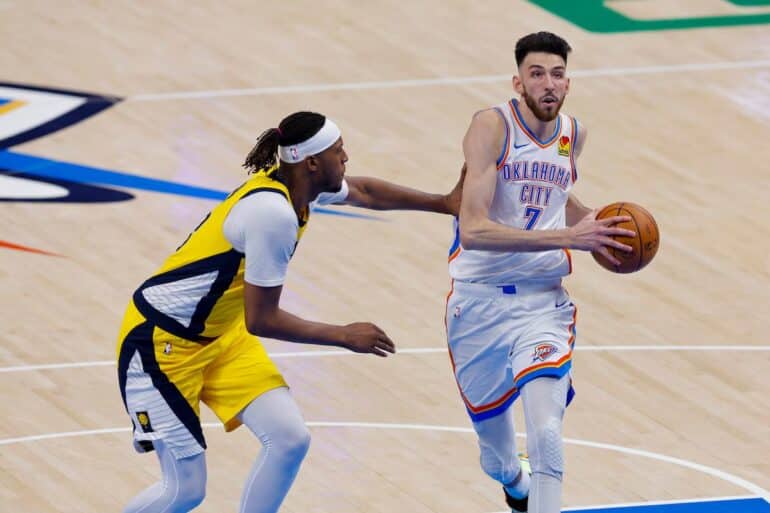
This is part of a series breaking down players poised to possibly take a leap this upcoming NBA season and influence the playoff race. Our latest installment featured Detroit Pistons guard Jaden Ivey.
We live in a beautiful era of parity in the NBA. Each of the last seven seasons, we’ve celebrated a different champion. There are a few reasons for this.
With the new CBA restrictions, it’s becoming increasingly complex for a contending team to build a championship-worthy roster and keep that roster intact for more than a few seasons without facing the repercussions of the first and second aprons.
Without super teams, the difference between making a championship run and losing early in the playoffs could be as simple as being healthier — always the case, but heightened now in a flatter competitive landscape. And finally, it’s physically taxing to complete back-to-back title runs. Only three teams have done it this century, and for good reason; it’s exhausting.
Nevertheless, the Oklahoma City Thunder are a legitimate candidate to buck this trend in 2025-26. Armed with the reigning MVP, young talent, depth, and a tried-and-true defensive identity, they stand the best chance to become repeat champions for the first time since the 2017-18 Golden State Warriors.
But they can’t do it by being the same team as last year. Every champion must evolve to keep opponents guessing. The Thunder are no different. The easiest way to do that is through their defensive anchor, Chet Holmgren, taking a leap in year three.
Here’s how he does it.
How Holmgren Can Help OKC Reach Another Level
The Thunder have a championship formula. Their historic defense, propelled by savvy, synergistic perimeter defenders, wreaks havoc at the point of attack. They cause deflections, throw teams in a rut, force turnovers, and get out in transition. They can play big (and even extra big) or go smaller. It doesn’t matter what you throw at them. It’s truly a beautiful, well-oiled machine.
Holmgren is a significant part of that versatility.
His ability to guard in space, while also being one of the NBA’s very best rim protectors, provides OKC with a unique level of flexibility only a handful of teams possess. His malleability ensures the Thunder can bend into whatever defensive shape is required.
But their offense lacks that same variety.
On the surface, you’d think this is a ludicrous statement. According to Cleaning the Glass, OKC boasted the NBA’s second-best offensive rating last season, including 104.6 points per 100 possessions in the half-court — also second-best behind the Cleveland Cavaliers.
But OKC’s offense, particularly in the playoffs, had stretches of real stagnation. While a drop in offensive efficiency is typical during the postseason, the Thunder’s half-court offensive rating dipped by eight points per 100 possessions — the second-largest differential of any team to make the second round in 2025.
So, heading into 2025-26, the Thunder must experiment as much as possible offensively to become more dynamic for the postseason. That starts with Holmgren — the key piece to unlocking OKC’s true potential on offense.
Tweaking His Offense
A hip injury forced Holmgren to play just 32 regular-season games last season, so it’s worth noting health should be the main priority for him and the Thunder this year (as is the case in any season). That’s not just because of OKC’s own title aspirations, but because staying on the floor is Holmgren’s easiest path to fine-tuning his offensive game.
Earlier, I made clear Holmgren’s defensive flexibility is vital for the Thunder. When he’s in form, he can have a similar effect offensively, with his ability to knock down threes, create his own shot, finish as a roller and find openings as a cutter to score inside.
During the regular season, he’s a career 37.2 percent 3-point shooter. Although he’s shot just 28.4 percent from three through two postseason runs, that number should improve as long as health permits — primarily because there is a large sample of him shooting much better than that in the regular season.
Instead, the relevant number for his outside shooting is volume. He averaged just 3.6 attempts per game in 2024-25 and 4.2 per game as a rookie. Compared to the per-game output of other stretch bigs last season — Kristaps Porzingis (6.0), Victor Wembanyama (8.8), Myles Turner (5.5), and Jaren Jackson Jr. (5.3) — Holmgren needs to let it fly more frequently.
In fact, last season, he ranked 22nd in 3-point attempts per game among players 6 feet 10 inches or taller. Increasing that frequency is crucial because not only does it help better space the floor for Oklahoma City’s entire offense, it also makes life easier for Holmgren himself. If teams are forced to guard him farther from the basket, he can attack more closeouts and work as a driver, adding another tool to his toolbox.
On top of 3-point volume, his midrange touch must return as well. As a rookie, he shot 7.6 percent better on two-pointers than he did in his second year. In 2023-24, he shot 51 percent (81st percentile) from short midrange, compared to a woeful 34 percent in 32 games last season. He shot 38 percent on long midrange jumpers as a rookie and just 30 percent in year two. If healthy, he should bounce back in those areas next season, which will only make him a more dynamic pick-and-roll threat.
Experimentation
Beyond that sort of growth, the Thunder need to continue experimenting with the ball in Holmgren’s hands. We’ve seen very little of that so far in his career, primarily because they haven’t required it of him. But the better he becomes at creating his own shot or as a passing hub above the break, the better equipped OKC is offensively when its primary options run dry.
We’ve seen greater offensive production in flashes. He averaged 18 points (56/37/72 shooting splits) across five Western Conference Finals games against the Minnesota Timberwolves this past spring. He had 18 points on 6-of-8 shooting in Game 7 of the NBA Finals. That’s the version of Holmgren who can thrust himself into the Most Improved Player conversation next year and make the defending champions more dynamic offensively.
Holmgren, rightfully, received a five-year, rookie max extension this summer. But he got it in part because of what’s expected moving forward. It’s already assumed he’ll be a perennial Defensive Player of the Year candidate; that’s how dominant he is on that end. But to truly reach star status, he has to continue sharpening his game offensively.
He’s in the right environment to do so. Head coach Mark Daigneault has never shied away from experimenting during the regular season, using the 82-game schedule to stretch the rotation and test his players’ limits. If Holmgren is to reach his full potential and help the Thunder realize theirs, Daigneault must do exactly that with his budding big man.