
The San Antonio Spurs forked over an unconscionable amount of money to De’Aaron Fox this summer, inking their star guard to a four-year, $222 million contract. Fox’s annual earnings will level out at $55.6 million per year and the contract ascends as it ages, starting at an estimated $49 million in 2026 and $61 million in 2029.
Fox’s shiny new deal will jump him up from 48th in average annual earnings to fifth, just above Jimmy Butler and Nikola Jokic and just below Jaylen Brown and Anthony Davis. The Spurs are committing around 30 percent of their cap to Fox over the next four years, which places him a more reasonable 20th league-wide.
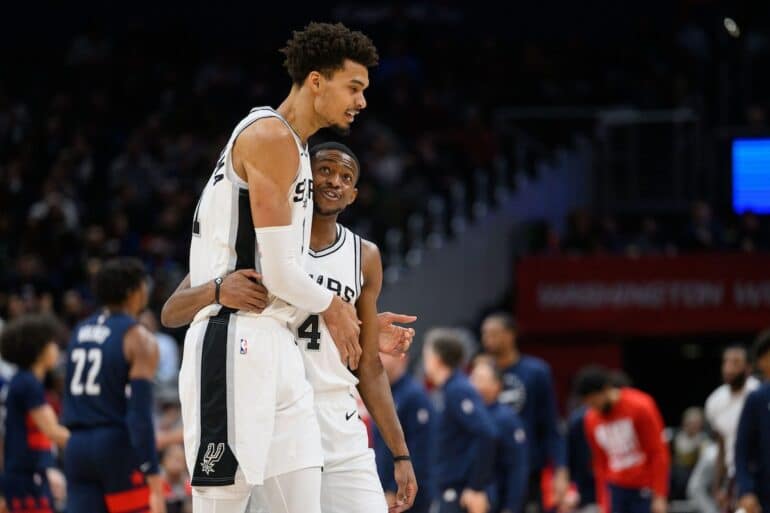
Even if the inflated league-wide cap numbers can exaggerate how highly paid a player feels, the Spurs will expect Fox to produce like a star throughout his tenure, impacting winning as one of Victor Wembanyama’s co-stars. To pay out a contract of that magnitude, San Antonio must have confidence Fox can synergize with and amplify Wembanyama.
A blood clot in Wembanyama’s right shoulder ended his season shortly after Fox arrived, so they barely had the chance to play together and build chemistry. The duo played just 112 non-garbage time minutes and posted a minus-4.4 net rating. Defense was the culprit, which is especially noisy in tiny samples, but the offensive rating sat 0.9 points above league average.
A Work In Progress
Those minutes are far too narrow a sample to draw salient conclusions from, but we can watch back the tape in search of signals. To live up to his contract, Fox must lead efficient offenses alongside Wembanyama. Doing so could hinge on Fox’s willingness to adopt a more rhythmic downhill approach and improve as a floor-spacer.
In 2024-25, he averaged 23.5 points, 6.3 assists, 4.8 rebounds and 1.5 steals on scoring efficiency 1.7 percent below the league average. At this stage of his career, Fox does most of his damage in the midrange, taking eight midrange shots per game and converting at a strong 47 percent clip. His rim frequency has consistently dipped, nearly slashed in half since his peak in 2020.
Despite an effective midrange game, Fox’s poor outside shooting on average volume — he made 31.1 percent of his 6.1 threes per 75 possessions last year — drags down his spacing value. His occasional blips of shooting success, even season-long ones (37 percent on eight attempts per game in 2023-24), aren’t as valuable without nuclear downhill pressure on the ball.
Here, Jayson Tatum doesn’t respect Fox’s shooting on the move, even from the midrange. Fox has years of experience curling around handoffs — initially with Domantas Sabonis and now Wembanyama — but Tatum ducks under the screen and blocks the shot:

There’s a glimpse of promise in that clip, though, as Wembanyama’s passing already rivals most big men in the NBA. His potential assists per 100 possessions (9.7), rim assists per 100 (2.8) and on-ball rate (13.6 percent) all placed him in the 91st percentile or better last season.
Among all centers, he ranked sixth in rim assists per 100 possessions. He’s constantly looking for cutters and dribbling into handoffs and screens to create shots in the lane. This will benefit Fox, who flashed off-ball chemistry with Wembanyama this past season. A career-high 41.4 percent of his makes at the rim were assisted last season and we could see that rise again in 2025-26:

Fox is at his best creating in the pick-and-roll, where he and Wembanyama should thrive together. In Sacramento, Sabonis lived at the high post and elbows, rolling hard to the rim less often than many other great bigs. Wembanyama is a dynamic vertical threat with an all-time catch radius, which should make Fox’s life easier as a passer.
While Fox lacks the passing vision and floor processing to play as a team’s full-time primary decision-maker, he’s skilled enough to punish drop coverage, especially with his advanced pacing and intermediate scoring. Last season, among all pick-and-roll ball-handlers, he ranked in the 85th percentile for points per possession and 93rd percentile for volume. That elite blend of efficiency and workload should open more scoring opportunities for Wembanyama.
If Wembanyama’s threat as a roller is too punishing, defenses will begin switching the action. But Fox roasts weaker defenders like nobody else on the Spurs. He’s still a lethal isolation scorer, especially against bigger defenders who can’t contain his speed and change of pace:

On most teams, Fox and Wembanyama make sense as a primary pick-and-roll partnership. The Spurs’ recent drafts complicate this, as they selected two pick-and-roll operators in Stephon Castle and Dylan Harper. For both players, but especially Harper, the bulk of their offensive impact comes with the basketball, leaving Fox to space the floor off the ball.
We haven’t seen enough of the Fox-Wembanyama pairing to know how they’ll mesh. As both gain confidence and trust with each other, it’s easy to imagine them generating great offense (and Wembanyama covering for everything on defense, as usual). Fox has driven elite offenses before but he’ll have to overcome a suboptimal roster design in San Antonio.
By maintaining his 2024-25 level of play, Fox can return star value. To live up to his contract and San Antonio’s lofty expectations, he’ll need to rediscover his form of a few seasons ago. While the Spurs’ collection of promising young players provide other pathways toward a strong roster, they won’t reach their ceiling in 2025-26 and beyond without a potent star partnership, the likes of which Fox is integral to establishing.