
The New York Giants traded Dexter Lawrence to the Cincinnati Bengals and walked away with extra first-round capital in a move that immediately reframed everything about their draft strategy.
That deal — a franchise cornerstone for premium picks — was not a salary dump. It was a declaration.
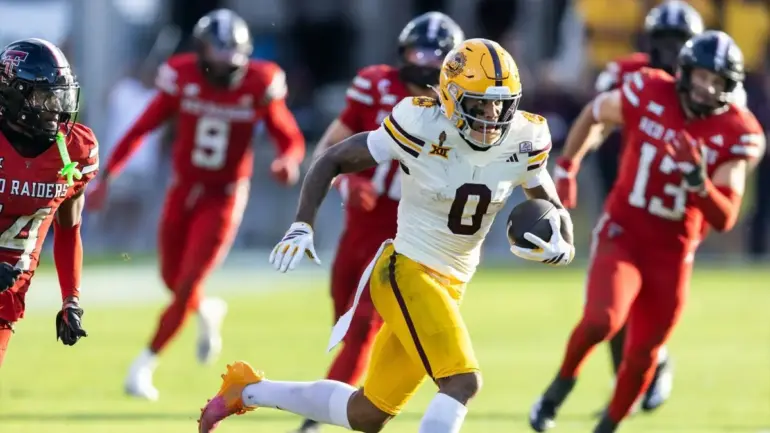
Now the name generating the most heat in NFL rumors circles is Arizona State wide receiver Jordyn Tyson. General manager Joe Schoen personally attended Tyson’s pro day.
Multiple pre-draft meetings have been confirmed. Three analysts have independently projected Tyson to the Giants at No. 5 in recent mock updates. This is not noise. This is a paper trail.
The Dexter Lawrence Trade Gives the Giants Real Options
Strip away the sentiment around losing Lawrence and what you’re really looking at is a Giants front office that now holds two first-round picks — including their existing No. 5 selection and the additional capital coming back from Cincinnati.
That is a meaningful repositioning for a team that entered this offseason light on elite offensive weapons.
Two first-rounders means the Giants do not have to choose between talent and need. They can do both. Take the best receiver on the board at No. 5, then address edge rush or linebacker depth with the second selection.
Our full first-round composite for the 2026 NFL Draft outlines exactly how that capital fits into the broader draft landscape — and the Giants are now among the most dangerous teams in the top ten.
The Cowboys have been running a similar playbook. As Jerry Jones has demonstrated in Dallas, teams with surplus first-round assets can afford to draft elite talent over positional need — and that philosophy is exactly what the Giants appear to be executing right now.
Jordyn Tyson Is a First-Round Talent Hiding in a Mid-Round Conversation
Tyson broke out at Arizona State Football as one of the most complete receivers in the Pac-12, combining elite vertical tracking with contested-catch reliability that translates cleanly to the NFL level.
He’s not just a burner — he wins at all three levels of the route tree and carries real post-catch acceleration that shows up on tape as much as in the measurables.
NFL.com analyst Daniel Jeremiah currently has Tyson ranked 18th overall on his big board, which places him behind Ohio State’s Carnell Tate at No. 6 and Indiana’s Omar Cooper Jr. at No. 17.
That ranking matters because it’s the honest baseline — Tyson is a mid-first-round talent by consensus evaluation. But consensus and draft-night reality are two different things when a specific team has fallen hard for a specific player.
The buzz coming out of those pre-draft meetings is direct: the Giants love Tyson.
ESPN’s Todd McShay, speaking on the Rich Eisen Show, reported hearing the Giants had pivoted from Ohio State linebacker Sonny Styles to Tyson — and Eisen added his own read, noting the draft-street chatter suggested Styles was no longer New York’s priority.
When McShay and Eisen are citing the same name independently, it carries weight.
Why Tyson Fits What Brian Daboll Is Building
The Giants’ receiving corps has been a structural problem for years. They have lacked a true WR1 — a receiver who can be targeted as the primary read on third down, manufacture separation against press coverage, and give a developing quarterback a reliable vertical option. Tyson addresses all three of those gaps.
For a second-year quarterback who needs a genuine field-stretcher to work with, Tyson’s combination of route refinement and deep-ball tracking is exactly the profile that accelerates development. The Giants are not looking for a slot complement or a possession receiver.
They are looking for the X — the player who forces defenses to declare coverage before the snap. Tyson has quietly built that reputation through two dominant college seasons, and Schoen’s pro day visit was not a courtesy call.
The Complication: Is No. 5 Too Early?
Here’s the pushback you will hear most: Tyson is an 18th-ranked prospect. Drafting him at No. 5 is a twelve-spot reach by Daniel Jeremiah’s own board.
Analyst Patricia Traina has been vocal that a top-10 selection on Tyson “doesn’t make sense whatsoever,” citing injury history and the Giants’ roster needs elsewhere as compounding concerns.
It is also worth noting that the Giants are not the only team interested. Baltimore has been consistently linked to Tyson in composite mocks, with some projections placing him to the Ravens as early as No. 14. If Baltimore moves first, the Giants’ window closes before their pick is even announced. The board has to cooperate.
Bottom Line
The Dexter Lawrence trade bought the New York Giants the freedom to make exactly this kind of call — a talent-over-need selection at a premium position with a second first-rounder available to patch the defensive holes left behind.
Tyson may be ranked 18th on paper, but draft positioning has never been purely about consensus boards. It’s about which team needs a player badly enough and has the capital to justify moving early.
The Giants have the capital. The meetings confirm the desire. If Tyson is still on the board when New York’s card goes in, do not be surprised if Joe Schoen makes the call that resets the offense for the next four years — reach label and all.