

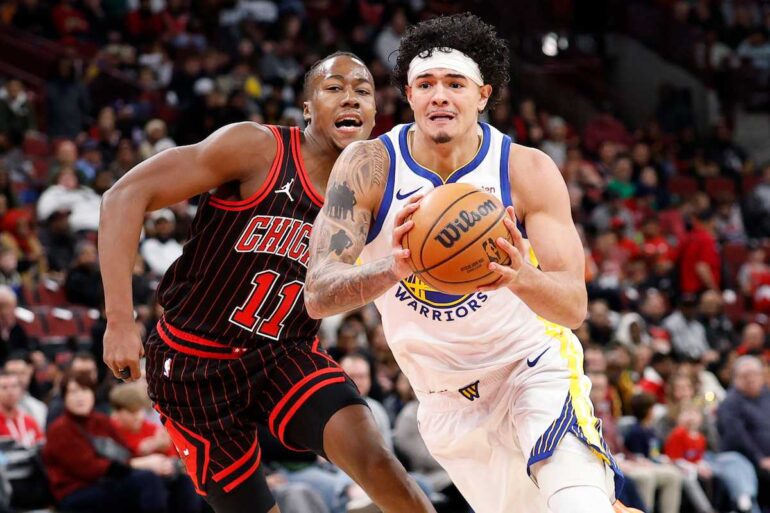
A couple of nights back during the Golden State Warriors’ almost-win against the Philadelphia 76ers, head coach Steve Kerr drew up an after-timeout (ATO) set for his only 7-foot player on the roster in Quinten Post. Typically, drawing a set play for a center would entail some sort of up-close endeavor, either in the form of a post-up, pick-and-roll/pick-and-roll-adjacent set or lob set up by some sort of back screen or decoy action.
However, not only did Kerr not draw up a play that placed Post near the rim — Kerr drew up a play that lifted Post as far away from the rim as possible, beyond the 3-point line.
Quinten Post’s Impact
Post profiles as a luxury Kerr and the Warriors haven’t had prior to drafting the second-year Dutch center out of Boston College. He is a legitimate shooting five who can stretch the floor and, therefore, stretch defenses and their ability to make decisions to their limit. In that regard, a player of Post’s literal stature typically relaxes big-man defenders into a certain line of thought, one also baked into their natural tendencies as a defender: that it is almost certain their counterparts wouldn’t be a threat outside the paint.
In Andre Drummond’s case on the ATO possession, that line of thought was used against him:

Being caught unaware, Drummond is stuck in Pat Spencer‘s screen for Post but not before Will Richard’s movement toward the corner to create an initial layer of confusion. These maneuvers in tandem create an open shot for Post.
Two games later in Sunday’s 123-91 win over the Chicago Bulls, Kerr draws up virtually the same ATO set but with different personnel and a different focal point. Moses Moody becomes the recipient, playing the role Spencer played in the first instance, while Brandin Podziemski is the man in motion creating the initial confusion. Post shifts to a more natural role as a big man, that of a screener, a part he plays well, considering Moody gets free for the look around the screen:

Why The Warriors Have Made Rotational Changes
While employing decoy actions and overall movement have been hallmarks of Kerr’s offense, both in his scripted actions and freelance flow, it can be argued interchangeability and versatility are equally as important, if not more. Being able to play multiple roles on offense is key to staying relevant in Kerr’s system, a fact exemplified by none other than the biggest driver and beneficiary of that system in Stephen Curry.
Without Curry, and with only Jimmy Butler as the team’s main advantage creator and driver of the offense, the importance of having players who know their roles and willingly embrace them becomes even more pronounced. That was a huge reason behind the healthy benching of Jonathan Kuminga against the Bulls, who has struggled to fit into what Kerr and the team want their complementary players to accomplish.
Meanwhile, it’s also a huge reason behind the increase in playing minutes for the likes of Gui Santos (who plays the same position and role as Kuminga) and Spencer (who has usurped Podziemski in the pecking order, at least for the time being).
No one certainly doubts the talent and potential of Kuminga. But talent and potential need to translate into actual winning impact, buoyed by a development process that is intentionally reasonable. For reasons both of his own making as well as the team’s making, Kuminga just hasn’t been able to fit in, nor has he acquired the requisite skill-sets (e.g., ball security, handles, advantage creation, etc.) to justify being an important cog in the offense. That’s why someone who, on paper, is less talented and certainly has a lower ceiling than him has usurped him in the rotation.
Santos’ effort flies off the page through the literal ways he flies around the court, whether on the boards or darting around on the floor in his efforts to create chaos. Like Kuminga, he is disadvantaged in the sense he may never develop into an on-ball scoring threat capable of creating advantages. Unlike Kuminga, Santos was a late second-round draft pick, a draft position where no team expects to hit the primary ball-handler jackpot.
But Santos is well aware of his relative standing and how much more effort he has to expend in order to stand out. He may not be getting the kind of touches Kuminga should be getting (and has often demanded) but he subscribes to the mantra of the offense: keep the ball moving, keep yourself moving and maintain the flow of the entire machinery.
As of late, Santos’ role in that team-wide goal has been to act as a serviceable in-between playmaker: in the short roll, while attacking off the catch and cutting toward the middle of the paint to act as a pressure release valve:

Spencer, on the other hand, has both been the spark that triggers the offense and part of the collective oxygen that keeps the fire going. His presence on the floor creates the kind of movement and motion Kerr has been wanting to see from his squad all season. In tandem with a bona-fide advantage creator and equally willing ball mover in Butler, the Warriors’ offense has been at its most healthy as it’s ever been (albeit, against a Bulls squad in freefall).


It’s important to take the Warriors’ 132.3 points per 100 possessions against the Bulls with a considerable level of salt, considering the quality of opponent. But the Warriors also didn’t have a full squad in hand while having to cobble together a squad that could capably hold the fort. Tough decisions were made along the way. They’ve limited Kuminga’s playing time until he didn’t play altogether and relegated Podziemski to a bench role after being told not to do too much for himself at the expense of what the team wants him to do.
To Podziemski’s credit, he took those comments by Kerr to heart and came back with a steady performance against the Bulls by scoring 21 points, hauling in eight boards and dishing seven assists. With Spencer on the bench, Podziemski ran the offense with steady decision-making and — more importantly — being an assertive decision-maker with little-to-no hesitation behind his thought process.

As a final aside, the importance of De’Anthony Melton to this offense, in addition to being a point-of-attack specialist, was never more pronounced than Sunday, both as a secondary ball-handler and as an off-ball mover darting around screens. The Warriors’ patented low-post split action seen below exemplifies that. Melton has been the quintessential example of a willing mover in an offense where the main currency is constant movement.