

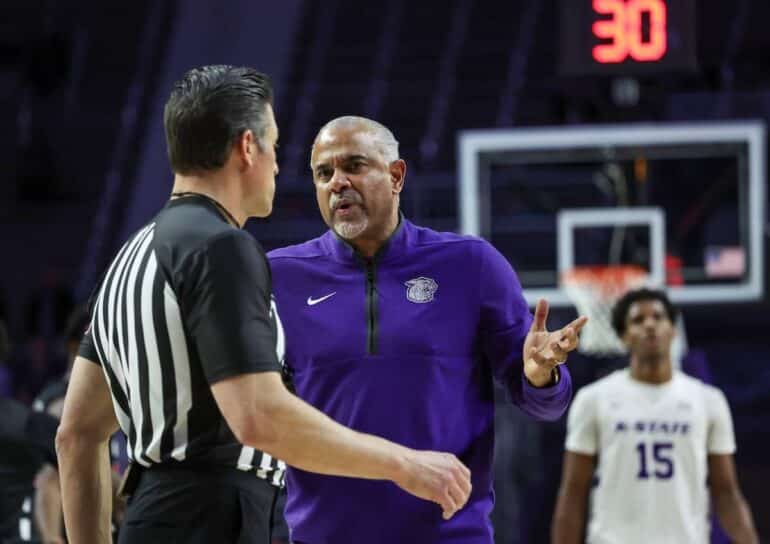
Kansas State may have fired Jerome Tang for cause following his emotionally charged press conference but the saga is far from over.
The decision appears to be a transparent attempt to void the $18.7 million remaining on his contract, yet legal experts and insiders warn the university could be setting itself up for a costly misstep that might leave them liable for the full amount — and then some.
With Tang already lining up top-tier legal representation in Tom Mars and Bennett Speyer, the Wildcats’ gamble could quickly turn from a financial strategy into a full-blown courtroom spectacle.
The “For Cause” Gambit
Coaching contracts at the Power Five level are written with precision.
A “for cause” termination typically requires clear and demonstrable breaches: major NCAA violations, criminal conduct, fraud, or behavior that materially damages the institution’s reputation under explicitly defined standards.
Disappointment, locker-room tension, or administrative frustration do not meet that bar.
“There’s language in his contract that addresses certain things that potentially bring embarrassment,” athletic director Gene Taylor said in his press conference. “Basically his comments about the student-athletes and the negative reaction to those comments from a lot of sources both nationally and locally.”
K-State Athletic Director Gene Taylor confirms that Jerome Tang's firing was FOR CAUSE. This followed statements Tang made about the student-athletes after Wednesday's loss to Cincinnati, where he stated: "These dudes do not deserve to wear this uniform. There will be very few… pic.twitter.com/a1xOKr0eoR
— Asia Cymone Smith (@asiacymoneTV) February 16, 2026
By invoking “cause,” Taylor is signaling confidence that Tang’s conduct meets that threshold. The financial incentive is clear: nearly $19 million in guaranteed money would disappear if the university prevails.
But if the case fails, Kansas State could be liable for the full amount, plus potentially millions more in legal fees and damages.
Courts typically scrutinize employer motives closely in high-dollar contract disputes, particularly when timing suggests the action may be tied to performance rather than misconduct.
Prior to getting fired, Tang’s Wildcats had lost 11 of their last 12 games.
The Coaching Community Is Skeptical
Reaction from respected figures within college basketball has been telling.
ESPN analyst Seth Greenberg suggested that the university’s grounds for termination are flimsy at best, a sentiment echoed by college basketball veteran Fran Fraschilla.
“Just say ‘He’s not winning enough games, we need to make a change’”, Greenberg said in a rant on ESPN. “But to try to dispute and create some type of narrative that he didn’t fulfil his contract – that is absolutely embarrassing to K-State.”
The only thing Jerome Tang did wrong was is not win enough games. Trying to fire him with a cause is embarrassing. Honor the contract and move on. @KStateMBB @Big12Conference pic.twitter.com/h7v3UyDZ6L
— Seth Greenberg (@SethOnHoops) February 16, 2026
In a post on X (formerly Twitter), Fraschilla backed Greenberg’s assessment, offering a stern warning to coaches in similar positions:
“Seth is correct. Jerome Tang will get every dime. Coaches, if you are in this situation, you must hire the best sports law attorneys in the country to settle this.”
Fraschilla’s commentary suggests that the coaching community views Tang’s firing as a power move to fire a coach for cause due to on-court performance.
Tang’s Lawyer Responds To Firing
In a statement provided to ESPN, his attorney suggested that if Kansas State believes it has been embarrassed by recent events, the administration may soon experience far greater public scrutiny.
“If K-State’s president and AD really think the school was embarrassed by recent events,” Tom Mars told ESPN. “That’s nothing compared to the embarrassment that both of them are about to experience.”
In a wrongful termination dispute, discovery can expose internal communications, decision-making timelines, and administrative deliberations that universities would typically prefer to keep private.
Litigation of this magnitude rarely remains confined to the courtroom.
The Financial and Reputational Stakes
For Kansas State, $18.7 million represents a significant portion of its athletic department resources. Even if insurance offsets part of the exposure, prolonged litigation would carry legal costs and reputational risk.
Tang led the Wildcats to an Elite Eight appearance in his first season — a rapid ascent that elevated the program’s national profile.
If future coaching candidates perceive that contractual guarantees can be contested when relationships sour, the job may be viewed differently in high-level hiring searches.
That stain could last a lot longer than the payment on Tang’s potential buyout.