
NBA stars usually score lots of points. Fans easily recognize the value of supernova scorers and, therefore, those players hog much of the spotlight. Basketball encompasses more than scoring points, though. Many underwhelming scorers contribute massively to title-winning teams or deep playoff runs and some have busts in Springfield.
On a recent episode of “The Zach Lowe Show”, Lowe lightheartedly introduced the idea of a “Dennis Rodman All-Star” slot, reserved for spotlighting players who score fewer than 10-12 points per game (and introduced to me by our editor, Jackson). Myself and Mat Issa will take this a step further, picking our low-scoring All-Star team by identifying six players — two guards, one wing, two bigs and a reserve — who star in their roles and are critical to winning without posting gaudy point totals.
To qualify for this list, players must average fewer than 10 points per game and only one player is allowed per team. Let’s dive into six of the NBA’s most impactful complementary players and what makes them great.
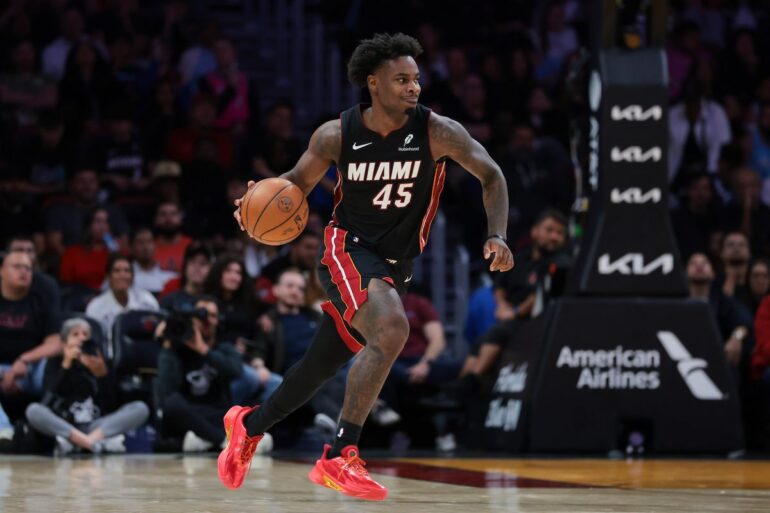
Guard: Davion Mitchell
Since his trade to the Miami Heat in February 2025, Davion Mitchell has created shots like an elite passer. In 2025-26, he graduated to high-volume playmaker territory, placing in the 95th percentile for potential assists per 100 possessions (18.5), 90th percentile for potential assists per minute (3.3) 94th percentile for bad-pass turnover rate (7.3 percent) and 93rd percentile for rim assists per 100 (3.4).
Miami’s isolation and cut-based offense needed an initiator like Mitchell with the speed to bend set defenses and the vision to locate cutters and shooters on the move. Five years of NBA experience have seasoned his decision-making and control with the ball, and it’s unlocked him as a playmaker this season.
in 2025-26 davion mitchell ranks in the 90th percentile or better for…
potential assists/100 (18.5)
rim assists/10 (3.4)
3pt assists (5.6)
potential assists/min (3.3)
bad pass tov rate (7.3%)MIA’s offense needs a pg with his downhill speed and passing on the move pic.twitter.com/yr86bvlRKR
— Ben Pfeifer (@bjpf_) December 15, 2025
Mitchell isn’t a zero as a scorer (his 9.9 points per game render him just eligible for this list) but he certainly isn’t a dynamic one-man offensive option. But efficient, low-volume 3-point shooting, midrange shotmaking verve and the speed to constantly generate shots at the hoop (even without efficient finishing) are all valuable.
With Mitchell on the floor, Miami’s offense jumps from a bottom-five unit to a top-12 one. Only Norman Powell (plus-8.0 swing) influences the offense more strongly and those two have been devastating as a pair; lineups with those two guards produce the equivalent of a top-seven offense (119.3 offensive rating).
He’s not as impactful a defender as his reputation might suggest but Mitchell’s point-of-attack stopping and incessant motor support offensively tilted guards like Powell and Tyler Herro. His blend of skills with the Heat’s ecosystem was a perfect marriage and they’re reaping the benefits of one of the NBA’s best role-playing guards. -Ben Pfeifer
Guard: Cason Wallace
We created the one-player-per-team rule primarily to avoid an all-Oklahoma City Thunder team but Cason Wallace has evolved into the NBA’s best guard defender. A full All-Defensive Team stock of weapons drives Oklahoma City’s historic defense and Wallace is spearheading it; his plus-3.4 Defensive Estimated Plus-Minus currently ranks second league-wide.
Among high-minute defenders (25 minutes per game), Wallace leads the NBA in steal rate (four percent) and deflections per 100 possessions (8.5). He’s racking up more deflections and narrowly fewer steals than 2024-25 Defensive Player of the Year finalist Dyson Daniels.
Few perimeter defenders are capable of wrecking games and invalidating matchups like Wallace can. He’s only a guard by his height and slighter frame, siccing every inch of his 6-foot-9 wingspan to ruin shakier ball-handlers, clog driving gaps and jump passing lanes.
Wallace sports the second-lowest usage rate of any 25-minutes-per-game guards (13.2 percent), fitting the mold of a true 3-and-D guard. While his limited ball-handling has and will continue to hamper his offense in the postseason, there’s ample value to extract from a defensive ace who sinks 37.3 percent of his triples on solid volume.
Would Oklahoma City still roll out an all-time defense without Wallace in the fold? Probably, but his ability to moonlight as a No. 1 corner and remove offensive players from the action places him among the Thunder’s most valuable defenders. That’s a notable bar to clear. -Ben Pfeifer
Wing: Jordan Walsh
Despite losing Kristaps Porzingis, Jrue Holiday, Al Horford and Luke Kornet this offseason, with Jayson Tatum missing (most of) 2025-26 as he recovers from a torn Achilles, the Boston Celtics are pretty good.
Some of the success falls on Jaylen Brown’s broad shoulders. Some of this is because of a major leap from Neemias Queta. Head coach Joe Mazzulla deserves credit for tweaking his scheme to better fit his younger team. But everything really changed for Boston when Jordan Walsh, a 2023 second-round pick who spent most of his first two seasons in the G League, was inserted into the starting lineup.
Since Walsh joined the opening group, the Celtics have gone 10-4 with the league’s fourth-best net rating. It isn’t that Walsh has been a scoring machine. He’s only averaging 9.7 points per game as a starter. He’s just, well, a Dennis Rodman-like star in his role.
Of everyone on this list, one could argue Walsh plays most similarly to Rodman. He’s a pterodactyl forward (7-foot-3 wingspan) with excellent leaping abilities and a nose for the basketball. Over its last 14 games, Boston is seventh in offensive rebounding rate.
Walsh also hounds people at the point of attack and his length engulfs ball-handlers like a shadow. This makes him a steals machine (94th percentile), which is another way to win the possession game. Being that long and bouncy also serves Walsh as a weak-side rim protector (something Tatum is also quite adept at). He’s in the 75th percentile in block rate among all players (centers included).
Being that versatile and athletic is a rarity at almost all levels. However, in the NBA, there are tons of players who can do what Walsh does defensively and on the offensive glass. What makes Walsh special is he can also hit enough threes to keep defenses honest and maintain his team’s pristine spacing. He won’t hit nearly half his 3-pointers (48.8 percent) the entire season but it seems likely he will hit enough for Boston to continue benefitting from all his other great gifts. -Mat Issa
Big: Jay Huff
Following Myles Turner’s departure last offseason, the Indiana Pacers entered the starting center market for the first time in a decade. Their big-ticket acquisition was Jay Huff, a low-cost journeyman center with impressive highlights and gaudy statistics but inconsistent overall impact.
Through the first quarter of the NBA season, Huff’s stellar defensive production is an undeniable bright spot amid a lost campaign for the Pacers. He leads the league in blocks per game (2.5) and total blocks (66), something Turner did regularly in Indiana, and no other player comes close.
Huff’s shot-blocking production is beginning to reach historic heights; his 11.5 percent block rate (an estimate of opponent 2-point shots blocked while a player is on the floor) leads the NBA. Three players in NBA history have finished seasons at a 10 percent block rate or higher: Manute Bol (1986, ’87, ‘89), Mitchell Robinson (2019) and Victor Wembanyama (2024, 2025).
these are the NBA defenders posting 90th percentile marks or higher in blocks/100, stop rate and rim points saved/100:
victor wembanyama & jay huff. similar caliber players pic.twitter.com/amNIu1mpwH
— Ben Pfeifer (@bjpf_) December 11, 2025
Plenty of fly-swatter bigs post poor defensive impact, despite their raw numbers, but Huff hasn’t been that this season so far; his Defensive Estimated Plus-Minus soared up from the 10th percentile last season (minus-1.4) to the 92nd percentile this season (plus-1.5). He contests the third-most shots at the hoop per 100 possessions (12.1) in the NBA and holds opponents a huge 10.8 percent below their average at the rim on those opportunities.
He’s an inconsistent outside shooter and play-finishers are context-dependent offensively in nature, which hasn’t helped his production or impact on that end. And Huff is a flawed defender, despite his elite metrics, but the Pacers aren’t 15 points better defensively per 100 possessions with him on the floor for nothing. If he continues playing near this level, he’ll become a feature of this Pacers team once they return to postseason contention. -Ben Pfeifer
Big: Steven Adams
This is going to sound very weird the first time you read it. So, I suggest you look it over a few times. Steven Adams, a career journeyman in the back half of his career, may go down as one of the most influential players in this era of basketball.
Why? For starters, Adams made rebounding cool again. The Houston Rockets shoot the fewest number of threes in the league and have very little by way of on-ball creation (even the creators they do have carry some flaws). Yet, they have the NBA’s third-best offense, which is built around being the best offensive rebounding team of the play-by-play era.
Adams is the head of this venomous snake. He’s second in the league in offensive rebounding rate (behind only Mitchell Robinson). Even this is underselling his value because the gravity he creates with his size and power makes him the modern-day equivalent of Shaquille O’Neal and creates so many other second-chances for teammates.
He’s also helping further popularize double-big lineups. Prior to the pace-and-space revolution, everyone played two non-shooting bigs. But with advances in spacing and the rise in 3-point volume, causing a major spike in offensive efficiency, many teams went away from this approach. However, over the last two seasons, Adams is playing a role in reversing notions learned over the last decade from teams like the Golden State Warriors and Boston Celtics.
Who needs spacing and shooters when you have a human mammoth who can turn any inefficient contested jumper into a put-back layup? Over the last two years, the Rockets are plus-17.8 per 100 possessions when Adams shares the floor with Alperen Sengun (per PBP Stats). For reference, the Warriors were plus-19.3 per 100 possessions with Stephen Curry and Draymond Green on the court during their legendary 2015-16 run. That’s the kind of rarified air Adams puts this Rockets team in.
To put a bow on this celebration of an underappreciated star, guess who leads Houston in both on-court net rating and on-off rating? I’ll give you a hint: it’s not Sengun, Kevin Durant or Amen Thompson.
It’s Steven Adams! -Mat Issa
Sixth Man: Sandro Mamukelashvili
Arguably even more surprising than the Celtics’ continued excellence or the Rockets’ unorthodox top-five offense is the Toronto Raptors, which are third in the Eastern Conference after many people (myself included) saw them as Play-In Tournament fodder.
The health of their starters and head coach Darko Rajakovic’s ball-movement, pace-heavy tactics are obvious variables to point to here. But this Raptors’ bench is also sneaky deep (another storyline I did not expect), boasting the third-best bench net rating in the league (per NBA.com).
A couple of their guys could have made this list. My colleague, Ben, advocated for Jamal Shead in this exercise. But the one who really pops in all of this to me is Sandro Mamukelashvili. After years of failing to really crack any team’s rotation, he seems to have found his role with the Raptors.
The reason it took so long for Mamukelashvili to pop is because of his unique player type. He’s a very skilled offensive player for a 6-foot-9 big. He’s always been able to shoot. Last year, he hit 37.3 percent of his 8.5 threes per 75 possessions (86th percentile). He can also do some quick attacking off the dribble as a secondary driver (95th percentile rim efficiency last year). But he’s a below-average defender for his position and his offense isn’t amazing enough to make up for it.
This makes him the perfect pairing alongside Scottie Barnes. Barnes is a phenomenal passer, interior scorer and defensive Swiss Army Knife but he’s a poor floor-spacer at the four spot. Mamukelashvili makes up for this weakness while Barnes helps hide Mamukelashvili’s defense. They also amplify each other’s strengths. Barnes creates advantages for Mamukelashvili to profit from and Mamukelashvili’s shooting threat creates more space for Barnes to operate inside.
The numbers agree with this assessment. The Raptors are plus-14.4 per 100 possessions when Barnes and Mamukelashvili share the floor (compared to minus-2.7 with Barnes and Jakob Poeltl). Mamukelashvili is also Toronto’s leader in on-off rating (plus-10.2 per 100 possessions) among all players with at least 200 total minutes. -Mat Issa