
Basketball is a game of advantages. At the core of every offensive intention is to manufacture some sort of advantage over the defense. Defenses must deny these advantages and find ways to stop offenses from creating them in the first place. Teams create and defend advantages in many different ways, but individual players often drive advantage creation.
Nearly all of the great offensive players today and in league history excel at finding space from defenders to score or create shots for teammates. While the best tough shotmakers ever sometimes drag their offenses to great heights, the vast majority of legendary NBA offenses rely on their stars or offensive principles to keep defenses on their back foot.
Therefore, deciphering which NBA Draft prospects will create advantages most consistently, especially in the postseason, is incredibly important. Raw box score numbers struggle to capture advantage creation. Highly productive offensive college players often fail in the NBA because of their lack of tools to bend defenses and create consistent airspace for their own shots.
Some more granular statistics, like free-throw rate, half-court rim frequency and drive data, can help us project advantage creation more reliably than basic box score numbers. Those indicators still don’t do a good enough job, which inspired this project to quantify advantage generation in prospects better.
To better understand advantage creation and how to project it, I embarked on a new hand-tracking project to answer three central questions. First, how often does a prospect create advantages? What tools and traits do they use to create advantages? And, most critically, how will their pre-NBA advantage creation sample translate to the pros?
(Shoutout to Eli The Economist on Twitter, who has done similar advantage charting work)
Similar to my passing project from the past cycle, I watched all of the creation chances from the final AAU season for the 2026 draft’s consensus big-three: Darryn Peterson, AJ Dybantsa and Cameron Boozer. For each player, I watched all of their isolations, pick-and-rolls, post-ups and drives using Synergy. This methodology will inevitably miss some advantageous chances, but it still provides us with a solid sample of possessions.
For the purposes of this project, I’m defining a “successful advantage chance” as a player creating space to find their own shot or bending the defense to force rotations. I split those chances into three distinct scenarios: ball screens, one-on-one (non-ball screens) and tilted defenses (closeouts/off-ball attacking).
Advantages come in many shapes and sizes and those change more drastically based on the on-court situation. These advantages are easiest to conceptualize during perimeter isolations, where there are fewer confounding variables than ball screen and off-ball situations. Here, Peterson torches his defender off the bounce, creating easy separation to drive and score:

On this next play, the defense shows hard at Peterson, this time on a ball screen, so he counters with a slick behind-the-back dribble to crack the defense. That advantage created forces the back line defender to step up, leaving the baseline cutter wide open for a lob:

Plenty of advantages are created off the ball against a tilted defense, which usually include a closeout. Dybantsa draws a hard closeout here before weaving through the defense to find himself an open look:

Boozer attacks a closeout after popping out for a three, then spins back to change directions and create separation for an open jumper:

Inevitably, even the best offensive players will attempt and fail to create advantages in some situations. This possession from Peterson includes two “advantage fails;” he fails to drive past Nate Ament and resets the possession and then loses his handle and settles for a tough jumper. Even though the shot went in, Peterson wasn’t able to successfully bend the defense or create an open shot:
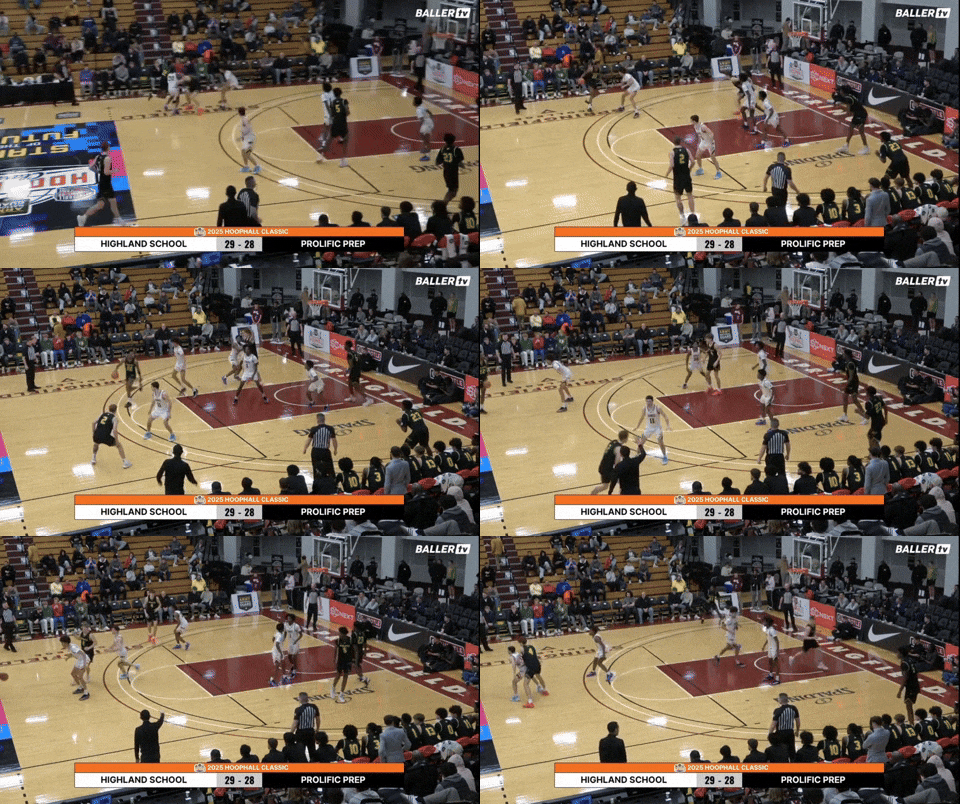
And on this play, Cameron Boozer attempts to back his opponent down and find position with a spin move, but he can’t generate any push and forces a difficult shot:

For the purposes of this project, I broke down advantage creation into six distinct modes (Though there may be eight pertinent modes. More on this at the end of the piece). Most players create advantages using more than one tool at a time, and some of the individual tools have some overlap. We’ll dive deeper into tool interactions throughout the article.
ADVANTAGE CREATION TOOLS
Burst
Burst encapsulates a player’s first step (and the few steps after that), allowing them to create advantages with speed and quickness. Players with great burst create quick, explosive advantages to open windows for attacking downhill and creating separation.

Craft
Craft describes a player’s ability to win with their footwork, manipulation and trickery. Players who lack traditional explosive athleticism, strength or ball-handling often lean on craft to create separation. Even elite players like Jalen Brunson and Nikola Jokic routinely generate space through footwork tricks and body language manipulation.

Advantage creation through craft also includes players who sharply weaponize ball screens to find space downhill. Brilliant pick-and-roll operators will wait behind a screen like a great running back, setting up defenders while they wait for a hole to open up or reject the screen:

Handle
Since ball-handling interacts with almost every tool (especially the next two), this tool covers the advantages created through ball control and dribbling creativity. Splitting pick-and-rolls are an easy example of handling-centric advantage creation, where players must maneuver the ball through tight spaces to find creases:

Change of Pace
For the purposes of this exercise, change of pace advantage creation includes players toggling speeds while moving with the ball (since a first step is technically a form of speed change). Most star lead guards excel at commanding pace, switching between fast and slow and fast to overstimulate defenders:

Players also weaponize pace to create advantages late in drives; the prevalence of slow steps to decelerate at the end of drives has spiked in recent years. Changing pace also encapsulates plays like these, where the driver sprints into the paint before slowing down and scoring:

Change of Direction
Change of direction-based advantage creation plays occur when handlers sharply switch their drive paths, flipping their hips and planting sharply to shift gears. Hang dribbles, behind-the-back moves and between-the-legs moves allow players to change directions and beat defenders (this Dybantsa play also features great change of pace):

Players who can simultaneously alter their pace and direction on the move can become nearly impossible to defend in space. The majority of handlers experience some lag in speed when changing directions, but some players glide in all directions in full command of their tempo:

Strength
Strong advantage creators dislodge defenders without the need to shake or evade them. Strength-based advantage creation includes plays where the offensive player moves defenders backwards to find space or knock them off balance with flexible shoulder bending:


For each of the three players I charted, I logged how often they created advantages using one or more of the six categories above. I’d like to eventually log those same tools for advantage failures in the future if I find the time. But for now, let’s compare how Peterson, Boozer and Dybantsa fared as advantage creators in different situations, as well as their preferred advantage creation tools:
how do the 2026 draft’s big 3 prospects compare as advantage creators across different situations? i charted every advantage chance during their final AAU seasons.
peterson created advantages most often, though boozer has both beat in ball screen/tilted creation pic.twitter.com/zSFZjANRFx
— ben pfeifer (@bjpf_) September 19, 2025
Peterson is the most consistent advantage creator of the three, ranking first in overall advantage success rate (80.3%) and per-game volume (6.8 per game). Boozer has by far the lowest volume (2.9 per game), but was the most efficient of the three in ball screen (84.6%) and off-ball (90.4%) situations. Dybantsa is the only player of the three with more successful advantage creation without ball screens (69.1%) than with ball screens (65.7%).
📊 new data viz!! 📊
i hand tracked how each of the 2026 nba draft top 3 create their advantages. peterson looks like the most well rounded of the bunch
i’ll have more information on how i specifically defined each trait soon pic.twitter.com/3lRCdTGRUK
— ben pfeifer (@bjpf_) September 21, 2025
When they create those advantages, Peterson is by far the most balanced in terms of tool usage, with five of the six tools (aside from strength) at 17% frequency or higher, with change of pace (21.6%) as the highest used tool. Both Boozer and Dybantsa are more specialized, turning to two advantage tools for over 50% of their tracked plays.
Those basic comparisons are solid starting points, but we can dive much deeper into how each of the big three prospects create advantages and how that might translate to the college and NBA levels.
Darryn Peterson
As previously mentioned, Peterson’s balance as an advantage creator stands out and matches the perception of him as an ultra-skilled player. It isn’t difficult to pick out his strengths on tape, as his handle is always on a string and he’s exceptionally fast and fluid moving downhill.
If Peterson has one go-to tool, it would be changing speeds, especially out of ball screens, where 26% of his advantages came via change of pace. He has a rare knack for stopping and starting without losing much, if any, speed and defenders usually can’t match up with him attacking the basket in space:

Peterson’s phenomenal first step most often helps him create non-ball screen advantages (19.1% usage). Most offensive players that rely on craft, ball skills and tempo can’t routinely blow by defenders like he can, especially when a screen or other players create the tiniest window for him.
Though Peterson is as complete an advantage creator as any prospect in recent memory, we can nitpick his lack of current functional strength. Teenagers lacking strength shouldn’t raise massive alarm bells, but he currently doesn’t look to move defenders with his body and can struggle to create clean advantages when he does, leading to difficult intermediate shots:

Cameron Boozer
Boozer turns to strength more frequently than his two elite peers, fueling a quarter of his total advantages (compared to 11.6% for Dybantsa and 5.4% from Peterson). He usually couples that strength with some craft-based creation as well, twisting in the post with deft footwork or long-stepping around and through defenders on drives:

His core and lower body strength on a 6’9, 235-pound frame let Boozer easily move defenders and that shines as an off-ball scorer as well. Boozer is the premier off-ball sealer of the class, routinely carving space under the hoop with his rear end to walk defenders into deep catches and easy buckets:

Extreme reliance on strength and craft could explain why Boozer is less effective as an advantage creator without a ball screen (65.4%) than his other playtypes. In those non-ball screen advantage chances, his craft usage spikes to 35.8% and his strength usage drops to 13.2%, replacing some of those with change of direction (18.9%).
Without a head of steam, Boozer struggles to turn his power into movement, turning to spin moves, step-throughs and quick spins to separate in a phone booth. His handle is strong for a big man but less so for a wing, leading to some ugly moments when Boozer can’t bash defenders as he usually does:

It’s reasonable to harbor some concern about Boozer’s advantage creation against set defenses, but I’d expect him to continue growing as a power slasher and shotmaker, especially considering his sparkling creation in non-one-on-one situations.
AJ Dybantsa
Of the three prospects I charted, Dybantsa logged the most total advantages created of the three (105), though he played more games than Peterson. He created 54.5% of his advantages utilizing burst and craft, most commonly manifesting in his bread-and-butter stutter rip, where he jabs hard before exploding to the hoop:

At 6’9, Dybantsa sports a quicker first step than most high school guards, capable of blowing by nearly any defender. When he throws in footwork and timing mix-ups, his straight-line drives become nearly unstoppable. In non-ball screen situations, he relies on burst and craft even more frequently (58.1% frequency).
This data helps us understand why Dybantsa fared better without ball screens as an advantage creator. For most players, ball screens help manufacture advantages but also require a deft handle and command of pace. Dybantsa isn’t as advanced here, and he’ll frequently turn ball-screen into non-ball-screen situations, backing the ball out after a switch or hedge.
There’s a reason Dybantsa created a huge 65.7% of his advantages without ball screens (compared to 30.4% for Peterson and 16.7% for Boozer). It didn’t look as comfortable when he attempted to hang behind a screen, especially in the rare matchups with NBA-quality athletes and defenders:
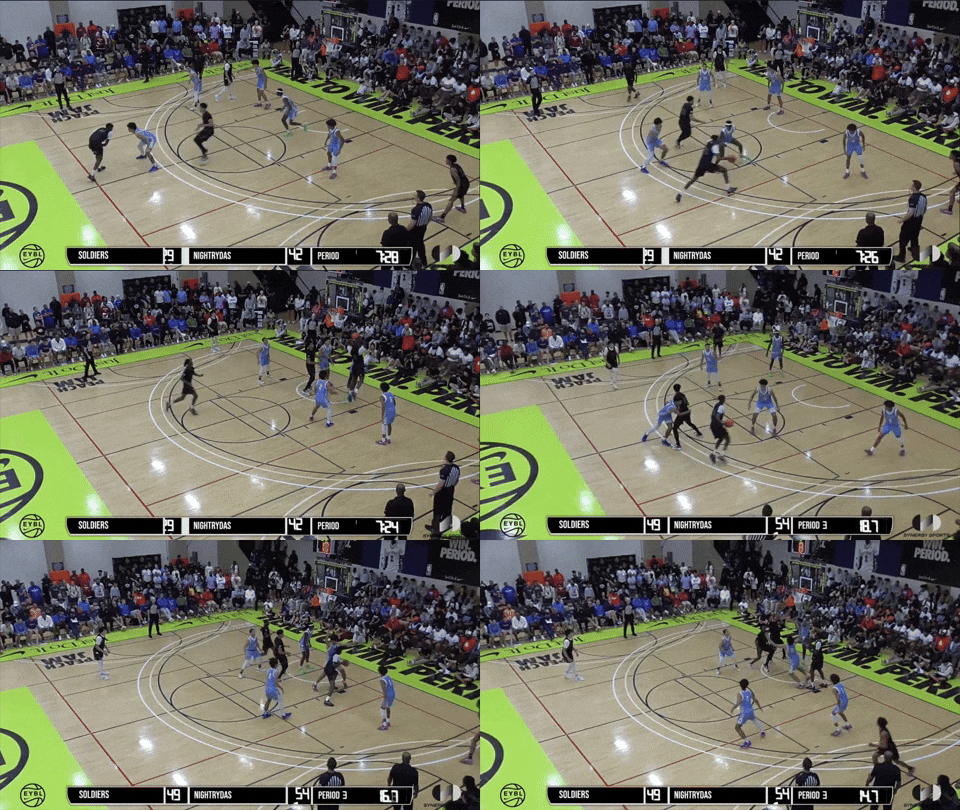
His best moments as a handling creator came when Dybantsa sought separation for his high-release pull-up jumper. Though Dybantsa can shoot over just about anyone, his pull-up creation is all the more deadly when he mixes in hang dribbles and snatch-back moves:

Perception and Gravity
As I briefly mentioned before, there are also two more methods of advantage creation that I haven’t discussed yet and didn’t include in this charting project — gravity and perception. Advantage perception is a critical yet underdiscussed component of creation. What good does elite advantage creation offer if a player doesn’t know it’s there?
The perception piece could offer an explanation for AJ Dybantsa, an athletic specimen with rare basketball talent, ranking last among the three prospects charted in overall advantage success rates (I’d guess 69% is still quite strong compared to the average prospect still). Dybantsa’s perception limitations make his life more difficult, where he could generate even more easy rim attempts and free throws than he does.
There’s no way to definitely know on film without speaking to Dybantsa or his coaches, but from my perspective, he often turns down potential advantage routes for difficult pull-up jumpers. On a play like this, there’s a clear lane for Dybantsa to drive into after a hard screen. Am I to believe he isn’t capable of knifing through an open driving window, or that he doesn’t know it’s there in the first place?

I’d love to figure out a suitable method for charting advantage perception, but it’s an extremely difficult trait to track remotely. Gravity, the other advantage tool I mentioned, would also offer some challenges to chart, but arguably matters even more than perception and many of the physical tools above.
As I charted Peterson’s advantage chances, so many of his pick-and-rolls looked something like this — multiple defenders converge on Peterson, so he fires a simple pass to a teammate, who now can operate with a numbers advantage:
Peterson doesn’t explicitly do anything on this possession to warrant a hard double team aside from existing, but that’s the concept of gravity in a nutshell. Defenders know how dominant a scorer is, so that forces them to willingly accept a numbers disadvantage, often a death knell in basketball. Shouldn’t that count towards Peterson’s advantage creation totals, even without him breaking much of a sweat?

Even elite high school initiators rarely command the gravity and attention Peterson does, not to mention his endless bag of handling counters, speed and athleticism. That rare gravitational pull makes his life even easier as an offensive player and makes his teammates’ lives easier, which makes me project Peterson as the best advantage creator of the bunch at this stage, though all three have avenues to warp defenses consistently.
The scope of this project so far is narrow and high school tape, even higher level AAU basketball, can often mislead. We won’t know exactly how these players shape up as advantage creators without a far larger sample of games and different prospects to compare and contrast. Like any hand-tracking project I do, this isn’t meant to be scientific; rather, an exploration of how I think about and evaluate the game of basketball.
This project is still in its infancy and I’m unsure how and when I will continue this work into the season. Any feedback would be appreciated as always, but what we know for sure is that the top three prospects in the 2026 NBA Draft all have enormous offensive ceilings.